The marching route blazes with fire.
(Baonghean.vn) - The Spring Campaign of 1975 was honorably named the Ho Chi Minh Campaign.The campaign received a letter of commendation from the Central Military Commission, and the order from General Vo Nguyen Giap, Minister of National Defense, was disseminated to every officer and soldier: "Speed, even greater speed! Boldness, even greater boldness. Seize every hour, every minute to advance and liberate the South..."
AHLLVT, Lieutenant General Doan Sinh Huong, then the Company Commander of Tank Company 9, in the 273rd Tank Brigade, 3rd Corps, had unforgettable memories of that moment when "one day felt like decades" as the army swiftly advanced towards Saigon, sharing tears and singing together the song "Saigon! We've returned, we've returned!"
We met at Bong Bridge.
On the night of April 16, 1975, the 273rd Tank Brigade was ordered to move its formation out of Buon Ma Thuot after months of intense fighting and rapid victories, along Highway 14 towards Dak Nong and Binh Phuoc... towards the operational assembly point at the Dau Tieng rubber plantation (Thu Dau Mot). Company 9, led by Doan Sinh Huong, in the regiment's formation with captured M48 and M41 tanks, was the first to arrive safely and completely. After days of rapid marching, crossing countless battlefields reeking of gunpowder, Company Commander Doan Sinh Huong's face had become tanned. So much so that Truong Cong Dao joked: "Entering the campaign, the company commander was Asian, but halfway through the campaign he's become African. This time, he'll have to put on some makeup when he goes to Saigon."
Constantly advancing and engaging the enemy, all units on the entire front were focused on one objective: Saigon - Gia Dinh. Those were moments when the soldiers told each other: one day felt like a month. On the night of April 27, 1975, Company 9 received the mission to reinforce Regiment 66 in attacking Tan Son Nhat Airport. The following day, at 10 pm on April 28, 1975, Regiment Commander Le Ngo summoned Company Commander Doan Sinh Huong and assigned Company 9 the task of leading the attack on Saigon from the northwest, seizing Cau Bong Bridge to create a favorable position for the entire corps to capture the assigned targets. The arduous task was emphasized by the Regiment Commander with one firm statement: "At all costs, Company 9 must hold the bridge. Losing the bridge would mean the corps would have virtually no way into the city, and the mission would not be accomplished."
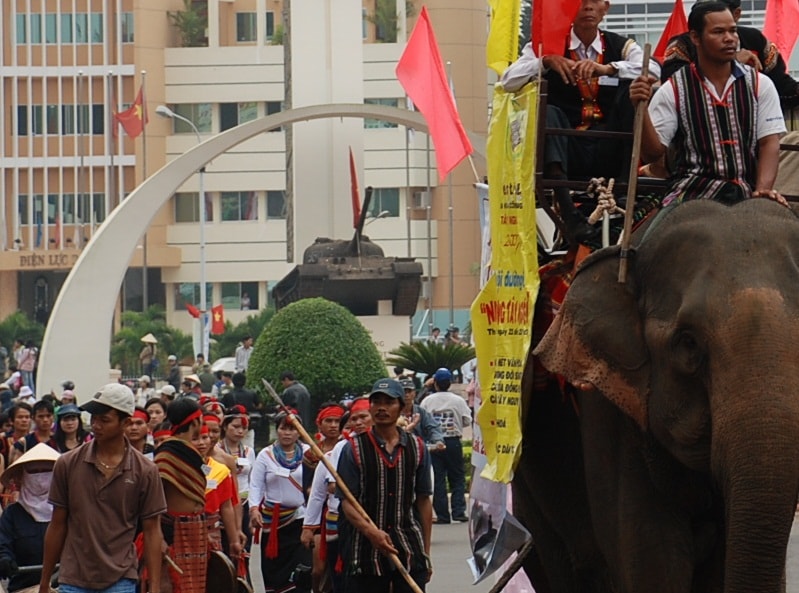 |
| Tank number 980, commanded by Lieutenant General Doan Sinh Huong, distinguished itself in the Central Highlands Campaign and is now being used as a Victory Monument at the Six-Way Intersection in Buon Ma Thuot City. |
At this time, Company 9 still had 7 combat vehicles, but the ammunition supply was too low. At exactly 1:00 AM on the night of April 29th, Regiment Commander Le Ngo further defined the company's mission: Bypass the Dong Du base and other targets along the way, seize the Bong Bridge at all costs so that the Corps' formation could attack Tan Son Nhat airport. Also on the night of April 29th, in the dim light of oil lamps, Doan Sinh Huong met a group of female liaison officers tasked with guiding the 1st Tank Battalion into Saigon. Among them was Nguyen Trung Kien, whose famous photograph, "Miss Nhip," with her bright smile and floppy hat next to a K63 tank, was taken by journalist Dau Ngoc Dan. This photograph was later adapted into a famous film of the same name, in which Miss Nhip (Nguyen Trung Kien) is the central character.
The image of the pretty female commando, wearing a floppy hat and carrying an AK47 rifle, sitting on a liberation army tank, guiding the driver into the city; the fierce battles; the desperate resistance strongholds of the puppet army along the marching route; the unexpected sacrifices of liberation soldiers just before liberation; and the image of the tank driver, the smile of Nhip, the Saigon commando, signaling the tank to stop and pointing towards the puppet army's General Staff headquarters before parting ways to take on a new mission, remains etched in the eyes of the tank driver as well as in the hearts of every viewer who has seen this film.
The tank company was advancing at high speed when they suddenly saw an open-top Gat 60 tank and a bald man inside (it was the Political Commissar of the 10th Division, La Ngoc Chau) signaling them to stop. He jumped into the command vehicle of Doan Sinh Huong and breathlessly asked, "Why can't the division and the corps get a signal from C9 despite all the radio calls?"
- Reportedly, it seems that all media outlets are currently operational, resulting in significant interference.
Then, unexpectedly, the division's political commissar looked directly into Đoàn Sinh Hưởng's eyes and said:
Are you afraid of dying?
- Are not.
- Do you dare to lead the way, dare to take the bullets for the main army?
- Have
Next, the Political Commissar asked how many vehicles were left, and the report stated 4. How many men were left? 16. The Political Commissar of the Division, while marching amidst the pungent smell of gunpowder and the tension of tank tracks, continued his mission: "The Corps has assigned Company 9: At all costs, even if it means sacrificing the last man, you must hold the Bong Bridge. Do not be greedy and risk losing the great mission."
After bidding farewell to the Political Commissar, Đoàn Sinh Hưởng ordered the convoy to head east, speeding at maximum velocity. Leading the way was the company commander's vehicle, followed by Comrade Đạo and Comrade Hổ's vehicles, with Political Commissar Huỳnh Rịch's vehicle at the rear. After advancing about 10 km, suddenly, on the left side of the convoy, a person holding a pink scarf waved (it should be noted that the vehicles we were traveling in at that time were captured M48 tanks from the enemy)..Remembering Kỷ's instructions, the company commander was certain they were his own men and allowed the vehicle to continue its advance. Only when they got closer did they realize they were from the other side when a group of men in camouflage uniforms rushed out, shouting loudly to drown out the engine noise: "Which unit are you guys from? Can you give us a ride back to Saigon?" They only had time to shout "Wrong unit!", at which point Đoàn Sinh Hưởng loaded his BBs to fire immediately. Đạo and Hổ's vehicles behind them also joined the frenzied gunfire.
At approximately 8:00 AM on April 29th, Company 9 arrived at the Bong Bridge. Here, a fierce encounter began that will not only remain etched in the battlefield memories of the illustrious Lieutenant General, but will also be recorded in military textbooks both domestically and internationally. At that moment, a convoy of 24 enemy M113 armored vehicles was retreating towards Saigon from Hau Nghia along Highway 8. The force ratio was 1 of ours to 6 of the enemy. Assessing the situation in an instant, Doan Sinh Huong ordered the immediate deployment of a defensive plan..Over the radio, the commander of Company 9 ordered: "Be ready to fight and sacrifice to protect Bong Bridge, to protect the marching route for the corps to advance into Saigon."
Seeing the C9 formation was too small, the enemy aggressively charged forward. Doan Sinh Huong's vehicle fired at the lead vehicle while simultaneously ordering his tank, Rich, to fire at the rear vehicle. Caught off guard, the enemy regrouped, their formation disrupted, and suffered immediate losses. The enemy convoy scattered to both sides of the rice fields. The close-quarters battle unfolded in an instant. Thanks to the cover provided by his comrades' vehicles, Company Commander Doan Sinh Huong's tank destroyed four more vehicles, Comrade Ho's tank destroyed five, Political Commissar Huynh Rich's tank destroyed two, and Dao's tank destroyed one. The remaining enemy vehicles charged straight into the thinly spread C9 formation, firing relentlessly. Doan Sinh Huong once again made a daring decision, deploying his tanks on the road, ready to counter the tactic of using shrapnel to eliminate the crew members. While observing, the Company Commander suddenly noticed the gun barrel of an M113 tank gradually turning towards him. At the same time he ordered his tank's gun to turn to engage the enemy, he discovered his tank had been hit, losing its 12.8mm gun. However, the straight, accurate trajectory of his bullets blew up the enemy tank.
After destroying a total of 12 enemy vehicles, Doan Sinh Huong continued to command the assault formation, using cluster munitions, explosive rounds, and shrapnel to eliminate the enemy who jumped out of the vehicles and captured the remaining 12 vehicles, handing them over to the local troops. Upon reaching Bong Bridge, they discovered two wounded special forces soldiers. They emotionally said: "The forces were too outnumbered, even though we tried our best. If our tanks hadn't arrived in time, we would have certainly sacrificed ourselves to the last man to keep the advance of the vanguard army." Moved and spirited, Company Commander Doan Sinh Huong radioed back to the Corps Command: "Company 9 has captured Bong Bridge." Squinting slightly to recall, the lieutenant general added another detail: "At that moment, I saw Miss Nhip Tran Trung Kien clutching an AK47, clinging to the side of a tank, guiding the 1st Tank Battalion forward."
In the short story "An Ha Bridge" by writer Khuat Quang Thuy, published in the collection of selected short stories by the Army Writers' Association (People's Army Publishing House) in 2002, there is a passage that reads, "...An Ha Bridge was once the place where the tanks of Army Hero Doan Sinh Huong and his comrades clashed with a swarm of enemy tanks. It is said that it was one of the most glorious tank battles in the history of our army..."
The road back to the city
On the advance towards Hoc Mon, the vehicles of Company 9 spotted enemy forces converging in large numbers from Hau Nghia and other locations. At that time, the unit had to use artillery, grenades, and small arms fire. The enemy recklessly jumped onto our vehicles, forcing the crews to use the electrically controlled gun barrels to dislodge them. Even with only four vehicles remaining, Company 9 had almost completely dominated the road, clearing the way for the main army. Once the other units safely crossed the Bong Bridge, Company 9 continued its assault into the city center, capturing the Quan Nam fortress (Hoc Mon), advancing towards the Ba Queo intersection, and then storming and capturing the Quang Trung training camp. There, the enemy fiercely resisted with various heavy weapons and personal weapons.
Together with a platoon of local troops, Company 9 essentially took control of the battlefield, forcing the enemy to surrender en masse. At that time, Company Commander Doan Sinh Huong stormed the enemy's command bunker and captured two colonels (one of whom was the deputy head of the training camp). Before thousands of enemy soldiers who were brought out and gathered in the courtyard, he explained the leniency policy of the Liberation Army and allowed them to return to their families after shedding their uniforms. (Recalling this detail, Lieutenant General Doan Sinh Huong remembered that later, some military officers from the Quang Trung camp at that time sought him out and thanked the soldiers of Company 9 for their leniency in allowing them to return home on April 29th. Otherwise, with the overwhelming force of the Liberation Army pouring in during those fiery moments, it would have been very difficult for them to survive.)
At 11:00 AM on April 29th, Company 9 was about 5 km from the Bay Hien Crossroads. Guided by an elderly man on the way to the Independence Palace, Doan Sinh Huong gathered his men and made a firm decision: "This is the last battle. Attacking the Independence Palace at this time is very risky in terms of casualties. Think about it, whoever can go, go, it's not mandatory…" Of course, all the men eagerly continued on this heroic journey. However, the problem was that each artillery piece only had 3-4 rounds left, and fuel was running out. After searching for a long time, and with the help of the local people, the unit finally found 4 drums of gasoline and 3 drums of diesel for the M48 tanks.
At that moment, Đoàn Sinh Hưởng contacted the Corps Command Headquarters via radio and spoke to Political Commissar Đặng Vũ Hiệp, almost shouting: “Where are you guys? Why haven’t we contacted you for two days? I thought you were all ‘burned’!” “Reporting, C9 is at Bà Quẹo intersection. We haven’t been able to contact you for two days because of a communication jam” (in reality, they were too busy fighting the enemy to remember). Upon learning that C9 was preparing to advance into the Independence Palace, Political Commissar Đặng Vũ Hiệp ordered: “Stop immediately. Your mission is to capture the puppet regime’s General Staff Headquarters. Don’t be reckless.” Lieutenant General Đoàn Sinh Hưởng recounted that he later met with General Đặng Vũ Hiệp, who said he regretted not allowing C9 to attack the Independence Palace, because who knows, C9 might have made a difference. Because, at that time (noon on April 29th), our troops were only just approaching the outskirts of Saigon.
After receiving orders from the Corps Political Commissar, Company Commander Sinh Huong stopped to consolidate forces to hold the Ba Queo intersection and transferred to serve as a reserve force for the 1st Tank Battalion to coordinate with the infantry in attacking the Bay Hien intersection, Tan Son Nhat airport, and the South Vietnamese General Staff Headquarters.
The final hours
On the morning of April 30th, Company 9, along with Tank Battalion 1, deployed their formations and headed straight for Tan Son Nhat airport. Enemy gun emplacements, bunkers, and resistance strongholds were successively destroyed along our advance. The target now was the South Vietnamese General Staff Headquarters. However, the fierce battle between the two sides at Gate 5 of the airport continued. Our tanks were being destroyed by enemy fire on the road from Lang Cha Ca to the General Staff Headquarters, causing traffic congestion. Company 9's tanks had to turn onto Truong Minh Ky Street to reach their target with the help of a young man from Saigon who climbed onto Tank 819, commanded by Deputy Commander Do Hong Ky of Tank Company 5, to guide them. Our forces at that time also included Infantry Company 10, two engineering and reconnaissance companies, and a 37mm anti-aircraft battalion, fighting back and advancing towards their objective.
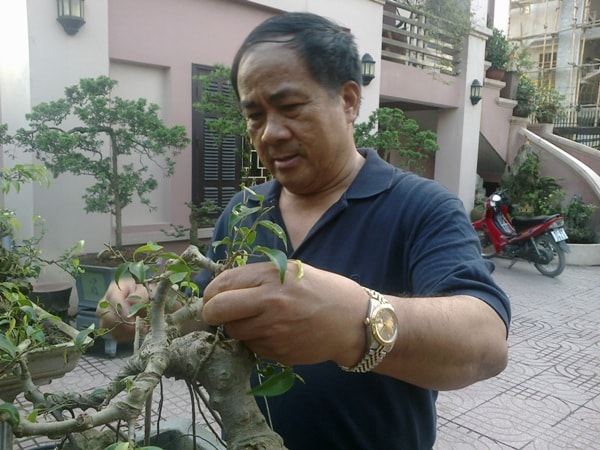 |
| Lieutenant General Doan Sinh Huong takes care of the ornamental plants in his garden after returning to civilian life. |
At the enemy's General Staff Headquarters, they deployed tanks and infantry to block the main gate, combined with two counterattacks from the southeast. We had to form separate attack columns to divide and destroy the enemy. Attacked from both front and rear, one enemy company was forced to surrender. We destroyed one M48 tank, one vehicle with a four-barreled machine gun, and one GMC truck. The remaining enemy troops hastily fled. Taking advantage of the victory, our troops continued the pursuit inward, and the last three M41 tanks that counterattacked were all destroyed. After passing through the main gate, tank number 982, commanded by Nguyen Huu Thin - Political Commissar of Tank Company 5, advanced straight ahead, crawling onto the high platform of the main building of the puppet regime's General Staff Headquarters, providing cover for our infantry to climb to the upper floor, take down the three-striped flag, and raise the Liberation flag. The flag, half red and half green, symbolized the aspiration to unite the entire country, and the brilliant, proud five-pointed golden star flew over the last stronghold of the puppet army's headquarters, marking their complete collapse and announcing the joyful news of victory.
At precisely 11:30 AM on the historic April 30th, four battle-stained tanks of the 9th Tank Company were fully positioned in front of the South Vietnamese General Staff Headquarters. Doan Sinh Huong continued to command his unit, providing cover for the infantry soldiers of the 28th Regiment who divided up to control the remaining buildings, while simultaneously seizing the headquarters of General Cao Van Vien – Chief of Staff of the Republic of Vietnam Armed Forces, confiscating all the seals, swords, and command batons. At this very moment, the Liberation flag was flying atop the Independence Palace. Duong Van Minh, the president of the Saigon government, and his entire cabinet surrendered unconditionally to the Liberation Army. The campaign, named after beloved Uncle Ho, achieved complete victory, reunifying the country.
It's difficult to describe the atmosphere and emotions of the soldiers of Uncle Ho's army and the people of Saigon at this moment. All we know is that everyone seemed to burst into joy: "After 30 years, we finally meet again, how joyful, tears well up..." Recalling this moment, the illustrious general, renowned for his battlefield prowess, said thoughtfully: "On the first night of the day of complete victory, after the overwhelming, ecstatic noise of joy, we observed a profound silence to think of our beloved comrades who had fallen in every battle, on the roads leading to the city named after our beloved Uncle Ho. When we recalled the names of those who had fallen before the day of complete victory, the tears of those who survived flowed uncontrollably. Xuan Truong, Hong Tu, if only you were all here at this incredibly sacred moment?"
On September 12, 1975, Company Commander Doan Sinh Huong was awarded the title of Hero of the People's Armed Forces at the young age of 26, holding the rank of Second Lieutenant, along with 6 individuals and 59 units.
Cong Manh