
Ruth Bader Ginsburg: The iconic female judge of American justice.
(Baonghean) - As a female judge considered a symbol of justice and equality in the United States, the strong and resilient Ruth Bader Ginsburg has been especially admired by the American people over the years for her tireless contributions.
At 85 years old, despite some health reasons, she has yet to allow herself to plan for retirement. However, behind the scenes, a race for her position is heating up daily between the Republican and Democratic parties vying for a majority on the Court.
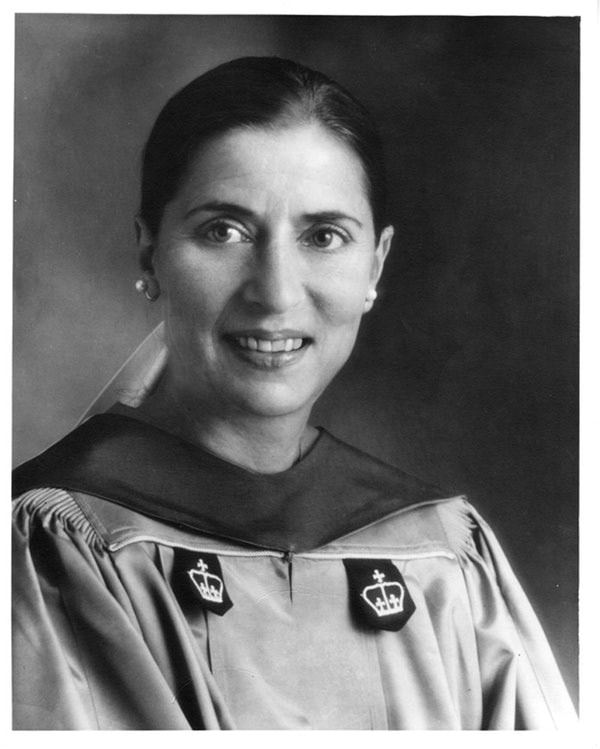 |
| Ruth Bader Ginsburg as a young woman in the 1980s. Source: New Republic |
JUDGES OF THE PEOPLE'S HEART
Public opinion is likely wondering why a female Supreme Court justice has such a powerful influence and is so beloved by the American people. Remember when Justice Bader Ginsburg recently fell and was hospitalized, the community and the American people were constantly concerned about her health. And the answer is simple: this 85-year-old woman, under any circumstances, even in her old age, has always remained steadfast in her long-standing commitment to justice and equality.
Born on March 15, 1933, in Flatbush, Brooklyn, New York, Joan Ruth Bader (her maiden name) was the daughter of Jewish immigrants. With her mother's encouragement, Ruth excelled at James Madison High School. In 1954, she graduated from Cornell University in New York and married Marty Ginsburg, then a lawyer, becoming Ruth Bader Ginsburg.
Two years later, in 1956, Bader was one of nine women to enroll in Harvard Law School. She then transferred to Columbia Law School in New York, earning her bachelor's degree at age 26. Despite consistently being a top student, Bader struggled to find employment after graduation. Companies were hesitant simply because she was a woman, had children, and was of Jewish descent. Perhaps these injustices gradually fueled her determination to defend justice and fairness.
In 1963, Ms. Bader became a professor at Rutgers Law School. By 1973, she had become the head of the legal department of the Women's Rights Project at the American Civil Liberties Union.
Her career continued to flourish when, in 1980, she was appointed to the District Court of Columbia at the age of 47. Following this, she was appointed to the Federal Court of Appeals by President Jimmy Carter that same year.
A turning point in Justice Bader's life and career came in 1993 when then-President Bill Clinton nominated her to the Supreme Court as Associate Justice. Justice Bader Ginsburg officially became the second woman appointed to the U.S. Supreme Court, after Justice Sandra Day O'Connor. Furthermore, she was the first Jewish woman appointed to this important position. Like a fish in water, she began her struggle for women's rights and equality.
Throughout her career, she has worked tirelessly to eliminate numerous injustices and legal and professional barriers for women. Notable examples include her efforts to promote the passage of same-sex marriage laws in all 50 US states in June 2015.
In 1999, the American Bar Association awarded her the Thurgood Marshall Award for her contributions to the cause of gender equality, civil rights, and social justice. Her contributions were even immortalized in a Hollywood film, with the role of the female judge played by the famous actress Natalie Portman.
The battle for vacant seats
However, while Ruth Bader herself has no plans to retire and hasn't allowed the fight for equality to stop, American politics is quietly revolving around the vacant seat should she leave. This dispute began when, in early August, Bader unfortunately discovered a tumor in her pancreas that threatened her health, forcing her to be hospitalized. Appearing in public after three weeks of treatment, Bader still managed to smile and wave, while reaffirming that she would continue her current work as long as she maintained her mental strength. She has also hired a legal secretary to assist her until 2020.
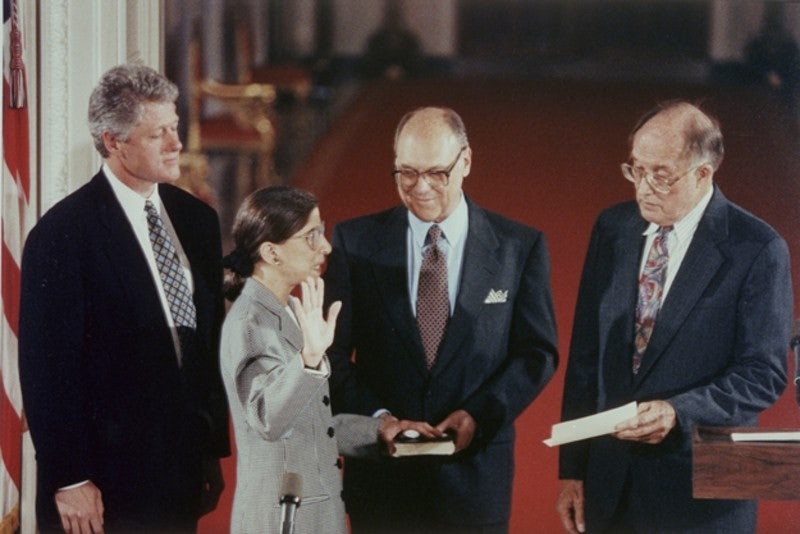 |
| Ruth Bader Ginsburg was sworn in as Deputy Chief Justice of the Supreme Court in the presence of President Bill Clinton. Source: New Republic |
It should be recalled that, to date, the US Supreme Court has always maintained eight justices and one chief justice, who can serve for life. However, according to observers, if Justice Ruth Bader decides to retire or her health prevents her from continuing her work, President Donald Trump will have the opportunity to appoint a third conservative justice after Neil Gorsuch and Brett Kavanaugh.
Clearly, this would be a favorable opportunity for Mr. Trump to reform the Court in a more conservative direction. It also means that President Trump's plan to strengthen conservative control over the Supreme Court is gradually becoming a reality. Both Republicans and Democrats understand that a conservative figure chosen to replace Justice Ruth Bader would shift the majority to a conservative one (6-3), which would put the Democrats at a significant disadvantage in limiting Republican control. And this would be a "nightmare" for the Democrats!
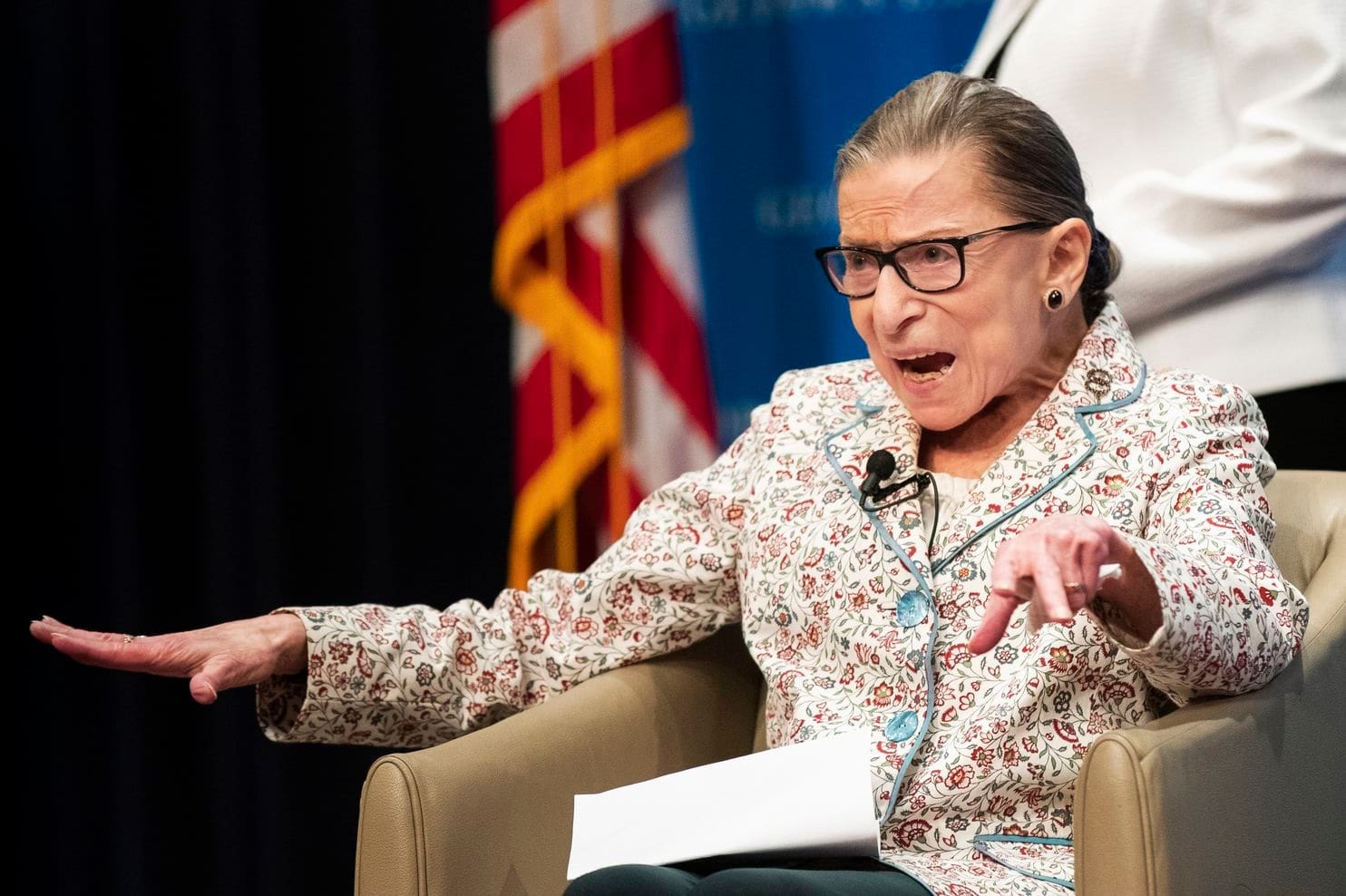 |
| Judge Ruth Bader is admired by the American people for her fight for justice and equality. Source: AP |
According to some sources, a list of potential replacements for Ruth Bader Ginsburg has been compiled, and preliminary assessments are underway. However, the reality is that the chances for Democratic candidates are very slim. This also means that once the Supreme Court is no longer headed by the "queen of equality," Ruth Bader Ginsburg, its personnel will change according to the political leanings of its leader. Inevitably, the policies of the nation's highest court will be significantly impacted for decades to come!


