
Springtime at Nam Can International Border Gate
(Baonghean.vn) - Fog blankets the villages nestled in the mountains. It's 9 a.m., and on the road to Nam Can commune, Ky Son district, even just five or six meters apart, people are barely visible. Yet, a continuous stream of people and vehicles travels back and forth through the Nam Can International Border Gate. Trucks loaded with peach blossoms and other local specialties are "bringing Tet (Lunar New Year) down to the lowlands." Spring has arrived earlier for this remote border region of southwestern Nghe An province!
(Baonghean.vn) - Fog blankets the villages nestled in the mountains. It's 9 a.m., and on the road to Nam Can commune, Ky Son district, even just five or six meters apart, people are barely visible. Yet, a continuous stream of people and vehicles travels back and forth through the Nam Can International Border Gate. Trucks loaded with peach blossoms and other local specialties are "bringing Tet (Lunar New Year) down to the lowlands." Spring has arrived earlier for this remote border region of southwestern Nghe An province!
Meeting Mr. Luu Dinh Binh, from Nam Dan district, who was going through customs procedures at the Nam Can International Border Gate, joy was evident on his weathered face. In the biting cold below 10°C, rubbing his hands together to ward off the chill, Mr. Binh told us: "My brothers and I work as construction workers in Laos, and we took a bus from Nong Het back here. Working far from home, it's hard work and a bit tiring, but at least we have some income to support our families. Back home, looking at our few acres of rice paddies, we don't have enough to feed and clothe our children. We've been away from home for a long time, and now that Tet (Lunar New Year) is approaching, we're very excited."
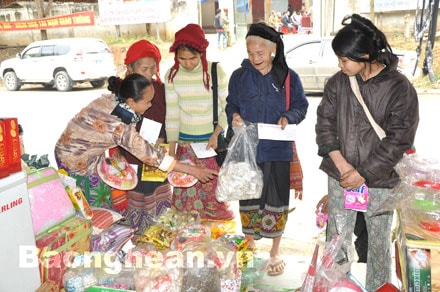
People from Chieu Luu commune, Ky Son district, go to the market to shop for Tet (Lunar New Year).
In the days leading up to Tet (Lunar New Year), the Nam Can international border gate is busier than usual. Besides trucks specifically transporting peach blossoms from Laos to Vietnam, other cargo vehicles and family cars passing through the border crossing also carry peach blossom branches. While waiting for the convoy ahead, Mr. Cut Van Xi from Noong De village busily ties up some peach blossom branches he had just cut in Noong Het. He explained that to find the perfect peach blossom branches, buyers have to travel all the way to Laos, a journey of about two hours along a very difficult road deep into the forest.
Normally, he works as a porter right at the border crossing, but taking advantage of the Tet holiday, from the 15th day of the 12th lunar month onwards, he goes to Laos to cut peach blossoms to sell. On average, a beautiful peach blossom branch costs 2.5 million kip, equivalent to 5 million Vietnamese dong. Mr. Xi added: Buyers prefer the most popular types of peach blossoms, such as those with mossy branches, with some branches selling for 20-23 million dong, yet there aren't enough beautiful branches to sell. The peach blossoms from Laos are gathered at the border crossing, and peach blossom traders from Vinh come up to collect the goods and transport them back to the lowlands on the same day.
Every day, a large number of people working in Laos return home for Tet (Lunar New Year) through this area. On each bus, it's easy to see that most people bring along a few peach blossom branches, sticky rice, piglets, black chickens, and other traditional items. Many tourists from Western countries have also come to Vietnam to witness our people celebrating the traditional Tet holiday.
Every year, regardless of holidays or weekends, as Tet (Lunar New Year) approaches, customs officers and staff at the Nam Can International Border Gate are always on duty to process Tet shipments, serving the needs of tourists and people crossing the border to celebrate Tet and welcome the New Year. The Mong people in Noong Het (Xieng Khouang, Laos) and Nam Can, Ky Son, are largely related by blood, so during Tet, the volume of people crossing the border is 2-3 times higher than usual.
In addition, the volume of goods crossing the border has increased dramatically, mainly essential items such as alcohol, beer, MSG, and clothing. Therefore, it is easy for social ills such as smuggling, security breaches, and especially the illegal trafficking and transportation of narcotics across the border to arise. To prevent this situation, the Nam Can International Border Gate Customs Sub-department has planned and assigned officers to strengthen inspection and control of goods passing through the border gate, and implemented measures to combat smuggling, counterfeit goods, and fake products.
Many kinds of goods from various regions have been brought to Nam Can, mostly food items for the Lunar New Year celebration. Vietnamese goods at the market mainly consist of clothing, shoes, and household items... while Lao traders supply brocade fabrics and food for tourists visiting the market. Mong cabbage and black chicken are favorite foods of the Vietnamese, while the Lao people focus on salt, dried squid, sea fish, and freshwater fish...
From afar, looking towards the Nam Can border gate, one can see the colors of spring on the budding peach blossoms, the green of the rolled-up banana leaves, and the convoys of vehicles traveling back and forth, dispelling the chilly atmosphere of southwestern Nghe An province. During Tet (Lunar New Year), the green uniforms of border guards and customs officers blend with the vibrant colors of the ethnic minority people celebrating the spring festival in this highland region.
Le Thanh


