
Tan Son Nhat Airport may close due to a canal.
Although the A41 canal is tasked with draining 50% of the airport's water, it is currently clogged, while many houses and buildings around Tan Son Nhat airport are also blocking other drainage routes.
On the morning of September 16th, Canal A41 in Ward 4 (Tan Binh District, Ho Chi Minh City) was full of debris, household waste, and even mattresses and styrofoam boxes scattered in many places, especially at the entrances of the culverts.
Spanning 2 km, the canal originates from a nearly 400-meter section of box culvert within the airport grounds before emptying into an open canal outside near the corner of Phan Thuc Duyet Street. From there, the water meanders through the residential area towards Cong Hoa Street before flowing through an underground culvert into the Nhieu Loc Canal. While tasked with draining 50% of the water from Tan Son Nhat Airport, the A41 canal is being encroached upon by residential houses, with many sections narrowed to only 0.8 meters.
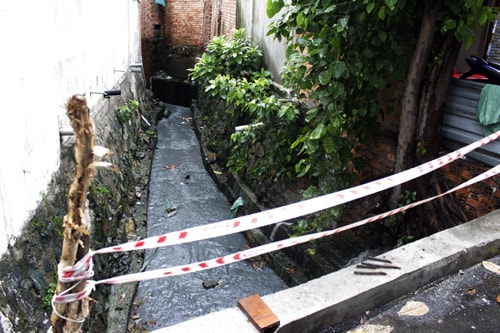 |
Canal A41 drains 50% of the airport's water, but many sections have been encroached upon, leaving it only 0.8 meters wide. Photo: Duy Tran |
"Previously, the canal was very wide, with clear banks on both sides, but then many households dumped garbage and built haphazardly, causing the canal bed to become silted up and obstructing drainage in the area," said Mr. Tam (70 years old), who lives about 200 meters from Canal A41.
Tan Son Nhat Airport also has two other drainage systems: the Hy Vong Canal (which helps drain water from the administrative area and the golf course area towards Pham Van Bach Street to the Tham Luong Canal); and the Japanese Canal (from the airport to Nguyen Kiem Street) which is responsible for draining water from the international terminal area and the aircraft repair area.
According to a Tan Son Nhat airport official, the severe flooding occurring at the airport whenever there is heavy rain like now is mainly due to the A41 canal's inability to properly drain water. The outer channel is small and clogged with trash, causing water to accumulate and not drain quickly enough.
The entire aircraft parking area (near Phan Thuc Duyet Street), the cargo terminal, and the warehouses depend on the A41 canal. If the water doesn't drain quickly enough, this area will experience flooding again like in previous rainstorms. The airport has requested the Ho Chi Minh City People's Committee and Tan Binh District to take measures to dredge and improve this canal.
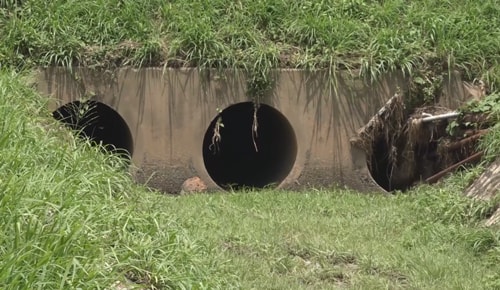 |
The drainage pipe of the A41 canal within the airport will run underground for 400 meters before exiting. Photo: AX |
Regarding the severe flooding at Tan Son Nhat Airport during heavy rains, Mr. Nguyen Ngoc Thiep, Deputy Secretary General of the Ho Chi Minh City Water and Environment Association, ruled out tidal surges as the cause, stating that the airport is 7-10 meters above sea level. While not pointing to the A41 canal as the sole culprit, he affirmed that the flooding is due to problems with the internal and external drainage systems.
"Heavy rainfall is becoming increasingly frequent, but the drainage system around the airport is experiencing sedimentation at the bottom. Vegetation and trash float on the surface, and in some sections, it's even being encroached upon in a 'bottleneck' fashion, causing blockages and reducing drainage capacity," Mr. Thiep analyzed.
Previously, the area around Tan Son Nhat was agricultural land, lower than the airport itself, so drainage was good. "Due to urbanization, people have raised the ground level and concreted the surface, causing rainwater to accumulate in the canals very quickly, creating immense pressure on drainage. When water cannot drain quickly enough from the surrounding area, flooding at the airport is inevitable," Mr. Thiep assessed.
Sharing the same view, Professor Dr. Le Huy Ba argued that the airport area is ancient alluvial land, with a high elevation and slope, so there was no flooding in the past. Before 1975, Tan Son Nhat had an area 4-5 times larger than it is today, allowing rainwater to easily drain over a wide area without causing flooding.
"The surrounding roads have been raised, but their drainage systems are not connected to the airport, causing many of Tan Son Nhat's drainage outlets to be blocked, leading to flooding inside," Mr. Ba stated.
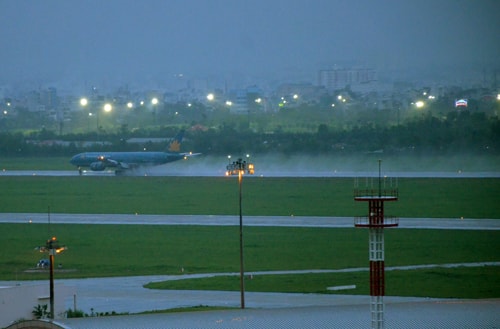 |
Tan Son Nhat Airport during the rain on September 11th. Photo: Duy Tran |
Furthermore, Professor Bá also hypothesized that Tan Son Nhat airport is flooding due to its shrinking area, coupled with the golf course's impact on the airport's drainage capacity. Specifically, numerous facilities serving the golf course, such as restaurants, hotels, and a drainage system, are only used to drain water from the golf course itself.
"The natural land area for rainwater drainage around the airport has once again shrunk. Moreover, the old airport's drainage system has been encroached upon and filled in, causing severe flooding in many areas inside," Mr. Bá said.
Recently, heavy rains have submerged the Tan Son Nhat airport's aircraft parking area by up to 30 cm, forcing numerous flights to land elsewhere. In the most serious cases, the airport could be closed if flooding causes transformers in the power station to explode.
According to VNE


