
Fishing on the Nam Xan River
(Baonghean) - As the summer sun begins to shine down on the mountains and forests of western Nghe An province, the profession of diving to hunt fish begins. This profession has existed since ancient times, and recently it has become increasingly popular.
As in other regions, people in western Nghe An have many ways of catching fish: nets, scoops, hooks, using leaves to tie fish to the surface, feeding them fermented rice residue to make them drunk... But here, there is also a rather unique method: using homemade guns and iron arrows to shoot fish underwater, a method often called "fish hunting." On the weekend, we went to Tung Huong village, Tam Quang commune (Tuong Duong district) and followed young man Vi Van Son on his fishing trip.
Preparing for his fishing trip, Son's first task was to replace the rubber band securing his homemade gun, and to check if the iron arrow was sharp and securely fastened. To test its sturdiness and accuracy, he attached the arrow along the wooden gun, tightened it with a rubber band, and then pulled the trigger. The rubber band stretched, and its elasticity propelled the arrow forward, hitting a banana tree about 7 meters away. Seemingly reassured by the gun, Son ran upstairs to get his diving goggles and set off.
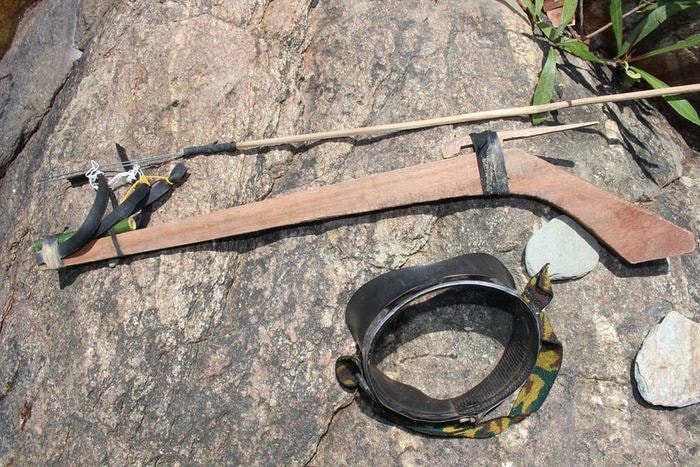 |
| Fishing gear. Photo: Cong Khang |
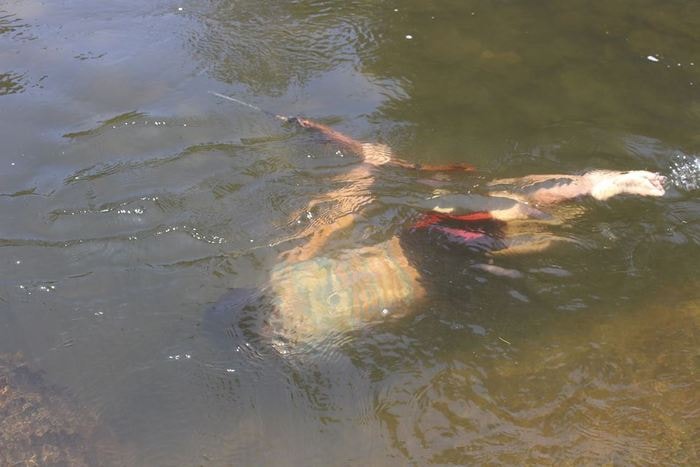 |
| Vi Van Son dives to the bottom of the Nam Xan River to hunt for fish. Photo: Cong Khang |
Vi Van Son headed towards the Nam Xan stream – a large creek originating from the Vietnam-Laos border, flowing through Tam Quang commune, then through Lang Khe commune (Con Cuong district) before merging into the Lam River. During the rainy season, the Nam Xan's water is clear and blue, allowing one to see every pebble at the bottom, and occasionally schools of fish of all sizes swim playfully as if waving hello. He chose a deep spot with a calm current to "work." Because at these points, the fish often gather, hide, and forage around the rocks, making it easy for the hunter to observe and manipulate his gun and arrow. Wearing shorts and a T-shirt, a diving mask, and a gun with the trigger already pulled, Vi Van Son slowly dived beneath the water's surface.
From the shore, looking through the clear blue water, we saw him moving along the rocky crevices, one hand still tightly gripping his homemade gun. After more than a minute, the water suddenly rippled, Son surfaced, raised his diving mask to his head, and breathed heavily, because after holding his breath for a while, he now had to take a breath.
About a few dozen minutes later, he submerged himself again, reaching his hand along the bottom of the Nam Xan River as if searching for something. Surprisingly, when Son stood up, he was holding an arrow with a fish pierced through its body at the tip, writhing in the water.
The fish was removed from the arrow, and its owner placed it in the basket he had prepared on the shore. Without resting any further, Vi Van Son reloaded the arrow into his gun and dived to the bottom of the Nam Xan stream, but this time he caught no fish. He continued this process about 10 times, and by then his basket contained 4 fish, enough for the whole family's evening meal.
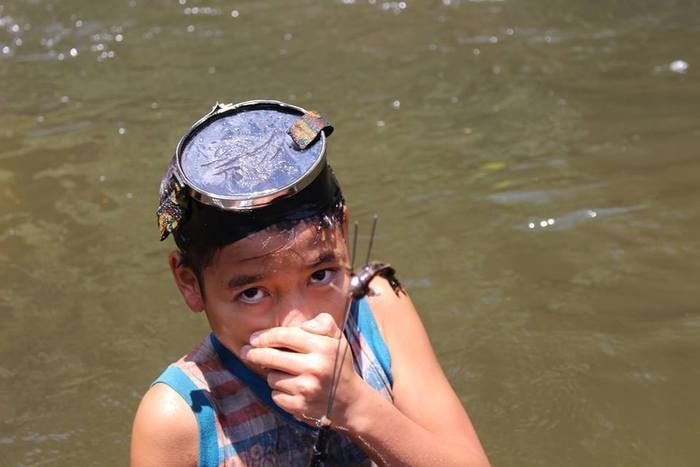 |
| Diver Vi Van Son surfaces. Photo: Cong Khang |
While waiting for Son to come ashore and rest, we asked him about this rather unique fishing profession. Regarding equipment, first, you need a diving mask, which costs a considerable amount of money, around several hundred thousand dong; a better quality mask will naturally cost more. As for the gun, it's simple: just a wooden stick about 1 meter long and a rubber band. The arrows are made from sharpened steel wire, with the tails attached to a rounded bamboo stick.
To shoot accurately, you need practice, starting with shooting on land. Choose an object and stand 5-7 meters away to shoot. But the aquatic environment is completely different. The water resistance and current speed can cause the arrow to miss the target. Not to mention that fish rarely stay still and are always swimming around, especially when humans are present; they often hide in rock crevices.
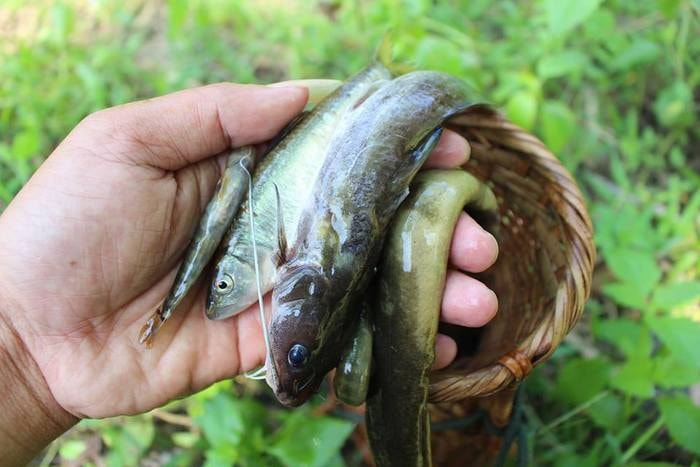 |
| "The spoils of war" after 10 dives into the Nam Xan River. Photo: Cong Khang |
Therefore, after practicing on land, you must practice in the water to gain more experience in the aquatic environment. Only when you are confident enough to dive for a long distance (over 1 minute) and observe underwater can you pick up a gun to hunt fish. Initially, it's not easy; you're not very used to it, so when you pull the trigger, the arrow often goes astray, allowing the fish to hide in crevices. Sometimes you dive all day without shooting a single fish. Gradually, you gain experience, determine the level of water resistance and current, accurately predict the direction of the fish's movement to shoot at it, and only then might you catch a fish. Then you have to know each section of the stream, which places have many fish, and understand the habits and feeding methods of each fish species to find the right hunting method.
For Vi Van Son and his peers, fishing is both a profession and a pastime during holidays, especially in the summer. Recently, some tourists visiting western Nghe An have brought their own fishing gear to experience the courage, skill, and creativity required of diving underwater to hunt fish.
Cong Khang


