
Producing green squash according to VietGAP standards.
(Baonghean)For a long time, farmers in Cam Son commune, Anh Son district, have been producing green squash with relatively high economic value. However, to ensure product quality, food safety, and stable income, they are now aiming to produce green squash according to VietGAP standards.
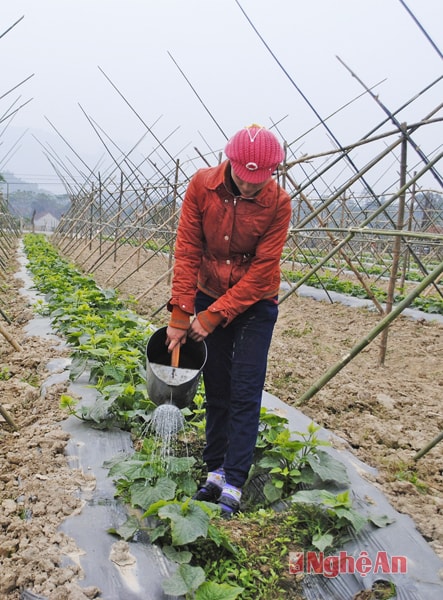 |
| Ms. Nguyen Thi Luong, residing in Hamlet 4, Cam Son Commune, is tending her pumpkin garden. |
| RELATED NEWS |
|---|
Ms. Nguyen Thi Tham, also from Hamlet 4, who is currently using bamboo stakes to build trellises for her green squash plants, said: "Growing green squash according to VietGap standards using the trellis method has the advantage of keeping the plants from touching the soil, allowing them to receive more sunlight, resulting in fewer diseases and better utilization of the space above. The squash, hanging on the trellis, develops evenly, has a more attractive appearance, and can be stored longer (when it rains, there's no worry about waterlogging or rotting if not harvested in time). With this new technique, the trellises are built with wide beds: 1.5 - 2m, and the planting distance is 40 - 50 x 80cm." Ms. Tham added: “Previously, we sprayed pesticides on our pumpkin plants haphazardly, but through guidance from technical staff on VietGAP-standard vegetable production, we were advised to limit the use of pesticides or use non-toxic biological products. For example, my family grows 5 acres of pumpkins, and in the past two seasons, we have implemented integrated pest management measures such as using disease-resistant pumpkin varieties, balanced fertilization, and proper irrigation. During cultivation, we collect and destroy old and diseased leaves, promptly dispose of plant residues after harvest; monitor the appearance of some major pests and diseases in the seasons mentioned above and control them when necessary. We also use manual methods, such as using lights to catch insects at night.”
Mr. Dau Xuan Phu, Chairman of the People's Committee of Cam Son commune, shared: Cam Son currently has over 35 hectares of pumpkins, all of which are cultivated according to VietGAP standards. Over 150 pumpkin growers have participated in training on safe and clean vegetable production processes according to VietGAP standards, conducted by the Nghe An Provincial Department of Agricultural Product Processing and Preservation and relevant departments of Anh Son district. Farmers were guided on the production, harvesting, and preservation of green pumpkins, soil management, and handling of surplus products after harvest. In addition to theoretical learning, farmers also received practical guidance from technical staff in the fields, discussing and sharing experiences in applying VietGAP standards to production. They were also guided on methods for identifying common pests and diseases affecting green pumpkins to use appropriate control measures, such as using non-toxic biological products.
Two production cycles have brought about positive changes in the awareness, mindset, and actions of farmers. It has helped pumpkin growers understand that product quality is the prerequisite and vital condition for maintaining and developing their businesses. Producing green pumpkins according to VietGAP standards also promotes the connection between production and the market, thereby bringing higher benefits and income to producers, gradually building a brand for safe vegetables and fruits, minimizing food poisoning and environmental pollution, and contributing to protecting consumer health in the area.
The advantage of Cam Son is that the people have seen the effectiveness of growing green squash and have voluntarily invested in electricity and water (mainly dug and drilled wells), with each household contributing 3 million VND, totaling over 600 million VND, thus ensuring a reliable source of clean irrigation water. However, the difficulty for the people of Cam Son is applying the VietGAP standard for green squash production, which requires strict adherence to regulations and high costs, while conventional production still allows for easy product consumption. Therefore, some households are not yet enthusiastic about adopting the VietGAP standard.
King Tran


