
High-tech tea production - a sensible direction.
With its unique soil and climate characteristics, Nghe An does not have the same advantages as some other localities in tea cultivation, yet it boasts one of the largest tea growing areas in the country. However, Nghe An still faces many limitations in tea cultivation and processing. To improve the efficiency and value of tea production, developing high-tech production methods is considered a logical direction.
(Baonghean)With its unique soil and climate characteristics, Nghe An does not have the same advantages as some other localities in tea cultivation, yet it boasts one of the largest tea growing areas in the country. However, Nghe An still faces many limitations in tea cultivation and processing. To improve the efficiency and value of tea production, developing high-tech production methods is considered a logical direction.
Huoi Tu (Ky Son) is a region with favorable natural conditions for developing high-quality tea, especially Shantuyet tea. In previous years, after the eradication of opium cultivation, the people were guided on techniques and provided with all the necessary conditions to switch to tea cultivation. However, at that time, the tea growing area in Huoi Tu consisted only of LD7 tea, Suoi Giang tea (Yen Bai), and Hoang Su Phi tea, all of which were of low quality. The project on the production and processing of high-quality tea in the high mountainous region of Huoi Tu - Ky Son is considered a breakthrough that will help increase the value of tea and effectively exploit the potential of this land.
The 8th Youth Volunteer Brigade researched and selected Shan tea varieties with good yield and quality, namely Shan Chất Tiền and Tham Vè, which have high yield potential, are suitable for intensive cultivation, and have good raw material quality suitable for processing into high-quality tea products to meet the domestic and export markets. With these initial results, the project has created a foundation for developing a stable Shan tea raw material area with high yield and quality.
Nghe An province currently has over 8,000 hectares of industrial tea plantations, spread across many districts, particularly concentrated in the midland areas of Anh Son and Thanh Chuong districts, with over 6,000 hectares dedicated to commercial tea production. Annually, the province processes over 10,000 tons of tea, exporting 5,000-6,000 tons, generating over 7 million USD in revenue and providing a stable source of foreign exchange.
However, upon objective assessment, we still have many limitations. The quality of our tea is not high enough, and the selling price is low compared to tea products from many countries around the world. In particular, we have not yet fully met the strict food safety and hygiene requirements for export to European markets.
The tea industry's growth rate has not met targets, and the volume of dried tea exported in recent years has decreased. A major reason is the rapid development of processing facilities, especially manual ones. Currently, the province has nearly 60 manual tea processing facilities with a capacity of 0.5-10 tons/day, with the highest concentration in Thanh Chuong district with 54 kilns. This situation easily leads to an imbalance between raw materials and processed products, and the quality of processed products is not guaranteed. In addition, while machines are now used for harvesting tea in raw material areas, it is quite common for people to harvest improperly, reducing the quality of the finished tea product and potentially depleting the tea plants and shortening the lifespan of the tea plantations.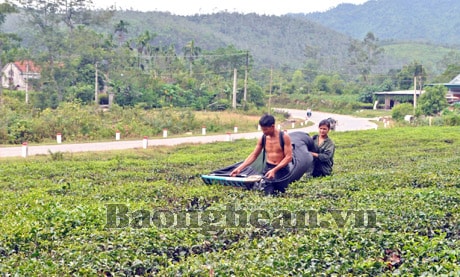
Tea harvesting using machines at Ngoc Lam Tea Plantation (Thanh Chuong).
In the development orientation for the industrial tea industry in the coming years, our province aims to apply high technology in tea production in 32 areas in Thanh Chuong, Anh Son, Con Cuong, and Ky Son districts by 2015, covering approximately 1,000 hectares of commercial tea plantations. The expected yield is 200 quintals/hectare, resulting in a total output of 20,000 tons, equivalent to 4,000 tons of dried tea buds. By 2020, this number will increase to 107 areas, covering approximately 3,500 hectares of commercial tea plantations, with an expected yield of 2.5 quintals/hectare and a total output of 87,500 tons, equivalent to 17,500 tons of dried tea buds, generating an export value of up to 22 million USD.
According to Mr. Ho Ngoc Sy, Director of the Department of Agriculture and Rural Development, in order to achieve the set goals, Nghe An prioritizes allocating land areas with favorable conditions for tea production investment, with a minimum area of 10 hectares or more, contiguous, with convenient transportation and, especially, with irrigation capacity.
Among them, with its unique characteristics, Thanh Chuong remains the locality with the largest tea growing area, reaching 1,850 hectares, followed by Anh Son with 1,000 hectares, and Con Cuong and Ky Son with 300 and 350 hectares respectively. “Along with that, we are committed to researching, adopting, and applying advanced technologies in biotechnology, mechanization, and irrigation, in order to invest in the development of tea production using high-tech processes suitable to the production conditions of each region and locality, ensuring high efficiency and sustainability.”
"In particular, the Thanh Chuong, Anh Son, and Con Cuong regions mainly use LDP1 and LDP2 tea varieties, while Ky Son mainly uses specialty Shan Tuyet tea varieties such as LD97 and TB14. Regarding irrigation, depending on the specific conditions of each production area, we invest in building reservoir and dam systems to provide irrigation water and maintain moisture, as well as boreholes and pipelines to irrigate tea-growing areas," Mr. Sy said. In addition, depending on the conditions, scale of area, and investment capacity in each region, we will gradually introduce machinery and equipment such as tea harvesting machines, sprayers, and transport equipment with appropriate capacities.
In particular, tea producers will receive training and technology transfer on advanced scientific and technological processes, high-tech applications, biosafety, and environmental protection, aiming to create safe, high-quality tea products that meet the increasingly high demands of the market. The province needs appropriate mechanisms to attract organizations and individuals to participate in joint ventures and partnerships to develop high-tech tea production and invest in the construction of processing facilities.
Phu Huong


