
The belief in medical ethics will shine brightly forever.
(Baonghean)After nearly 10 years of implementing the "Improving Medical Ethics" project in medical examination and treatment facilities (April 29, 2004 - 2014), the health sector has achieved many remarkable results: specialized medical science has developed significantly; the spirit and attitude of staff in medical examination and treatment have improved considerably, creating a positive public opinion in the community... To further clarify the achievements, as well as the remaining shortcomings in the implementation of the project, a reporter from Nghe An Newspaper had an interview with Dr. Bui Dinh Long - Director of the Department of Health.
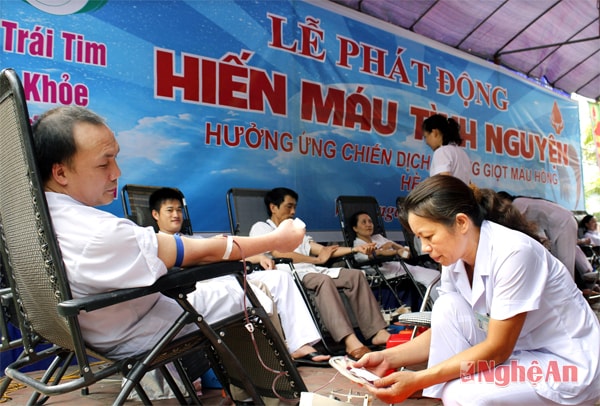 |
| Doctors and nurses from Nghe An Friendship General Hospital participated in voluntary blood donation. |
PV:After 10 years of implementing the "Improving Medical Ethics" project in healthcare facilities, could you please tell us about the results achieved?
Dr. Bui Dinh Long:Evaluating the results of 10 years of implementing the "Improving Medical Ethics" project, it can be affirmed that the health sector has achieved many successes through this project. Specifically, there has been a change in the awareness and responsibility of management staff regarding the ideological education of officials and employees. Similarly, health sector officials and employees have also shown changes and progress in their sense of responsibility, service attitude, and conduct towards the people. Emphasis has been placed on improving medical skills, with the vast majority of staff self-training and learning to enhance their professional qualifications. As a result, over the past 10 years, the health sector has successfully researched, applied, and utilized advanced techniques to treat patients. For example, by the end of 2013, the health sector had successfully performed one kidney transplant at the Provincial General Hospital and one bone marrow transplant at the Oncology Hospital. This shows that although the health sector still faces many difficulties, it has been able to implement advanced techniques.
In parallel with this, implementing the project to improve medical ethics, over the past 10 years we have honored many exemplary medical professionals. In 2013, the industry's Medical Ethics Council reviewed, selected, and honored 53 exemplary medical professionals. It is encouraging that on this occasion, more nurses and medical staff who directly serve patients were honored than in previous years. We believe that the implementation of the project to improve medical ethics has brought about many positive changes in the industry, including awareness, responsibility, and action.
PV:Sir, what are the reasons for the success in achieving the project's objectives?
Dr. Bui Dinh Long:To achieve the aforementioned results, it is necessary to acknowledge that the "Improving Medical Ethics" project has received attention and decisive leadership from Party committees and government authorities at all levels. At medical facilities, the project has been implemented through specific action plans and programs, tailored to each unit and different stages. The sector has strengthened its communication efforts to patients and the community. The role of Party committees, government authorities, and the community in monitoring, detecting, and providing information on the ethical conduct of medical staff has been promoted, especially by the media, to promptly address issues and contribute positively to the project's implementation. Through budgetary and socialized resources, medical units have gradually acquired modern medical equipment, thereby improving the professional skills of medical staff, which has been a decisive factor in the effectiveness of medical examination and treatment and the implementation of the "Improving Medical Ethics" project.
PV:Despite the achievements, there are still many shortcomings in healthcare facilities. Could you comment on this?
Dr. Bui Dinh Long:In recent times, the health sector has faced numerous challenges and difficulties. These include: changes in disease patterns, with the continuous emergence of various types of epidemics. Secondly, the demand for medical examination and treatment has increased significantly, both in quantity and quality. This is a very legitimate need, but the sector's development has not kept pace with the people's expectations. Thirdly, while investment in healthcare has increased in recent years, it remains limited compared to actual needs. For example, many medical facilities in the province are in a state of disrepair. In the past 25 years, only one new hospital has been opened in the province; the Provincial Friendship General Hospital has been under construction for 10 years but is still unfinished; and eight other hospitals have received approval from the Provincial People's Committee but lack proper buildings. This illustrates the many challenges facing the health sector.
And in reality, the industry still faces many shortcomings: The quality of care, examination, and treatment provided by some staff in certain hospitals remains weak. While medical ethics throughout the industry has been significantly improved, there is still public concern among staff and the public regarding a segment of medical personnel with poor attitudes, low service spirit, reluctance to face difficulties, unsympathetic language, and even negative behavior during patient care, examination, treatment, and referrals. Leaders in some units have not regularly directed, inspected, and supervised implementation within their units. Within the industry, especially in medical facilities, there is a lack of information to address violations by staff and to promptly commend and reward those who provide good service. The percentage of staff recognized as exemplary in medical ethics over the years remains low. Administrative reform has not met the needs of patients, particularly in the settlement and payment process for patients with health insurance cards.
PV:Could you please tell us about the main objectives of the "Improving Medical Ethics" project for the period 2014-2023, as well as the solutions to achieve those objectives?
Dr. Bui Dinh Long:Clearly identifying the existing problems and challenges, the health sector has determined that in the coming years, it will continue to focus on disease prevention and control. It will also improve the quality of medical examination and treatment by gradually meeting patient satisfaction. To achieve this, the health sector must comprehensively improve the quality of medical examination and treatment, technical skills, and service attitude. The workload that the sector has undertaken and is currently undertaking is enormous. To effectively achieve the set goals, the sector has developed a specific strategy and plan: continuing to implement the "Improving Medical Ethics" project in medical examination and treatment facilities regularly and with diverse activities; improving the quality of medical examination and treatment, enhancing medical ethics, and reducing inconvenience for patients; gradually increasing the number of hospitals meeting "Hospital Quality Management Standards" and the number of staff members receiving the "Exemplary Medical Ethics" award.
Continue to strengthen the Steering Committee for the Implementation of Medical Ethics at all levels to effectively implement the project. Organize the signing of commitments to uphold medical ethics in patient care and register to strive for the title of "Exemplary Medical Ethics Practitioner". 100% of units continue to thoroughly understand, study, and promote the implementation of the 12 Regulations on Medical Ethics, the Regulations on Communication in Medical Examination and Treatment Facilities, the Code of Conduct for officials and employees in medical service units, and Directive No. 03/CT-BYT dated April 1, 2013, of the Ministry of Health on strengthening solutions to effectively implement the code of conduct, improve professional ethics, and study and follow the moral example of Ho Chi Minh in medical examination and treatment facilities; 100% of units publicly display the main contents of regulations related to medical ethics in easily visible and high-traffic areas for monitoring by staff, patients, and their families. This should be disseminated individually or integrated into meetings, workshops, conferences for officials and employees, and departmental activities. In addition, strengthen inspection and supervision to improve the quality of medical examination and treatment, and administrative reform. Organize evaluations and classifications of medical facilities based on professional standards, medical ethics, and conduct periodic and ad hoc surveys of staff confidence and patient satisfaction.
PV:Thank you, sir!
Thanh Chung(perform)


