
After 2 years of vocational training for rural workers.
(Baonghean) - The Provincial Agricultural Extension Center is an institution assigned by the Department of Labor, Invalids and Social Affairs to provide agricultural vocational training for rural laborers according to Decision 1956/TTg. The Center recognizes this as an opportunity to improve its capacity and operational efficiency, but also as a very challenging task. Nghe An province has been implementing the vocational training program for rural laborers under Decision 1956/TTg for three years, but in reality, the Agricultural Extension Center has only been conducting training for two years (2011-2012) since the Provincial People's Committee issued Decision 5918/QD.UBND on December 30, 2012, which added the function and task of providing vocational training and issuing agricultural vocational certificates to rural laborers.
(Baonghean) - The Provincial Agricultural Extension Center is an institution assigned by the Department of Labor, Invalids and Social Affairs to provide agricultural vocational training for rural laborers according to Decision 1956/TTg. The Center recognizes this as an opportunity to improve its capacity and operational efficiency, but also as a very challenging task. Nghe An province has been implementing the vocational training program for rural laborers under Decision 1956/TTg for three years, but in reality, the Agricultural Extension Center has only been conducting training for two years (2011-2012) since the Provincial People's Committee issued Decision 5918/QD.UBND on December 30, 2012, which added the function and task of providing vocational training and issuing agricultural vocational certificates to rural laborers.
After two years of implementing agricultural vocational training for rural laborers, the center has initially achieved positive results. Regarding registration for agricultural vocational training, in 2011 the Agricultural Extension Center was assigned a training target of 11 agricultural occupations by the Department of Labor, War Invalids and Social Affairs. In 2012, an additional 8 new occupations were added, bringing the total number of licensed agricultural occupations to 19 (8 crop cultivation occupations, 3 livestock farming occupations, 4 forestry occupations, and 4 fisheries occupations).
Vocational training programs are structured with an average duration of 1-2.5 months per profession (calculated based on actual teaching days). Regarding the teaching staff involved in vocational training, the center has standardized training for 117 out of 216 teachers, achieving 54.1% of agricultural extension officers receiving vocational pedagogical training and teaching skills training according to Circular 30/2010/TT-BLDTBXH of the Ministry of Labor, War Invalids and Social Affairs.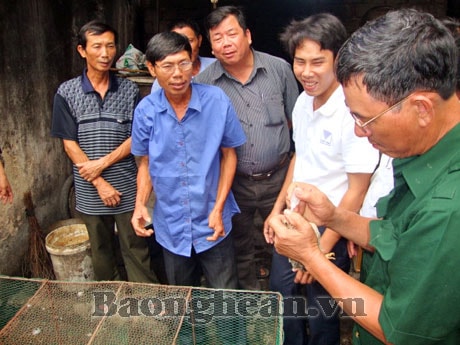
Inspection of vocational training in chicken farming in Quynh Luu district.
Regarding the results of vocational training after two years (2011-2012), the Agricultural Extension Center trained 10 agricultural professions in 104 classes, with 3,154 trainees from 19 districts and towns participating (of which: ethnic minority groups, poor households, people with meritorious services to the revolution, people whose agricultural land was confiscated, etc.: 1,654 trainees, accounting for 52.4%; near-poor households: 511 trainees, accounting for 16.2%; other rural laborers: 989 trainees, accounting for 31.4%). The number of trainees who received agricultural vocational certificates after training was 2,879 out of 3,154 trainees, reaching 91.28%.
Throughout the training process, the agricultural vocational courses consistently adhered to the planned schedule and training progress. The curriculum was based on the needs of the learners, making it engaging and attractive from the outset. Students mastered one skill before moving on to the next, following a hands-on approach with practical application in the fields and livestock pens. During practical sessions, 100% of the students participated and followed the instructors' instructions. The effectiveness of the training was assessed as follows: over 85% of students were able to immediately apply their theoretical and practical knowledge to production, and over 70% were able to immediately apply their skills and generate income and economic benefits from their training.
However, the implementation of agricultural vocational training has encountered numerous difficulties. These include insufficient investment and support policies for vocational training in rural areas, as stipulated in Decision 1956/TTg, which hinder training institutions and fail to attract many rural workers. Furthermore, local authorities and relevant departments have not been sufficiently proactive in leading, directing, promoting, planning, and orienting vocational training programs to suit local production and economic conditions. There is a lack of specific policies and mechanisms to provide effective support to learners before and after training. In particular, there has been insufficient attention and effective involvement from businesses, companies, and factories in supporting training and guaranteeing the purchase of trainees' products after completion of their vocational training.
Thus, after two years of the Nghe An Agricultural Extension Center participating in agricultural vocational training for rural laborers according to Decision 1956/TTg of the Prime Minister, the initial results have confirmed the effectiveness and success of this project. Developing agricultural vocational training for rural laborers is a completely correct direction, aligning with the aspirations and needs of agricultural workers today, who desire more opportunities to learn a trade, improve their skills and expertise, thereby creating more jobs and increasing economic income per unit area.
Cao Xuan Tuan (Deputy Director of the Provincial Agricultural Extension Center)


