
After the love market
The chill of the misty mountains doesn't lessen, but the vast forests of Ky Son are still brimming with life. Just a few spring rains are enough to awaken the mountains and forests, their lush green leaves bursting forth with a rustling sound. This vitality also flows through the hearts of many young men and women. From afar, the Huoi Tu Love Market (Huoi Tu commune) looks like a vibrant painting, its colors blending with the sounds of flutes and reed pipes calling out to each other, a scene of love between couples.
(Baonghean)The chill of the misty mountains doesn't lessen, but the vast forests of Ky Son are still brimming with life. Just a few spring rains are enough to awaken the mountains and forests, their lush green leaves bursting forth with a rustling sound. This vitality also flows through the hearts of many young men and women. From afar, the Huoi Tu Love Market (Huoi Tu commune) looks like a vibrant painting, its colors blending with the sounds of flutes and reed pipes calling out to each other, a scene of love between couples.
Here, every spring, during the bustling love market, people sing songs about love between couples. Some young men and women, already in love, hope the girl will "take" the boy to be their wife. When in love, they don't care whether they are of legal marriage age or not. "In Ky Son, the issue of limiting child marriage is a long-term and difficult one," said Mr. Dau Viet Cuong, Deputy Head of the Propaganda Department of Ky Son District.
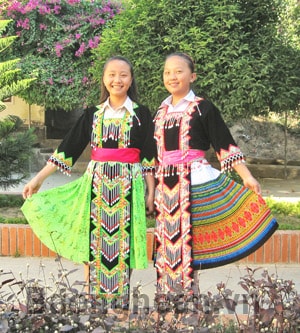
The Hmong girls shine brightly in the spring.
Lầu Y Gầu (Phà Nọi village, Đoọc Mạy commune) married Hờ Bá Lông (Nậm Cắn commune) while both were still in high school. After the wedding, they left school, dedicating their lives to the deep streams and high mountains, forever putting aside their youthful dreams. Indeed, these young people had barely grown up, were not yet mature, and had no preparation for a stable family life. Even Lô Thị Thiêm (Sa Vang village, Tà Cạ commune), who hadn't even finished 7th grade, went to school after the Lunar New Year to pack her clothes, return her books, and go home to get married. No one cared whether she was old enough or not. Teachers went to her house to advise her, and when parents explained, "She said if you don't let her marry, she'll eat poisonous leaves," they could only sigh and force a wry smile as they raised their glasses to toast their student's happiness. Four years ago, Lầu Y No (a student in class 8C at the district boarding school) was a diligent and excellent student, but after the spring, she didn't return to school. We thought she had married someone after those courtship meetings. While teachers might feel regret, it was less painful than hearing that she reacted to her mother's interference in her marriage by eating poisonous leaves! Even the case of secondary school students leaving their children at home who are already several years old is not uncommon!
In this land still fraught with difficulties, heartbreaking stories like these are still abundant. Lầu Y Bâu, only in the 7th grade, already has a face etched with resignation. People say that Hmong girls are incredibly resilient, sometimes spending their whole lives only seeing their own cracked feet, unaware of when the sun rises or sets. When I asked, "If someone were to take you as their wife this spring and you didn't want to, would you accept?" Lầu Y Bâu lowered her head. I clearly saw the resistance in her eyes, incredibly weak: "I don't want to, but if both sets of parents agree, I'll accept." "If you get married, will you still want to go to school?" "Probably not, teacher. I'll stay home and work in the fields." "If you don't like it, why don't you ask the authorities to intervene?" "In the commune, they don't really care about this." Y Bâu's mother is suffering from liver cancer, and her face and the profound sadness in her eyes haunt me, leaving me with a lingering, choked feeling. What do the local authorities think when they witness scenes like this?
Each story of child marriage leaves behind significant consequences. Some 8th and 9th grade students, when asked their teacher's age, shyly say, "My mother was also born in 1984 like you, but she's not as beautiful as you." This is the case of Ly YD, whose father is in prison for drug trafficking since she was an infant, and whose mother has been a widow for over a decade, with only a few happy days. The case of Lo Kham K is even more tragic; every time he receives a letter from his parents in Thanh Hoa prison, he cries uncontrollably. Because they didn't understand the deadly dangers of drug trafficking, they abandoned their two innocent children to relatives. K is now grown up and deeply distressed and ashamed. He doesn't know what his life will be like after graduating from junior high school, as his parents are gone forever, and the support from his siblings is limited!
Every spring, Ky Son District High School experiences a significant drop in the number of students. It's become a case of "it being the way it is." In my mind, I still picture young mothers carrying their children, one in front and one behind, their noses smeared with smudges, standing bewildered under a bauhinia tree, lost in thought listening to the sound of the flute from the love market…
The sound of the flute, calling for spring, beckoning a lover, stirs the heart with longing and emotion even from afar. And love is never a sin. We only hope that the light of spring will arrive in time to reach every village so that everyone may find their own way to live happily, with less bitterness and suffering!
Mac Khue (Ky Son Ethnic Boarding Junior High School)


