
There will be no more "lifetime employment".
On May 19th, the 12th Central Committee of the Communist Party of Vietnam issued a resolution of its seventh conference "on focusing on building a contingent of cadres at all levels, especially at the strategic level, with sufficient qualities, capabilities, and prestige, commensurate with the tasks."
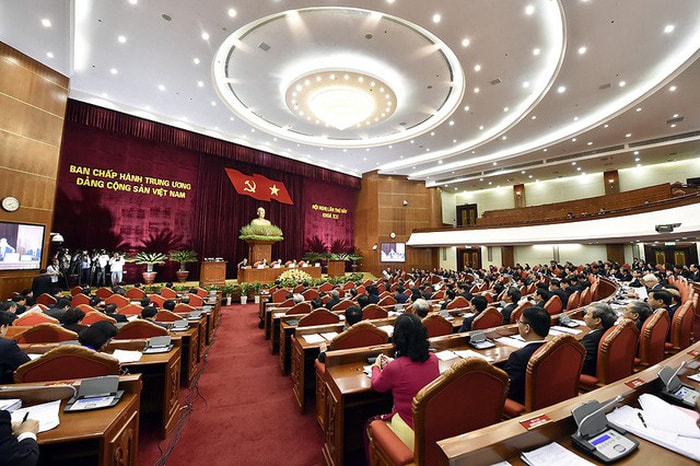 |
| 7th Central Committee Meeting, 12th term. |
The resolution sets the overall goal of building a team of cadres, especially strategic-level cadres, who possess the qualities, capabilities, and prestige commensurate with their responsibilities; sufficient in quantity, high in quality, and with a structure suitable for the socio-economic development strategy and national defense.
At the same time, it ensures a continuous and stable transition between generations, capable of leading our country to become a modern industrialized nation by 2030, with a vision to become a modern industrialized nation by 2045, following a socialist orientation, for the goal of a prosperous people, a strong nation, democracy, fairness, civilization, and increasing prosperity and happiness.
Standardizing and improving the quality of cadres.
Accordingly, by 2020, the Resolution will be institutionalized and concretized into Party regulations and State policies and laws on personnel work, and the building and management of the cadre team.
Improve mechanisms for controlling power; resolutely eliminate the practice of buying and selling positions and power; prevent and combat the decline, "self-evolution," and "self-transformation" among cadres and Party members.
Promote the implementation of the policy of appointing provincial and district-level Party secretaries who are not from the local area. Complete the development of job positions and review and restructure the staff at all levels, in conjunction with streamlining the organizational structure to ensure efficient and effective operation.
The goal by 2025 is to continue improving, standardizing, and synchronizing regulations, rules, and procedures regarding personnel work. Essentially, provincial-level Party secretaries will be appointed from outside the local area, and this will be completed at the district level; while also encouraging the implementation of this for other positions.
By 2030, the goal is to essentially build a team of leaders and managers at all levels, especially at the strategic level, who are capable of fulfilling their tasks.
Over 15% of strategic-level executives are under 45 years old, and 40-50% are capable of working in an international environment.
Of the leaders and managers at the general department, department, division, and equivalent levels at the central level, 20-25% are under 40 years old, and 50-60% are capable of working in an international environment.
15-20% of provincial-level leaders and managers are under 40 years old, and 25-35% are capable of working in an international environment. For commune-level specialized staff: 100% have college or university degrees and are standardized in political theory, professional expertise, and work skills.
20-30% of military and police leaders and commanders are capable of working in an international environment.
The goal is to build a team of leading experts and scientists in key areas of expertise, reaching a level comparable to that of the region and the world. The number of scientific personnel should reach at least 11 per 10,000 people.
The standing committees of Party committees and Party organizations at all levels must have female cadres. The percentage of female Party committee members at all levels should reach 20-25%; the percentage of female National Assembly and People's Council representatives at all levels should exceed 35%.
In areas with ethnic minority populations, there must be ethnic minority leaders who are appropriate to the population structure.
Moving towards abolishing the "lifetime employment" system.
The Resolution of the Seventh Central Committee Conference outlined key groups of solutions, the first of which is to raise awareness and strengthen political, ideological, moral, and lifestyle education for cadres and Party members.
At the same time, we must continue to innovate and improve the quality and effectiveness of personnel work. We must focus on decisively leading and directing efforts to effectively prevent and combat negative phenomena and corruption in personnel work.
Continue to innovate in the recruitment, planning, training, development, and rotation of cadres. Implement the policy of appointing provincial and district-level Party secretaries who are not from the local area, and encourage this for other positions, especially the position of Chairman of the People's Committee, if conditions permit.
The resolution also outlines solutions for building a team of cadres at all levels with the qualities, capabilities, and prestige to meet the requirements of the new era. It emphasizes equipping leaders at all levels with knowledge about cadre work. It focuses on improving the quality of Party committee secretaries, heads of departments at all levels, and grassroots-level cadres.
Restructure and reorganize the workforce at all levels and in all sectors according to job positions and competency frameworks, ensuring the right person is in the right job, reducing the number while improving quality and achieving a rational structure. Establish a competitive mechanism for job positions to improve the quality of cadres, civil servants, and public employees, and move towards abolishing the "lifetime employment" system.
完善 regulations and rules to strictly control, carefully screen, and promptly replace those with limited capabilities, low credibility, insufficient health, or who have committed violations, without waiting until the end of their term, appointment period, or retirement age. The assignment of positions, conferment of ranks, promotion of military ranks, and upgrading of grades should not be used to implement personnel policies and regulations.
Continue researching and piloting several policies:
+ Expand the competitive examination process for appointing leaders and managers at the departmental, divisional, and office levels.
+ The head of the organization selects and nominates cadres from the planning process to carry out the election and appointment process for their deputies; the Party secretary nominates candidates for election to the Standing Committee according to a specific procedure, ensuring the principle of democratic centralism and must be responsible for their nominations.
+ Grant the head of the organization the authority to appoint officials within the planning framework, dismiss subordinates, and be responsible for their decisions.
Prevent those who seek positions and power through illicit means from infiltrating strategic leadership positions.
Regarding the development of strategic-level cadres, priority should be given to identifying and selecting outstanding cadres from the planning pool, especially those who have been tested in practice, have outstanding achievements, have concrete "products," and have promising development prospects.
Accurately assess the personnel being considered for nomination, election, and appointment to strategic-level positions. Resolutely prevent unqualified individuals and those seeking positions through illicit means from infiltrating the ranks of strategic-level officials.
Regularly review and supplement the personnel planning for the Central Committee, the Politburo, the Secretariat, and key leadership positions of the Party, State, and socio-political organizations for each term. Proactively prepare personnel and build the "image" of key leadership positions of the Party, State, and members of the Politburo and Secretariat.
Building and perfecting institutions to control power in personnel work based on the principle that all power must be strictly controlled by mechanisms; authority must be bound by responsibility.
Deeply aware of the serious harm caused by the practice of buying and selling positions and power, considering it a form of corruption in personnel management. Clearly identifying and resolutely and effectively combating individuals exhibiting or engaging in such practices. Emphasizing political and ideological education, raising the sense of responsibility, self-respect, and honor of officials to foster a culture that rejects the practice of buying and selling positions and power.
Furthermore, it is essential to promote the role of the people in building the cadre of officials. The regulations of the Politburo and the Secretariat on the supervision and social criticism of the Vietnam Fatherland Front, political and social organizations, and the people in building the cadre of officials should be institutionalized, concretized, and effectively implemented.


