
Tighten control over vehicle load limits.
(Baonghean) - The increasing number of overloaded and oversized vehicles is causing serious damage to road infrastructure and compromising traffic safety. To address this problem, stricter management of vehicle load limits has been implemented with various solutions aimed at preventing and curbing violations, and restoring order in the field of transport management.
Complaining and avoidance!
The truck with license plate 72N – 6299 was one of several vehicles that the Nghe An Traffic Police and Transport Inspectors requested to be taken to the mobile weighing station located in the Den Cuong area (Dien An commune - Dien Chau district) for weight inspection. According to the registration, the truck's load capacity for bridges and roads is 16 tons, but it was carrying nearly 30 tons and had exceeded its inspection deadline. Explaining this excessive overloading, the driver said: "If you weigh 10 trucks, almost all 10 will be overloaded, it's just a matter of how much. I know it's a violation to carry this much, but I still take the risk to make ends meet. If I carry the correct load, I won't have enough money to cover the costs, and I'll have to quit the job..."
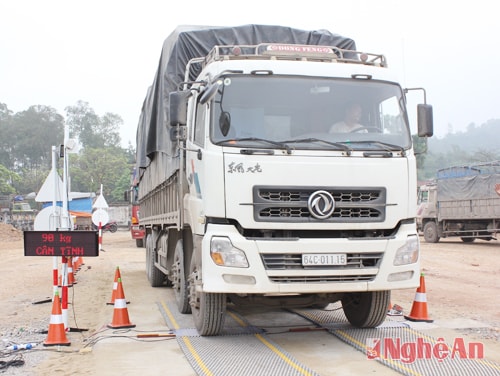 |
| The vehicle weight control station on National Highway 1A is located at Cuong Temple - Dien An commune (Dien Chau district). |
An hour spent with the inter-agency task force handling overloaded vehicles at the Cuong Temple area revealed that inspecting and handling overloaded vehicles on National Highway 1 through Nghe An province presents numerous problems. When a weigh station is present, many truck drivers resort to "camping out" at restaurants, gas stations, or parking in designated areas along National Highway 1 at both ends of the weigh station, monitoring the station's shift change time to allow their vehicles to pass. Some drivers even "holed up" in houses along the road to evade inspection; others move in a reactive manner, tailgating the vehicles in front to bypass the checkpoints. Another tactic to avoid weigh stations is for drivers to have a few empty trucks lead the convoy. Upon reaching the weigh station, these "bait" trucks suddenly break down, causing traffic congestion, allowing the remaining trucks behind to proceed. Drivers also commonly take advantage of waiting times for the inter-agency task force to bypass the weigh station in a convoy. "The truck is overloaded, passing through the toll booth now would definitely result in a heavy fine, so we've stopped and will figure it out later. To be honest, overloading is just a way of 'gradually siphoning off money,' because it's both dangerous and causes rapid wear and tear on the vehicle. With rising fuel costs, high investment and repair costs, and all sorts of taxes and fees, our only way to balance our income and expenses is to overload the truck, ensuring we can offer freight rates that the market can accept," a truck driver on the Thanh Hoa - Da Nang route candidly stated...
According to the vehicle load control procedure, after weighing a vehicle, if a load violation is detected, authorities will require the driver and cargo owner to unload the excess cargo and store it in designated storage areas. Only when the load meets the weight limit (as stated in the vehicle's registration certificate) will the vehicle be allowed to continue its journey. According to the general assessment of the authorities, in the initial days of implementing vehicle load weighing, most vehicles were found to be carrying more than the permitted limit; numerous vehicles were discovered to have been modified, with raised cargo beds, or even altered from their original structure to carry goods exceeding the permitted limit.
resolute action will be taken.
Since April 1st, traffic on National Highway 1A through Nghi Loc, Dien Chau, and Quynh Luu districts has been somewhat smoother due to a significant reduction in the density of heavy-duty vehicles. Mr. Hoang Van Chinh from Dien An commune, Dien Chau district, said: "I regularly travel twice a day from Dien An to Dien Chau town for work. Although I'm always mindful of being careful while driving, I still feel nervous when near heavy trucks and container vehicles. These past few days, the reduced density of heavy-duty vehicles has made my commute much easier."
Mr. Nguyen Khac Chuong, Deputy Chief Inspector of the Nghe An Department of Transport, stated: "Currently, some sections of National Highway 1A passing through our province are under construction for upgrading and expansion, making it difficult to find suitable land for placing weighing stations and ensuring traffic safety (as required, mobile vehicle weight inspection stations must have multiple locations along the route to prevent vehicles from taking detours to avoid or bypass the stations; the station location must be large enough to allow for unloading). Authorities cannot penalize drivers for stopping their vehicles on the road, at roadside stalls, or at gas stations because they are not violating any regulations. Therefore, to completely resolve the issue of vehicles avoiding weighing stations, localities must act synchronously, decisively, and over the long term with close coordination. Without strong action and transparent enforcement, even a slight lapse in vigilance will lead to the recurrence of overloaded vehicles."
According to Mr. Chuong, Decision No. 1196/QD-UBND approving the personnel of the mobile vehicle weight inspection station in Nghe An province stipulates a total of 28 officers, soldiers, and staff working at the station, including 10 station operators and 18 coordinating personnel. The station operates continuously 24 hours a day and is divided into 3 shifts, with each shift consisting of 2 traffic police officers, 2 traffic inspectors, and 1 military control officer. However, to date, the Provincial Police have only deployed 6 officers, of which only 2 are traffic police officers working at the station, leaving a shortage of 4 traffic police officers.
Based on the station's operational experience, the process of inspecting vehicle load limits is very complex. To have sufficient personnel and maintain continuous work in 3 shifts per day and night, each shift requires 7 members of the coordinating force. Therefore, the coordinating force needs 21 people, but currently only 13 have been deployed. The total number of officers and soldiers working at the station currently is only 13 out of 31 required, reaching only 45% of the necessary number. Meanwhile, the daily traffic volume of transport vehicles passing through Nghe An province reaches nearly 1,000, creating many difficulties in inspection work. Despite these difficulties, in the coming time, the Department of Transport will deploy mobile weighing stations on all national highways in the province and some provincial roads with high truck traffic such as Provincial Roads 532, 536, 537...
According to aggregated data from the weighing station, from April 1st to 17th, the mobile weighing station in Nghe An province issued fines to 188 oversized and overloaded vehicles out of a total of over 400 vehicles inspected (including 128 vehicles exceeding 50% of the permitted weight limit, 23 vehicles exceeding 30-50%, and 6 vehicles exceeding the permitted weight limit...). Fines were issued in 167 cases, totaling 872,100,000 VND; driving licenses were revoked for 1 month in 13 cases and 2 months in 108 cases. Vehicles exceeding the permitted weight limits often carry cement, steel, and fruit… For vehicles carrying special goods such as gas, gasoline, oil, and frozen goods in containers that cannot be disassembled and are sealed by customs authorities, appropriate measures are taken. On average, the weighing station inspects about 30 trucks passing through the area each day (each inspection takes nearly 20 minutes).
Trucks avoiding weigh stations continues to occur. However, this evasion is not a long-term solution, as drivers and vehicle owners find it difficult to pass all the weight inspection stations along the national highways located in all provinces and cities. Instead of avoiding them, businesses and transport companies should reconsider their practices and comply with regulations regarding cargo weight to ensure the stability of their transportation operations, contributing to the protection of transportation infrastructure and traffic safety.
Text and photos:Ngoc Anh
| Aiming to end the problem of overloaded vehicles by 2015, as per Directive No. 1095/CT-TCĐBVN dated March 21, 2014, of the Vietnam Road Administration, provinces have simultaneously launched campaigns to address and rectify the situation of overloaded transport vehicles since April 1, 2014. Accordingly, the Vietnam Road Administration has directed all 63 provinces and cities nationwide to install mobile weighing stations on key routes to inspect and monitor the weight of trucks in transit. In Nghe An, vehicle weight checks have been urgently carried out on National Highway 1; the weighing station is located in the Cuong Temple area (Dien An commune, Dien Chau district). According to the Department of Transport, the implementation of vehicle weight checks has uncovered numerous vehicles showing signs of carrying oversized and overloaded cargo. |


