
Who is the real super spy 007?
James Bond has many real-life role models, the most prominent of whom is probably William Stephenson. In 1940, Winston Churchill personally sent his top spy to New York to pressure the United States into entering World War II at all costs.
William Stephenson
...he was stunned. His telegraph crew had just deciphered a message from a secret Nazi German military radio station in New York. A British sailor had sold the Germans the routes of Allied ships carrying weapons from America to Britain. On the Atlantic, German submarines would have no difficulty destroying that convoy.
Stephenson thought for a moment, then left his office at the British Security Coordination (BSC) in Rockefeller Center, which served as the cover for the British Secret Intelligence Service in New York.
As night fell, Stephenson returned. An FBI investigator, also assigned to the case, anxiously awaited him to discuss their cooperation. “That bastard deserves a hammer,” he grumbled. “It’s done,” Stephenson replied curtly. The American collaborator didn’t appreciate the British joke; until the newspapers reported the discovery of a British sailor’s body in an abandoned basement.
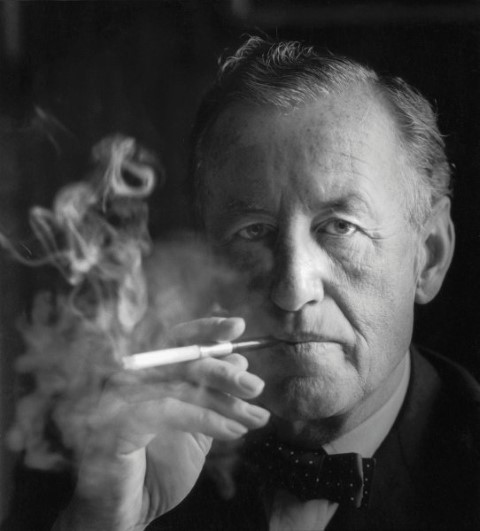 |
| In 1953, Ian Fleming published the first James Bond novel, using William Stephenson as one of the main models. |
The above anecdote, about an event that took place sometime between July 1940 and December 1941, was recounted by Ian Fleming, who at the time was not yet the creator of the legendary James Bond character, more familiar with the code name 007. Fleming himself only heard about it from FBI Director Edgar Hoover. The future writer Fleming was impressed by Stephenson's talent, as he recounted in 1962 to the Sunday Times, adding: James Bond is a "romanticized version" of a spy, while Stephenson is the "true character".
Fleming had the opportunity to meet his idol during World War II while serving as a liaison officer for British naval intelligence. Alongside other role models such as the British Edward Yeo-Thomas and the Yugoslav double agent Dusko Popov – who tried to warn the Americans before the attack on Pearl Harbor but went unnoticed – Stephenson was primarily the intelligent and sharp-witted figure Fleming used to create 007.
Stephenson's biography
...it began like the fictional and screen hero 007: he was born in 1896 in Canada. During World War I, he fought in the French ranks against Germany, initially as an infantryman, later as a fighter pilot. Due to a fatal mistake, he was shot down by his comrades and became a prisoner of war. When he escaped in October 1918, he stole a can opener, which, of course, he later patented and became wealthy thanks to after his discharge from the army.
In 1924, on his way to Berlin, Stephenson won the lottery again. In a shop, he stumbled upon an Enigma machine, a German-made encryption tool. He bought it and handed it over to British intelligence. The agency, sensing Stephenson's sensitivity, recruited him and later assigned him a unique mission during World War II.
On June 21, 1940, Stephenson, then codenamed Intrepid, arrived in New York. The then-British Prime Minister, Sir Winston Churchill, had personally selected him to send to America. Britain was the only nation in Europe opposing Hitler's Germany. Stephenson was ordered to persuade the United States to join the war as an ally of Britain, at all costs. A virtually impossible task, as 80% of Americans disapproved of the US involvement in the conflict.
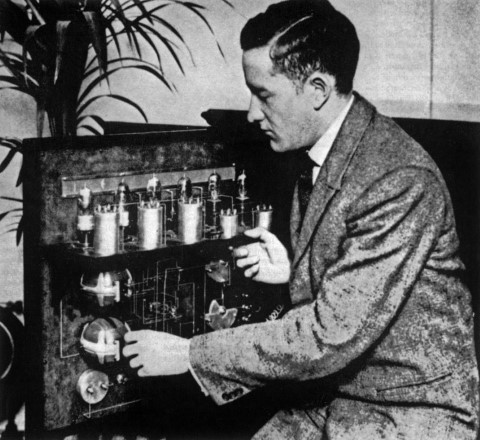 |
| William Stephenson was also the inventor of the photographic machine that transmitted images via electromagnetic waves. |
On the door of the BSC office
Stephenson's office displayed a sign that read "Passport Office." By the end of the war, Stephenson had a total of 3,000 employees. They operated not only in the United States but were also deployed to Canada and the Caribbean. U.S. President Franklin D. Roosevelt was not only informed about Stephenson's operations but also ordered maximum support. Hoover, the FBI Director, was secretly ordered to back British intelligence.
Stephenson spared no action that could harm the German military. In 1941, the BSC opened two counterfeit factories in Canada, Camp X and Station M. From there, countless German uniforms, badges, and passports were manufactured with great sophistication. At the end of 1941, Stephenson shut down the Italian airline LATI, which connected Italy with Rio de Janeiro-Unterhielt. He fabricated a letter from LATI headquarters in Rome to Vicenzo Coppola, the director of the Rio branch. The letter insulted Brazilian President Getulio Vargas, calling him "a short, fat man in the hands of the Americans."
During that time, Italy supported a fascist party in Brazil that was attempting a coup against Vargas. BSC agents managed to get the letter to appear... on Vargas's desk. As a result, not only was LATI shut down and Coppola imprisoned, but Brazil officially declared war on Mussolini and Hitler in 1942. Britain also acquired natural rubber from Brazil, much-needed for military supplies.
Stephenson's main task
...however, this influenced American public opinion. First, he planted a spy in the Gallup polling institute, who distorted all of Gallup's research results. Stephenson also extended his reach to newspapers. Paul Patterson, the owner of the Baltimore Sun, was charmed by Stephenson's female spy, Alice. J. Edgar Hoover even had his staff harass editors at smaller newspapers by phone, aiming to force them to publish news in his favor.
The BSC even created its own radio channel called World Radio University Listeners to incite war. American listeners completely believed it was an American radio station. "Stubborn" politicians were slandered, such as Governor Gerald Nye. Thousands of leaflets and numerous articles called him a "Nazi sympathizer." Republican Hamilton Fish, an anti-war activist, was photographed with his Nazi friends in America – of course, the photo was fabricated by the BSC...
On December 7, 1941, William Stephenson finally achieved his goal with assistance from Japan. The Japanese navy launched a surprise attack on Pearl Harbor, and four days later the United States declared war, becoming an ally alongside Britain.
Stephenson remained in New York to help build the OSS, later the CIA, until he retired to Bermuda.
According to the Cultural Center


