
Students in Nghe An province cultivate mushrooms using a '4.0 revolution' approach.
(Baonghean.vn) - With their idea of a smart garden model controlled by a smartphone, a group of students from Nghe An won first prize at the 2017 Student Festival.
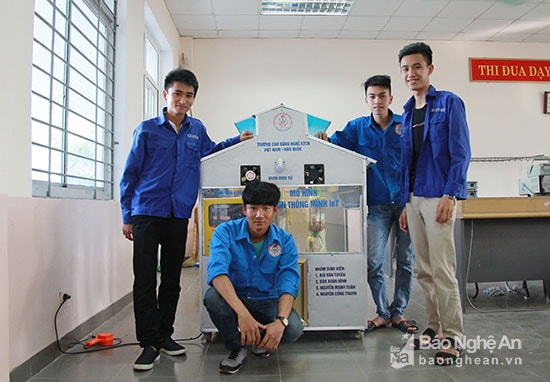 |
| Team members working on the IoT smart garden model. Photo: Chu Thanh |
With their "High-tech Oyster Mushroom Cultivation" model (IoT Smart Garden Model) utilizing technology geared towards Industry 4.0, a group of four students – Bui Van Tuyen, Nguyen Cong Thanh, Dao Xuan Binh, and Nguyen Manh Tuan – from class CD DT8D, Industrial Electronics, Vietnam-Korea Industrial Technical College, impressed the judges with their startup idea and product, winning first prize at the First Student Festival in 2017.
Student Bui Van Tuyen, the group leader, said that the IoT smart garden model was conceived by the students three months ago. This is also the graduation project for all four students. Sharing a common interest in technology, Tuyen, Thanh, Binh, and Tuan quickly became close friends and found a common idea for their graduation project.
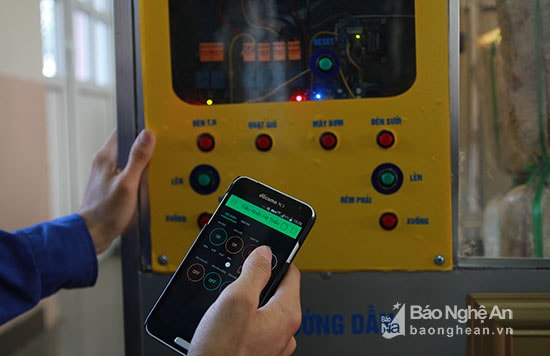 |
| Control the model using a smartphone with internet access. Photo: Chu Thanh |
Tuyen shared, “Vietnam is an agricultural country, and if information technology is applied appropriately, it will greatly benefit the people. For this reason, we decided to choose the topic of a model garden applying Internet of Things (IoT) technology, hoping to contribute to helping Vietnam's agriculture catch up with the world.”
IoT smart garden models utilize microcomputers combined with sensors for humidity, temperature, and light. Users can easily monitor environmental conditions and implement effective solutions, such as setting watering and lighting schedules, via smartphone. The IoT smart garden model operates based on three main components: IoT hardware devices with sensors that control environmental parameters such as humidity, temperature, and light. Information is sent to a server for storage and processing before being sent to a smartphone via a 3G or Wi-Fi network connection. When the smartphone sends a control command, the command is sent to the server and then transmitted to the hardware device for execution. |
During the process of transforming the model from paper to product, the team encountered numerous difficulties. First and foremost was the challenge of accessing IoT technology, a new technology compared to anything they had previously learned or practiced. Tuyen stated that, despite recognizing the difficulties from the outset, the team decided to use IoT because it is a new, faster, and more accurate technology, suitable for the Industry 4.0 era that Vietnam and the world are striving towards.
As final-year students with many tasks to complete, they all had to make the most of every free hour. Especially during May, they spent many nights at school perfecting their models. There were times when they encountered setbacks, and the team members had to encourage each other or pause to reconsider their approach.
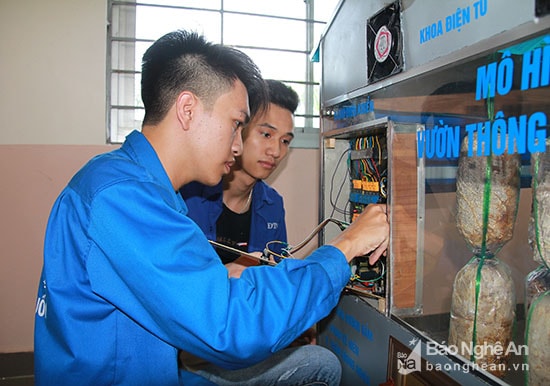 |
| To adapt to real-world situations, the team members still have to continuously refine the model. Photo: Chu Thanh |
Once the technical and mechanical assembly tasks were settled, the team members began researching mushroom cultivation methods. Thanh, a member of the group, said, “We searched for mushroom growing facilities online and contacted them to learn more. Luckily, we found a mushroom farm in Yen Thanh, and the owner enthusiastically taught us about mushroom growth. The team members spent the whole day learning and had to return two or three times to ask questions and learn from each other.”
Although it took considerable effort and time, seeing the mushrooms grow well and yield more than double the usual harvest, all the members were delighted.
Thanks to the application of IoT technology, the team's model will overcome the disadvantages of manual mushroom cultivation methods such as saving energy, yielding higher productivity, enabling year-round harvesting, reducing labor, and saving production costs. Currently, the team is continuing to refine their model.
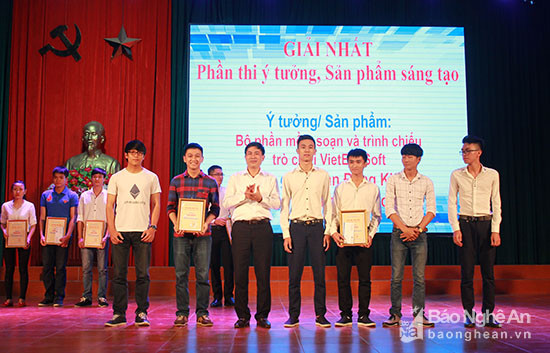 |
| The "High-tech Oyster Mushroom Cultivation" model (IoT Smart Garden Model) won first prize at the First Student Festival in 2017. Photo: Chu Thanh |
Commenting on the students' model, Mr. Pham Van Can, Head of the Electronics Department at the Vietnam-Korea Vocational College, said that the students' idea was good, creative, and progressive in applying the benefits of the internet. However, there are still some limitations such as low stability and the need for more careful planning before practical application and commercialization.
Chu Thanh


