
Proper first aid at the scene for victims of traffic accidents.
For someone with a fractured cervical vertebra, do not attempt to move the victim during emergency treatment, as this may lead to paralysis later on.
Traffic accidents whenIn situations with many casualties, knowing how to provide first aid can help save the lives of many victims. However, these well-intentioned acts of rescue can sometimes be harmful if the rescuer lacks basic first aid knowledge.
According toAssociate Professor, Dr. Nguyen Tien Dung, from Bach Mai Hospital, said that in other countries, there are small medical stations on the streets to provide first aid to people in emergency situations, while in our country, when an accident occurs, people only know to call emergency number 115. People gather around to observe, sometimes providing first aid, but not correctly because they lack expertise.
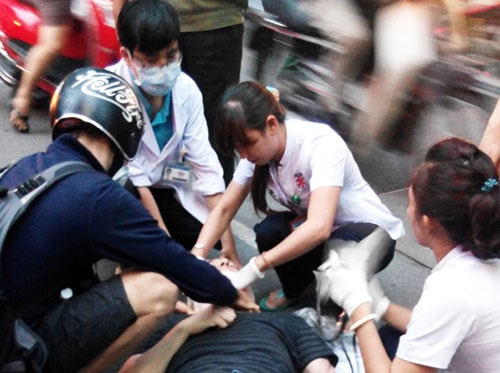 |
First aid for victims on the roadside. Photo: An Nhon. |
According to Associate Professor Dung,Not all victims of traffic accidents are quickly taken to the hospital.Pre-hospital care for victims is crucial, but each case requires individual assessment and treatment; there is no one-size-fits-all approach.Ordinary people don't know how to assess a victim's injuries, leading to incorrect first aid that worsens the situation. There have been many such cases.In some cases, the victim's condition worsened after transportation.
Associate Professor Dung provides guidance on how to handle some common injuries sustained in traffic accidents, as follows:
The wound is bleeding.
This is the most common injury in traffic accidents. It's caused by impact, sharp objects piercing the skin, or severed blood vessels, leading to bleeding. Victims who lose too much blood can easily become dizzy, unconscious, or even die.
This case requires...Apply a tourniquet to stop bleeding by wrapping it tightly 3-5 cm above the wound. A clean cloth can be used as a tourniquet if medical supplies are not available. Check the tightness of the tourniquet regularly.If a wound contains a foreign object, do not remove it as this may cause more bleeding and lead to blood loss.For bleeding wounds without foreign bodies, dApply pressure directly to the wound with a clean gauze or cloth, holding it firmly to stop the bleeding, then bandage it.All procedures must be performed quickly, accurately, and hygienically to prevent wound infection. Afterward, the patient should be promptly transported to the nearest hospital.
Fracture
When a bone is fractured, typical signs include pain at the fracture site, which worsens with palpation or movement, reduced or no movement of the injured area, accompanied by swelling and bleeding. In some cases of open fractures, the bone may pierce the skin, and the limb may be detached and dangling.
The first thing to do is to temporarily immobilize the fractured area. Homemade splints made from wood or bamboo can be used to stabilize the broken bone. If the fracture is near a joint, the joint must also be immobilized. For open fractures, do not wash the wound; only clean the area around the wound, apply antiseptic, and apply a sterile compression bandage. Absolutely do not push the broken bone back in. Afterward, quickly take the patient to the nearest medical facility for treatment.
Pay particular attention to those who have suffered accidents resulting in cervical spine fractures. Do not attempt to move the victim yourself. If you attempt to move the victim without proper guidance...Improper use can easily lead to the risk of complete paralysis or death.
Traumatic brain injury
Victims of traumatic brain injury may experience skull fractures, penetrating wounds, brain contusions, internal bleeding, or brain edema, and seizures. In such cases, the victim should be placed in a well-ventilated area. If the victim experiences cardiac arrest,If breathing is impaired, prioritize artificial respiration and chest compressions in the heart area. After treating the injury, call for emergency medical assistance as quickly as possible.
Associate Professor Dung emphasized that when encountering a seriously injured victim, the best course of action is to lay them still in a well-ventilated area and quickly seek first aid from a professional before transporting them to the hospital.
According to VNE
| RELATED NEWS |
|---|


