
The Department of Health issues recommendations for disease prevention after Typhoon No. 2.
(Baonghean.vn) - Following Typhoon No. 2, the Nghe An Department of Health has requested health centers and stations to closely monitor and promptly prevent outbreaks of infectious diseases.
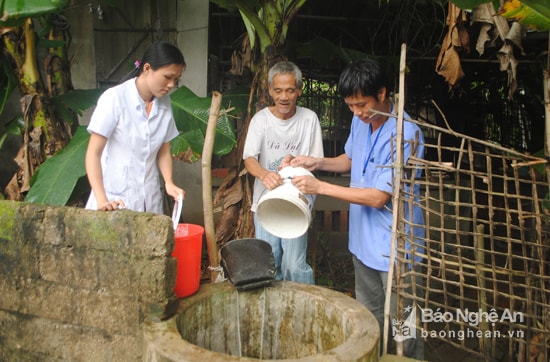 |
| Instructions for residents on how to manage water during the flood season in Nam Trung commune, Nam Dan district. Photo: Thanh Son. |
Following the recent Typhoon No. 2, many medical facilities in the province suffered damage to their infrastructure and buildings. In Tan Ky district, the fences at the medical center and the health stations in Tan Long, Tien Ky, and Nghia Thai communes collapsed; the health stations in Ky Tan, Nghia Dong, and Nghia Binh communes had their roofs blown off.
Similarly, in Yen Thanh district, the storm also ripped off the roofs of health stations in the communes of Ly Thanh, Minh Thanh, Thinh Thanh, Bac Thanh, Tay Thanh, Tho Thanh, and Long Thanh; many fences and gates of the stations collapsed.
In Anh Son district alone, the district medical center suffered damage to two sections of its corrugated iron roof; the patient treatment building at Tao Son commune health station collapsed; the estimated damage caused by the storm is approximately 165 million VND.
Following the directive from the Department of Health regarding the response to Typhoon No. 2, immediately after the storm subsided, health units in the province quickly restored and repaired damaged medical facilities, promptly receiving, providing emergency care, and treating patients.
During the storm's landfall, health stations also organized 24/7 emergency response teams, ready to provide free emergency care to victims; they prepared sufficient supplies of medicines, chemicals, equipment, and vehicles, and assigned mobile teams to support local areas.
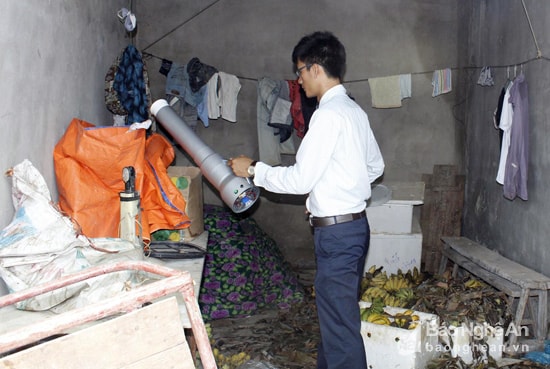 |
| Catching mosquitoes to prevent dengue fever in Quynh Luu district. Photo: Thanh Son |
In Cua Lo alone, the town's Medical Center dispatched one doctor, one medical assistant, two nurses, and a vehicle to be on standby at the Cua Lo Port Authority to treat shipwrecked patients; they also did a good job of providing healthcare for the seven crew members of the VTB 26 ship that was involved in the accident.
In mountainous districts with many flooded communes facing flash floods and landslides due to storms and their remnants, the Nghe An Department of Health is requesting health centers and health stations to closely monitor, promptly prevent, and organize treatment and management of various diseases; and to intensify propaganda and mobilization activities to encourage people to clean up the environment, treat drinking water, dispose of dead livestock and poultry, and maintain sanitation facilities.
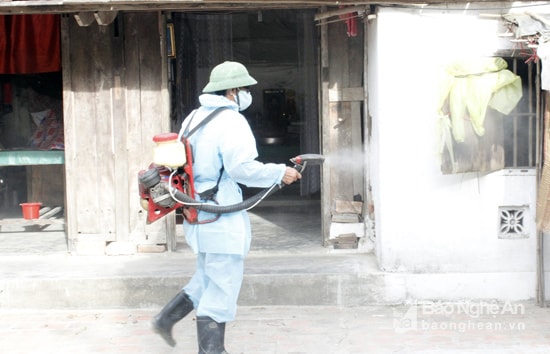 |
| Staff from Hung Nguyen Health Center spray disinfectant at households. Photo: Thanh Son. |
The health sector advises: During the rainy season, after the floodwaters recede, households should clean their houses, dry their clothes, and treat water sources for drinking and daily use with alum, aquatabs tablets, or chloramine B tablets; clear drainage ditches, and bury dead animals away from water sources.
To prevent intestinal diseases, households should always practice "eating cooked food and drinking boiled water," ensuring all food and drinks are thoroughly cooked and boiled before consumption. Food and drinks should be eaten while still hot, avoiding prolonged storage. Avoid eating raw vegetables and herbs. Do not consume raw pig blood or blood from other animals, as raw blood contains many bacteria that can cause diarrhea and food poisoning.
To prevent eye infections, skin infections, dengue fever, and malaria, people should regularly bathe and wash with purified and disinfected water. Avoid bathing in dirty, murky river, stream, or pond water as this can easily lead to illness. Use saline solution (9% NaCl) to rinse eyes 2-3 times a day; eliminate mosquitoes and mosquito larvae, and avoid mosquito bites.
Thanh Son
| RELATED NEWS |
|---|


