
The battle for ride-hailing services is heating up.
In recent days, many ride-hailing companies have launched a series of promotional campaigns to recruit drivers in order to gain market share from Grab after Uber left the Southeast Asian market.
Massive investment in transportation technology.
With only a few days left until Uber and Grab complete their transition, a new wave has begun in the transportation market: the emergence of numerous ride-hailing and taxi-based ride-hailing models from Vietnamese businesses determined to gain market share as Uber officially leaves Southeast Asia!
The transportation market is entering a new competitive battle between Grab and other purely Vietnamese transportation technology applications.
Since mid-November 2017, Mai Linh has established a ride-hailing center, attracting drivers. After a period of testing the ride-hailing market, this ride-hailing service was simultaneously launched in Hanoi, Da Nang, and Ho Chi Minh City. To date, Mai Linh has attracted more than 10,000 ride-hailing motorbike drivers. Mai Linh's goal is to have 1 million ride-hailing motorbike drivers by 2020.
According to Nguyen Thi Kieu Nhung, Director of Mai Linh Bike Operations Center (part of Mai Linh Group), after a trial period, Mai Linh Bike is currently perfecting both its operational procedures and technology. The fares are competitive and equal to or lower than other ride-hailing companies (for regular bikes, Mai Linh Bike charges 11,000 VND for the first 2km and 3,700 VND for each subsequent kilometer).
What sets Mai Linh apart is its commitment to not increasing prices during peak hours. Passengers can rest assured that if they have any complaints, they have a direct point of contact and support from Mai Linh as soon as possible.
 |
| Mai Linh Technology Taxi |
The next domestic company to enter the fray is Phuong Trang Company, which decided to launch its VATO ride-hailing model a month earlier than planned. Phuong Trang announced it will invest $100 million (over 2.2 trillion VND) in the VATO app to compete with Grab, Mai Linh, etc. VATO is considered a "Made in Vietnam" app, but it struggled during the boom of Uber and Grab.
Initially called Facecar, the app later changed its name to ViVu, and is now VATO after receiving additional funding. This app is not just for booking rides; it integrates many additional functions such as payment, phone calls, transportation, and delivery.
Previously, in Hanoi, Didi Vietnam Technology Joint Stock Company also introduced the Didi Vietnam ride-hailing application. The company currently has only 500 vehicles and operates a network linked with many taxi companies in Hanoi to meet customers' ride-hailing needs.
Pricing determines success or failure.
While Grab drivers complain about Grab reducing incentives and increasing commission, other ride-hailing companies are choosing to increase incentives and benefits to compete. According to Mai Linh Bike's operations center, the number of partners registering for Mai Linh Bike has increased many times in recent days compared to previous days. More than 100 drivers register to drive for Mai Linh Bike each day. Mai Linh Bike commits to collecting only a 15% commission and providing 100% free uniforms if partners achieve a revenue of 2.5 million VND or more in the first month.
Mai Linh also provides insurance for all partners after they have been operating for 6 months. For Mai Linh Taxi, only 12% of revenue is collected for the first year (3-year contract) and the first two years (5-year contract), and 14.9% for vehicles registered part-time... Unlike other ride-hailing services, Mai Linh Bike offers a booking service via a call center (call 1055 nationwide). In addition, Mai Linh also provides goods transportation and school transportation services for children.
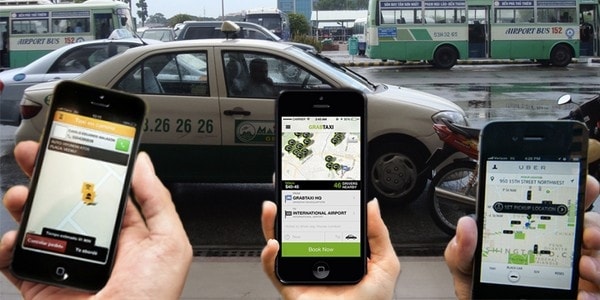 |
| Uber's withdrawal has triggered a race among ride-hailing technology companies, and domestic technology and transportation businesses have simultaneously jumped on the bandwagon to seize the opportunity. |
VATO is currently applying a 20% commission to its partner drivers (Grab's is 25% before tax), with a starting fare of 6,000 VND and a fare of 8,000 VND/km (other companies charge 9,000 - 11,000 VND). The company also claims to guarantee a support level of 35,000 VND per trip for drivers. This means drivers who earn less than 35,000 VND per trip will receive support to reach this level. Furthermore, during peak hours, VATO provides an additional 20% of the driver's revenue as a bonus.
This "Made in Vietnam" ride-hailing app plans to purchase pickup points at airports, bus stations, hotels, etc., to increase drivers' income. To attract customers, on its launch day (April 1st), VATO launched a huge promotion, offering each customer a 50% discount code (maximum 30,000 VND) for 3 trips that day.
Uber's withdrawal has triggered a race among ride-hailing apps, and domestic technology and transportation companies have simultaneously jumped on the bandwagon to seize the opportunity. The traditional taxi model is predicted to remain challenging, and a new battle has truly erupted in the ride-hailing app market. Naturally, services that are good, affordable, transparent, and beneficial will be embraced by customers.

