
Lively and frank in group discussions.
(Baonghean.vn) - This morning, the conference organizing committee divided into 5 discussion groups, chaired by the following Standing Committee members: To Hong Hai - Head of the Provincial Party Committee's Propaganda Department, Nguyen Huu Lam - Head of the Provincial Party Committee's Organization Department, Tran Cong Duong - Chief of the Provincial Party Committee's Office; Nguyen Xuan Son - Head of the Provincial Party Committee's Mass Mobilization Department and Vo Viet Thanh - Chairman of the Provincial Party Committee's Inspection Committee.
(Baonghean.vn) - This morning, the conference organizing committee divided into 5 discussion groups, chaired by the following Standing Committee members: To Hong Hai - Head of the Provincial Party Committee's Propaganda Department, Nguyen Huu Lam - Head of the Provincial Party Committee's Organization Department, Tran Cong Duong - Chief of the Provincial Party Committee's Office; Nguyen Xuan Son - Head of the Provincial Party Committee's Mass Mobilization Department and Vo Viet Thanh - Chairman of the Provincial Party Committee's Inspection Committee.
The working groups closely followed the four suggested topics for discussion by the conference organizing committee: analyzing and clarifying the reasons for issuing Resolution No. 4 of the Central Committee, its purpose, significance, importance, and key issues; clarifying the weaknesses that have emerged in current party building, their causes, and solutions; identifying the necessary solutions to create significant changes, including which solutions are breakthroughs; and providing feedback and drafting the implementation plan for the Provincial Party Standing Committee.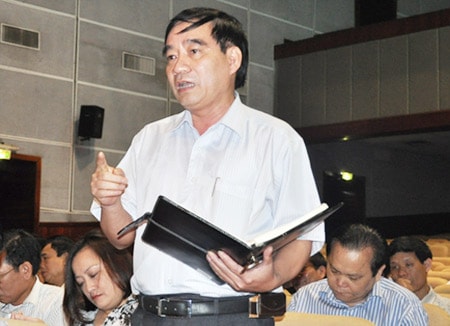
A representative from the Department of Finance gave a speech.
Representatives from the armed forces participated in the discussion.
In Group 1, comprising provincial departments and agencies, media outlets, and political schools, 12 opinions were exchanged, expressing strong agreement with the content and resolution, especially its objectives and the three urgent key issues that need to be addressed. Some opinions delved into analyzing the need for effective implementation of the resolution, emphasizing that only with a full and profound understanding can correct implementation be achieved, avoiding deviations.
The opinions expressed strong agreement with the content of the Resolution and demanded that every Party member, especially the leadership team, must rectify their own shortcomings. They argued that all manifestations of corruption, bureaucracy, and wrongdoing originate from those in positions of power at all levels, departments, and agencies, not from ordinary Party members. Furthermore, they asserted that the consequences for ordinary Party members are not as serious as those for those in positions of power. The opinions also affirmed that a segment of Party members are experiencing ideological and political decline, a weakening of willpower, and violations of ethics and lifestyle, which are undermining the Party's prestige and eroding the people's trust.
At Group 2, comprising military, police, and transportation agencies, universities and colleges located in the area, the Party Committee of the Provincial Agencies Bloc, and businesses, a lively discussion took place. Twelve frank opinions were expressed, showing strong agreement with the Central Resolution No. 4, and high consensus on the proposed solutions, especially the need for self-criticism and criticism, and the serious handling of violations. It is necessary to promptly review, develop, and promulgate a comprehensive policy mechanism to effectively prevent and eradicate negative manifestations, corruption, and intentional wrongdoing.
However, discussions within the group still raised concerns about several issues, such as how to effectively gather opinions (speaking truthfully and comprehensively, avoiding misrepresentation); the specific application to each unit, the practicality and feasibility of the plan; the need for a more unified and consistent review of the provincial guidelines; the need to supplement procedures and implementation steps; and the need for decisive and coordinated leadership throughout the implementation process, from disseminating the Resolution to its execution. Party members and leaders must set an example by conducting self-criticism first, leading by example in directing the implementation of the Resolution, and must be frank and sincere in criticism and self-criticism, avoiding the phenomenon of criticizing others while remaining detached from their own actions and those of their unit.
Literary Group


