
The vitality of Phu Xa craft village
(Baonghean) - Through many historical ups and downs, the noodle-making craft in Phu Xa noodle-making village, Hung Xa commune (Hung Nguyen district) has developed steadily. The application of continuous noodle-making machines, replacing the previous manual production methods, has contributed to increased productivity, reduced labor, and met market demand.
Mr. Le Van Huong, now 86 years old, is the oldest person in the village still passionately dedicated to the traditional noodle-making craft passed down from his ancestors. Despite his age and declining health, he wakes up at 3 a.m. every day to help his second son and his wife with the business. When we arrived, he had just finished cleaning the machinery, ending a day of noodle making, and preparing ingredients for the next morning. Mr. Huong recalled the difficult days of the 1950s and 60s, when his family, like other households in the village, made noodles manually, pounding the flour with stone mortars and twisting the noodles by hand.
Families involved in this trade usually buy rice at the local Vuc market to make vermicelli. Each day, the couple makes 30-40 kg of vermicelli. The wife takes the vermicelli to sell at the Vuc and Lieu markets, and it's all sold out within 2-3 hours in the morning. Back then, they mainly served the needs of the local people in the surrounding area. Regularly, baskets of warm vermicelli were sold, helping the family raise five children and provide for their education. Now, all the children have their own families, and the two of them have continued their parents' vermicelli-making business, becoming one of the largest vermicelli producers in the village.
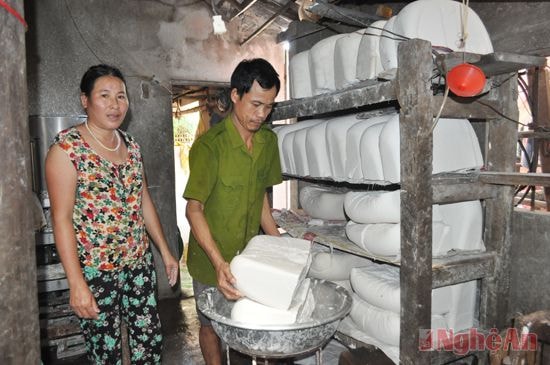 |
| Mr. Le Van Tuong and his wife are preparing the ingredients for making rice noodles. |
Through various stages of development, the noodle-making industry here has gradually shifted from manual production to mechanization, and now uses integrated machines for a closed-loop production system, with all stages done by machine. In recent years, thanks to an investment of over 50 million VND in noodle-making machines, Mr. Le Van Tuong (Mr. Huong's son) has increased production capacity to 350-400 kg of noodles per day. To produce delicious, hot noodles in the early morning to meet the demand of customers near and far, Mr. and Mrs. Huong start work at 1 AM every day to have enough stock for wholesale customers who come to pick up their orders at 4-5 AM, at a wholesale price of 6,000 VND/kg. Their noodles are carefully and cleanly made, popular in the market, and they sell out 300-400 kg every morning without any leftover stock. Mr. Tuong was also the first person in the village to buy a continuous noodle-making machine to apply to production. Since having the machine, processing capacity has increased, labor has been reduced, and the family always keeps over 3 tons of rice in stock to ensure a consistent supply of ingredients for making noodles.
Although they belong to a later generation in the profession, the family of Mr. Ngo Xuan Quang and Ms. Vo Thi Thu in Hamlet 3, Hung Xa Commune, has been making rice noodles for nearly 20 years. From making noodles by hand to producing them with machines, the couple diligently wakes up at 2 AM every day to work hard so that the noodles are ready by 5 AM to sell at the market. According to Ms. Thu, to have delicious, chewy noodles without a sour smell, it is important to choose good quality rice with plump, unbroken grains. Careful attention must be paid to the soaking time before grinding the rice into flour.
Soaking the rice too quickly will make the noodles cloudy and unappetizing; soaking it for too long will make them mushy and not chewy. After soaking, the rice is ground very finely, until it becomes sticky and pliable like modeling clay... After being tightly compressed, the rice flour is mixed with clean water. The ratio of water to rice flour must be carefully considered, because if it's not mixed properly, the noodles will be mushy and won't form into strands. During the noodle-making process, special attention must be paid to the steam; the steam must be hot and contained for the noodles to be firm and chewy. Nowadays, although there are machines to assist in production, the noodle-making process still requires careful handling by the artisans.
Mr. Vo Trong Ha, head of Hamlet 3, Hung Xa Commune, said: "The noodle-making craft here has a long history. Nowadays, the villagers apply the techniques and experience passed down from their ancestors, so Phu Xa noodles are soft, fragrant, and chewy, a quality not found everywhere. The Phu Xa noodle brand is increasingly favored by consumers because each person working here puts their heart and soul into serving customers in the best way possible, prioritizing food safety and hygiene, avoiding preservatives, and ensuring quality."
The Phu Xa noodle-making village currently has over 30 households engaged in the craft, providing employment for nearly 100 workers. Total production is approximately 5.2 tons of noodles per day, with an average income of 27 million VND per person per year for village workers. This is a significantly higher income than the average income of workers in the entire commune. Thanks to maintaining and developing this traditional craft, the people of Phu Xa village enjoy a prosperous and stable life. The seamless integration of modern and traditional production methods has contributed to the sustainable development of the village.
Quynh Lan


