
Positive impact of the project
(Baonghean) - During its implementation, the Poris project has actively contributed to helping communes in Quy Chau district develop short-term and long-term socio-economic development plans. These plans, along with support for several welfare projects and the development of economic models, have boosted the socio-economic development of the communes. Below are some assessments of the impact of the Poris project.
(Baonghean) - During its implementation, the Poris project has actively contributed to helping communes in Quy Chau district develop short-term and long-term socio-economic development plans. These plans, along with support for several welfare projects and the development of economic models, have boosted the socio-economic development of the communes. Below are some assessments of the impact of the Poris project.
Mr. Sam Van Thiet - Chairman of the People's Committee of Chau Hanh Commune, Quy Chau District:
Following the project's training courses, when we began developing the new plan, we established a clear hierarchy and delegation of authority; this included the participation of the people, villages, and relevant organizations and departments, and the selection of development strategies based on the available local resources. This approach ensures democracy, is both practical and realistic, and when handed over to the commune for management, it demonstrates the people's ownership and the dynamism of commune-level officials. Each time a plan is widely approved, it requires commune officials, from leaders to staff, to make concerted efforts to implement it... Through this activity, commune leaders and officials have gained a solid understanding of the steps in developing socio-economic development plans in the area. By strengthening communication with the people about the policies and guidelines of all levels and the local development strategy, the people themselves can contribute their opinions and participate in the implementation. Therefore, the commune's development plan for the next 1 to 5 years ensures transparency, accountability, and integrates investment resources from programs, projects, and contributions from the people.
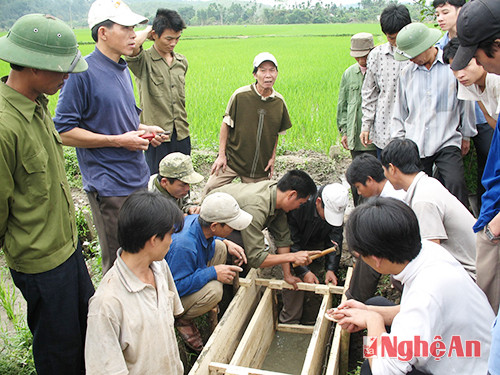 |
| Constructing irrigation canals in Chau Binh. |
Mr. Nguyen The Cong - Chairman of the People's Committee of Tan Lac Town:
Besides training local officials in planning skills, the project also enhances management and operational capacity through funding several welfare projects and public services, building production and livestock farming models that contribute to promoting poverty reduction at the grassroots level. To date, the Poris project has supported Tan Lac Town with billions of VND to build a community cultural center, renovate office buildings, develop a wild boar farming model, and purchase office, medical, and school equipment. Although the project has limited time remaining, the localities benefiting from the project still hope that the Poris project will continue to support environmental sanitation management - building a small-scale waste treatment plant; organizing visits and learning about urban environmental management services; and continuing to train management knowledge through application software such as civil registration and population management.
 |
| Facilities of the Chau Binh Community Learning Center. |
Mr. Luong Van Thu - Head of Luong village, Chau Binh commune:
Over the past few years, the Poris project has invested over 90 million VND in 12 families in Luong village, providing them with breeding stock, technical training, and the construction of pig breeding pens. During the breeding process, 6 out of 12 sows belonging to these households have given birth, some even producing their second litter, creating a source of breeding stock within the area. More importantly, these poor families have gained a solid understanding of breeding techniques, gained confidence in developing their livestock farming, and are gradually increasing their income and improving their living standards.
Mr. Nguyen Ba Hai - Head of Lau 2 village, Chau Binh commune:
Many families received support from the project in terms of seeds and techniques to cultivate agarwood trees as raw materials for incense-making villages in the district. After two years of pilot implementation, agarwood trees proved to be more economically viable than many other crops. Therefore, dozens of families expanded their agarwood cultivation area. This activity actively contributes to solving the problem of reducing the import of agarwood raw materials for some incense-making villages in Quy Chau district. The fact that many households are boldly expanding their agarwood cultivation area is a suitable direction in the current period, especially now that Quy Chau incense has established its brand and is selling well. The characteristic of cultivating agarwood trees is that they do not require much care, so people can dedicate their time to other activities. Therefore, families are now utilizing all available land to grow agarwood trees...
Mr. Nguyen Minh Lam - Planning Task Force of the Project Management Board, Department of Science and Technology:
The project also provided equipment and facilities for public services, healthcare, and domestic water supply, which have been put into use effectively and for their intended purpose. These facilities have helped overcome local difficulties in medical examination and treatment at health stations; improved working conditions for commune officials, social organizations, one-stop service centers, community learning centers, etc., enhancing work efficiency and providing better public services to local people. Over the years, the project has also focused on improving the living and operating conditions of community cultural centers in villages, creating better conditions for mobilizing people's participation and input in annual planning, and providing timely information on policies, laws, disease outbreaks, science, and social issues to local people. All activities are based on the common urgent priorities of the entire community, contributing to solving difficulties in poverty alleviation. In fact, the process has received active participation from the people. For example, in some public works projects, cultural centers, and roads in Ky Son, Tuong Duong, Thanh Chuong, etc., the people have contributed up to 50% of the investment value.
Nguyen Nguyen


