
Many instances of 'anti-cultural' behavior recur at weddings.
(Baonghean) - For more than 10 years, the movement to hold weddings according to the new cultural lifestyle in Nghe An has been formed and developed widely, spreading to localities and units, and has been embraced by all levels of the people... However, recently, many negative and "anti-cultural" manifestations in weddings have reappeared.
New cultural wedding models
In Dien Hung commune, a coastal area in Dien Chau district, the 500,000 VND wedding model has been implemented and popularized at the commune's cultural center for over 10 years. The Party Committee, People's Council, and People's Committee of the commune have established regulations for organizing weddings at the commune's cultural center.
Accordingly, each wedding held at the cultural center was very simple yet warm and joyful. The newlyweds only had to pay 500,000 VND, which included hiring musicians, an organizer, and buying candy, drinks, and fruit for the wedding, while the service was handled by the cultural committee and the youth union.
Mr. Phan Duc Luong, Secretary of the Party Committee of Dien Hung commune, said: "During the wedding ceremony, the newlyweds will lay flowers and incense at the commune's memorial; the Chairman of the People's Committee of the commune will give a congratulatory speech and present the marriage certificate. The entire procedure only takes about 40 minutes. Even families with better financial conditions only organize 25 tables for the celebratory reception for close friends and relatives. Initially, mobilizing people to implement the regulations was difficult, but when the model was implemented effectively, contributing to saving tens of millions of dong per wedding, people realized its value and responded positively. Every year, 100% of weddings are held at the commune's cultural center."
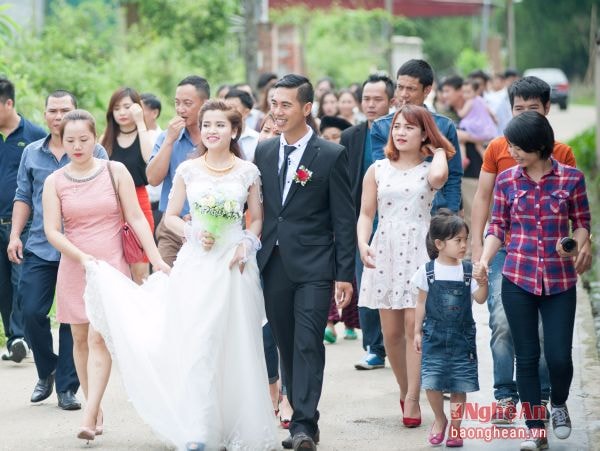 |
| A wedding procession on foot in Hung Tay commune, Hung Nguyen district. |
Similarly, Nghi Hop commune (Nghi Loc district) has also developed a model for weddings according to new cultural norms. To implement this model, the commune integrates it into meetings, broadcasts through the commune's loudspeakers to every hamlet, and publishes articles and real-life stories about the consequences of wasteful weddings; it also directs the youth union to create model weddings, which are then replicated and disseminated.
For model weddings, the commune government organizes the event at the village cultural center, with the youth union providing sound systems, tables and chairs, and acting as the master of ceremonies. If a reception is held on the main holiday, the attendees are limited to close relatives and friends of the host family. In the past five years, Nghi Hop commune has held over 30 such model weddings.
Ms. Tran Thi Anh Tuyet, Vice Chairman of the Nghi Loc District People's Committee, stated: Since 2004, 100% of hamlets, residential areas, and agencies in the district have incorporated civilized wedding practices into their regulations and customs. Accordingly, the wedding process and content are simplified and streamlined while still preserving cultural traditions, essentially consisting of only two ceremonies: the engagement ceremony and the wedding ceremony. Furthermore, weddings are now smoke-free, alcohol-free, and free of loud music after 10 PM and before 6 AM. There is no longer the practice of setting up wedding tents on public roads, and gambling is prohibited at weddings.
| According to Mr. Doan Hong Vu, Deputy Secretary of the Nghe An Provincial Youth Union: To promote weddings according to cultural norms, the Provincial Youth Union has directed its branches to establish 56 pre-marital clubs, 25 life skills teams, and youth volunteer teams to promote the reform of wedding practices. Notable examples include the "Economical Wedding" model in Quy Hop and Anh Son districts, and the Provincial Border Guard; the "Wedding according to the New Lifestyle" model in Nghia Dan, Quynh Luu, Tan Ky districts and Vinh City; the "Sweet Reception Combined with Announcing Good News After the Wedding" model; and the "Joyful, Civilized, and Economical Wedding" model in Nghi Loc and Yen Thanh districts. Over the past 12 years, the Provincial Youth Union has directed the organization of nearly 1,200 culturally appropriate weddings. |
Prior to the 2000s, extravagant and wasteful weddings, which caused public disorder and insecurity, were common in the province. To prevent and mitigate this situation, Nghe An province issued numerous directives, including Directive 19 dated February 18, 2004, from the Provincial Party Committee on implementing a cultured lifestyle in weddings for officials, Party members, and civil servants. According to statistics from the Department of Culture, Sports and Tourism, after 12 years of implementing Directive 19 and related documents, the entire province has established 86 model weddings, with 94,752 out of 229,771 weddings adhering to the new cultural lifestyle.
Combating negative behaviors
Implementing the new cultural wedding movement, outdated customs (such as exorbitant dowry demands, wife abduction, forced marriages, etc.) have been eliminated; wedding ceremonies have been shortened and held in one location; and wedding rituals have become more streamlined, gentle, and civilized. However, alongside these achievements, many shortcomings remain. At the recent provincial conference summarizing 12 years of implementing Directive 19, the report indicated that the rate of violations of cultural norms in weddings was 3.2%, with 1,250 cases of child marriage.
At the aforementioned conference, Comrade Nguyen Xuan Son - Standing Deputy Secretary of the Provincial Party Committee and Chairman of the Provincial People's Council - stated: In the first five years, the Directive was implemented seriously, but in recent years, the leadership and guidance of Party committees and authorities at all levels regarding weddings have been inconsistent, causing the movement to organize weddings according to cultural norms to stagnate; most models of weddings following cultural norms have not been maintained or replicated.
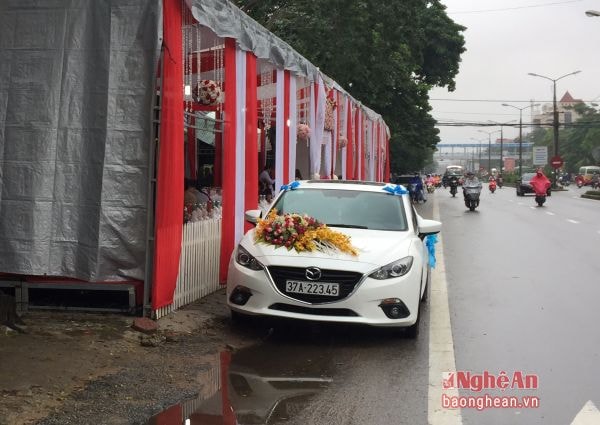 |
| In Vinh City, violations of regulations prohibiting the use of sidewalks and roads for weddings are still common. (Photo taken on October 9, 2016, on Le Duan Street) |
In recent years, a fairly common phenomenon in some urban areas is the increasing ostentatious and extravagant nature of wedding ceremonies, causing public outrage; the practice of scattering small change on the road during wedding processions still occurs, and violations of traffic order and regulations are quite common...
In Vinh City, during wedding season, many families often rent and set up wedding tents on sidewalks and roads, causing urban blight, traffic congestion, and obstruction. Recently, some ward and commune leaders even held lavish wedding parties for their children who were not yet of legal marriage age…
The reasons for the recent surge in "uncultured" weddings are attributed to lax management by local authorities and departments; limited awareness among some officials and Party members; insufficient and uninhibited penalties for violations; and the failure to develop and refine models of weddings that adhere to cultural norms for public awareness and implementation.
Party members lead the way, the people follow. To strictly implement weddings according to the new cultural lifestyle, the Standing Deputy Secretary of the Provincial Party Committee, Nguyen Xuan Son, directed: Party members and leading officials must set a high standard of exemplary conduct in organizing weddings; linking this exemplary conduct with the implementation of Resolution No. 4 of the 11th Central Committee of the Communist Party of Vietnam: Some urgent issues concerning Party building today; and simultaneously promoting the implementation of Decision 60/2016/UBND dated October 10, 2016, of the People's Committee of Nghe An province on promulgating regulations on implementing a civilized lifestyle in weddings, funerals, and festivals in Nghe An province. The implementation should be included in the criteria for evaluating and ranking Party organizations, government agencies, and mass organizations annually.
Regulations on implementing civilized practices in weddings, funerals, and festivals in Nghe An province: Article 4 - Wedding Ceremony Organization (1. The wedding ceremony shall be held at one location, on one day; 2. The reception shall ensure food safety and hygiene and only invite family, relatives, close friends, and colleagues from the same agency, with a limited number of guests, and a maximum of 600 guests. Civil servants and public employees shall not attend wedding receptions during working hours; when getting married or organizing a wedding ceremony for their children, they must report to the local authorities and the head of their agency about the wedding arrangements; 3. Agencies, organizations, and individual families shall organize wedding celebrations that are joyful, healthy, economical, and in accordance with the customs, traditions, and good practices of the locality, religion, ethnicity, and family circumstances.); Article 9 - Encouraging certain forms of wedding ceremony organization (1. Organizing tea parties and sweets for relatives; announcing the good news to colleagues and friends; 2. Using halls, cultural centers, or cultural and sports activity venues to facilitate wedding ceremonies organized by agencies and organizations; 3. The bride, groom, and their families offering flowers and incense at martyrs' memorials, martyrs' cemeteries, historical and cultural relics, and scenic spots; planting commemorative trees in the locality during the wedding; 4. Agencies and organizations in industrial zones organizing weddings for workers and employees at workers' cultural activity venues. The form of organizing collective weddings is encouraged). |
Dieu Thien


