
The talk show "Those Who Talk Too Much" on YouTube: A loophole in cultural management.
The talk show "Those Who Talk Too Much," which is self-produced and distributed on YouTube and features content attacking famous artists, is receiving much criticism from the public.
The talk show "Bitches in Town," also known as "The Talkative Ones," has caused a stir and controversy recently. Produced by Monday Morning, the program is hosted by MC Thùy Minh, blogger Nguyễn Ngọc Thạch, and stylist Lê Minh Ngọc. Throughout the show, the three hosts engage in casual conversations and gossip about scandals and celebrities in the Vietnamese entertainment industry.
 |
| The three hosts of the show. |
In recent episodes, "The Talkative Ones" has repeatedly "attacked" celebrities with shocking statements and negative remarks. For example, in episode 20 of the show, the three hosts took a jab at many singers such as Thuy Tien, Dong Nhi, Yumi Duong, Van Hugo, and Ly Nha Ky.
Nguyen Ngoc Thach said: "Dong Nhi's outfit makes her look old, like Ong Cao Thang's grandmother, not his girlfriend," or "Ho Vinh Khoa should just strip down for people to look at, he shouldn't sing." They also bluntly criticized Ly Nha Ky and My Tam for having bad fashion sense but "still confidently dressing badly." Regarding Toc Tien, the MCs said she has a strong voice but lacks emotion. Overseas MC Ky Duyen was also assessed by Thuy Minh: "Generally speaking, she (Ky Duyen) is a bit cowardly." The three MCs also commented on the Ho Ngoc Ha "husband-stealing" incident with many unverified details.
After saying things they were just "joking around," the three MCs burst into laughter. Not only the artists but also the public felt uncomfortable with the crude humor. Especially since many of the statements were personally offensive, violated moral standards, and many details were fabricated into stories that could significantly affect the artists.
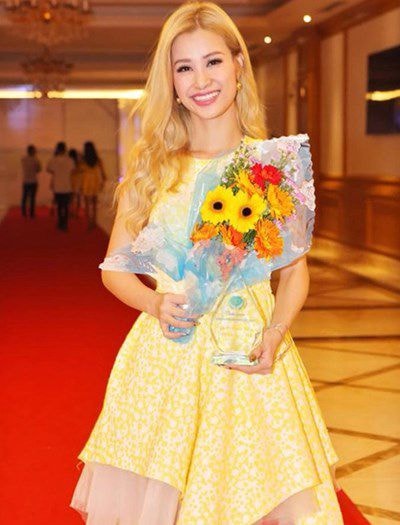 |
| Dong Nhi's outfit was criticized as ugly. |
On social media, artists continuously posted statuses expressing their anger and outrage at having their names mocked. Singer Dong Nhi stated that she would sue the organizers and seek intervention from relevant authorities if the program continued to go too far. Miss Dang Thu Thao shared: "Please stop this show. Don't hurt others with such terrible language."
Supermodel Ha Anh stated: "I believe that chat shows where people sit around gossiping about who wears what badly, who loves whom, who broke up with whom… cannot be considered a cultural program. When speaking in front of millions of people, you need to have standards in terms of language. The program does not bring any positive value to modern life, other than helping some people feel entertained and feel better about themselves by being able to mock others."
How should cultural gaps be addressed?
Despite the outrage from many artists, no official agency has yet intervened to address a program supposedly belonging to the cultural sector. This is because "Those Who Talk Too Much" has circumvented the law by distributing the program on YouTube.
YouTube is the world's largest online video sharing site, with servers located overseas. The platform's management is not responsible for videos uploaded by users. Users are responsible for removing offensive content by reporting violations.
Regarding the management of cultural content on YouTube, Mr. Hoang Vinh Bao, Director of the Department of Radio, Television and Electronic Information (Ministry of Information and Communications), acknowledged that: "The management of Vietnamese-produced cultural products posted on YouTube still has many limitations and shortcomings. We do not have enough resources to control and can only handle violations when detected."
However, even when violations are detected, how to handle them remains a difficult question. According to Mr. Hoang Vinh Bao: “In reality, there are currently some regulations on penalties, but they are not strong enough to be a deterrent, especially in the field related to digital content and the internet environment. However, the difficult question for managers is which decree's penalties should be applied to products that violate Vietnamese customs and traditions on the internet?”
It is difficult to prosecute infringing products; regulatory bodies can only hold those who disseminate infringing content on YouTube accountable: “Information providers and distributors on the internet are responsible under Vietnamese law for the content they upload if they are living or doing business in Vietnam. In some previous cases of distributing clips on YouTube with content that violated the law or went against Vietnamese customs and traditions, whether they were self-recorded or copied from others, the person who disseminated the content was still punished according to the law when investigated by authorities,” said Mr. Hoang Vinh Bao.
Previously, the loopholes in the distribution of digital content on the Internet were also discussed following the incident involving the obscene music of the group Yanbi and Mr.T, along with the 18+ rated "Apartment No. 69" being widely uploaded to YouTube. The question of which laws and regulations should be applied to punish these cases, and which regulatory agencies should be held accountable, has been the subject of much media attention.
At that time, the Department of Broadcasting, Television and Electronic Information (Ministry of Information and Communications) was discussing amendments to Decree 72 on services providing and sharing cultural products in Vietnam on the Internet as a way to prevent these loopholes. However, to date, no document or decree has been issued to tighten the management of cultural content on the Internet.
According to VOV.VN
| RELATED NEWS |
|---|


