
The dedication of a commune chairman
(Baonghean)From his position as head of the commune-level government, Comrade Ngo Xuan Nghia was reassigned to agricultural extension work due to a disciplinary violation. However, he remained cheerful and worked with a high sense of responsibility. After more than a year of observation, recognizing his determination to improve, the Party Committee, all Party members, and the people re-elected him to his previous position. And he did not disappoint that trust, dedicating himself wholeheartedly to his homeland.
That was the observation in the Party building work report of the Nghia Dong Commune Party Committee - Tan Ky District, presented to the Central Committee during a recent survey of 30 years of the ruling Party. What prompted us to seek out and meet this individual who had strived to shine after receiving a disciplinary penalty...?
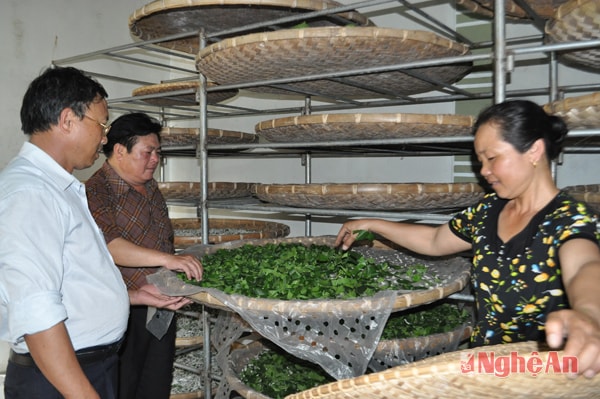 |
| Mr. Ngo Xuan Nghia (center) visits a model mulberry cultivation and silkworm farming facility in Hamlet 3, Nghia Dong Commune. |
Losing one job
When we arrived in Nghia Dong, the commune chairman, Ngo Xuan Nghia, was dealing with a farmer who had come to complain about the commune's veterinary officer vaccinating his calf, causing it to become paralyzed in both legs. The farmer said, "My calf was worth 22 million dong, and now I can only sell the meat for a maximum of 14 million dong." Chairman Nghia immediately called the veterinary officer, criticizing them for not reporting the incident to the commune in a timely manner. He also requested that the officer re-examine the situation and propose a solution. However, with his years of experience in management, he realized that if he forced the veterinary officer to compensate, they wouldn't have the money and would be afraid to vaccinate again in the future. So, he quickly decided that the farmer would sell the calf for meat, and the commune would cover half of the cost, with the family bearing the other half, ensuring the calf would still be worth 22 million dong. The chairman's solution was quick, reasonable, and reassuring, and the farmer left feeling relieved. That small story also illustrates that in the position of commune chairman – the level closest to the people – people turn to him for everything, requiring the official to first have knowledge in many fields to handle the work before having time to do more important things.
Nghia Dong is a lowland commune in Tan Ky district, but it's not near the town. It was formerly known as "Nghia Dong" because of constant famine, difficult and muddy roads, and the need to "ride buffaloes to beg for fire." Despite its size, the commune suffered from internal disunity; the district described it as "Nghia Dong like a kneeling elephant," meaning it was a large commune but incapable of being revitalized, with officials brought in often losing their influence. The fields were dry, the area of paddy rice was very small, and the plant and animal varieties were poor, making life very difficult for the people. Returning from the battlefield, Ngo Xuan Nghia, after a period of local activity, was elected Chairman of the Cooperative. He worked with the people to quickly solve the famine problem in Nghia Dong by eliminating dry rice production (rice sown on dry land) and simultaneously improving the fields, bringing in water to produce two rice crops per year. From then on, the people's lives gradually improved, and he was eventually elected Chairman of the Commune People's Committee. When asked about the time he lost his job and had to work as an agricultural extension officer in the commune, he laughed and said, "If I hadn't been cursed with that experience, I probably wouldn't have had the chance to stay in Nghia Dong for so long until today."
Previously, he had planned to be transferred to work in the district, but was discovered to be involved in gambling. However, many people in Nghia Dong petitioned for his release. “The then Chairman of Tan Ky District, Mr. Vo Viet Thanh, came to inquire about my situation and suggested that I remain in the Party, telling me I had to continue trying, but the disciplinary action would still be applied,” Mr. Nghia shared. That time, he was disciplined and transferred from Chairman of the Commune People's Committee to working in agricultural extension. He remained passionate and dedicated to the people, introducing many models such as industrial pig farming, potato cultivation, and rice field fish farming. The agricultural value per hectare in Nghia Dong increased from 43 million VND to 120 million VND and then 200 million VND per hectare. Mr. Nghia went down to every field to work alongside the people, building models and resolving difficulties.
The agricultural movement in Nghia Dong flourished. After some time, the Party committee and the people trusted him enough to re-elect him as Chairman of the commune. “To be honest, I am deeply moved by the trust placed in me by the people of Nghia Dong and the higher-level leaders. After returning as Chairman, I strive even harder to bring prosperity and happiness to the people of my commune. In personnel work, I also diligently nurture the younger generation, being very strict and setting an example for them so that they can inherit the traditions of the commune,” Mr. Nghia shared.
Policy on sustainable agricultural development
“In Nghia Dong, only agriculture is possible, but I believe it's impossible to develop without combining it with livestock farming and investing in science and technology. Nghia Dong doesn't have factories or industrial facilities. It only has land, so we have to organize farms to move to the fields, raise pigs and cattle, and grow grass to invest systematically, increase production value per unit area, and protect the environment. But it's easier said than done. We have to motivate and encourage people because livestock farming is not simple when dealing with diseases and market demands. People even have to sleep on the farms to protect their livestock, so without hard work, it's impossible to succeed,” Mr. Nghia shared. After reaching a consensus within the Party Committee, the commune allocated 5% of its land and uncultivated, barren land to encourage those who dare to think, dare to act, and dare to invest in farms. The requirement is that each household raising livestock must have at least 8 cows, and at least several dozen pigs.
The commune has planned and invested in infrastructure, ensuring electricity and water supply for the farms, guaranteeing their stability. The commune also facilitates access to development loans for the farms. Step by step, Nghia Dong now has many farm clusters, each with an area of 0.5 to 1 hectare, primarily raising commercial cattle, combined with poultry. The commune has arranged for livestock farming in the fields in areas such as Bau Lung, Canh Ran, Con Dong Am, Kho Cuon (currently with 10 farms), Hamlet 9, Dong Dai Giang area, Con Chua area, etc. The commune also supports households with funding for learning and training in the transfer of science and technology through agricultural and forestry extension funds, and provides financial support for households to build development models, prioritizing households utilizing the commune's 5% land allocation. To date, Nghia Dong has successfully relocated 25 farms to the fields, achieving high efficiency. From these farm fields, income has reached 200 million VND/hectare.
Nghia Dong also participates in sugarcane cultivation like other localities, but the sugarcane in Nghia Dong is field-grown. This means that sugarcane is prioritized for planting in good fields and intensive farming is invested in to achieve high yields. Mr. Nghia said: "A few years ago, sugarcane was the most profitable crop because of high prices and high yields, making people happy and confident with sugarcane cultivation. At one point, the area planted reached 350 hectares."
Nghia Dong is also famous for its mulberry cultivation and silkworm farming. Mulberry trees are currently the most sustainable source of income in Nghia Dong. Ms. Phan Thi Phuong from Hamlet 6 said: “Mulberry cultivation and silkworm farming is hard work, but there’s nothing better than mulberry trees. My family has 3 sao (approximately 0.3 hectares) of mulberry trees and 12 silkworm trays. We harvest 48 kg of cocoons a month, and with the current price of 130,000 VND per kg, I earn between 4.8 and 5 million VND a month.” Meanwhile, Mr. Nguyen Xuan Giao's family in Hamlet 3, Nghia Dong, has 4 sao (approximately 0.4 hectares) of mulberry trees and raises 23 silkworm trays. On average, they earn 6 million VND a month, enough to cover daily expenses and their children's university education. Mr. Nguyen Xuan Giao affirmed: People in Hamlet 3 can build beautiful houses from mulberry cultivation and silkworm farming. Each household earns an average of 5 million VND per month, plus they also grow sugarcane and raise livestock.
With just a few years of saving, all the households were able to build decent houses. Hamlet 3 currently has 60 households engaged in mulberry cultivation and silkworm farming, making it the most economically prosperous hamlet in the commune. The good thing is that all 60 households were allocated 5% of the commune's land for mulberry cultivation, while the land was divided among families according to their household size for sugarcane and other crops. Thus, the land is utilized efficiently, with no wasted land. Ms. Doan Thi Toan from Hamlet 3 commented: “The commune is very concerned about the people, from investing in modern infrastructure and convenient roads to providing land for production to households with the means to develop. My family also grows mulberry trees on the 5% of the commune's land, which provides additional income, allows us to raise our children and send them to school, and, through saving, we have a decent house.”
Each village gets one coin, each household gets one plot of land.
The Dền rice field stretches as far as the eye can see, and a new, wide 8-meter-wide road runs straight through it. The road was built entirely by the people of Nghĩa Đồng in three days of labor, using 3,600 cubic meters of earth and excavation. Chairman Ngô Xuân Nghĩa proudly remarked, “Later, I will ask the people to allow me to name this road ‘Mr. Nghĩa’s Road.’” As if to explain, Mr. Nghĩa pointed to the remaining, winding edge of the old embankment below and said, “Previously, the road was narrow and crooked. To bring mechanized machinery into the field to facilitate land consolidation later, I proposed the plan to build a wide road in the middle of the field. The plan was unanimously approved by the Party Committee, and the Fatherland Front mobilized the people to dig and build for many consecutive days.”
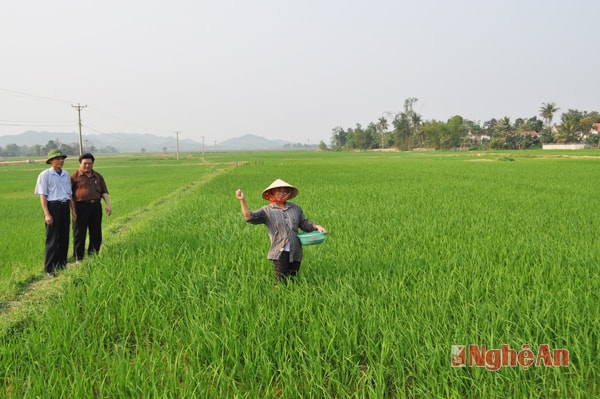 |
| Mr. Nghia surveys the "each household has its own plot" rice fields in Nghia Dong. |
The head of hamlets 5a and 5b, Hoang Van Loi, enthusiastically led us to the "One Plot Per Household" rice field in Tan Ky. Each plot in Tan Ky is at least 1,200 square meters, with the largest being one acre, and each household owns one plot. I was surprised that the villagers could accept having only one plot when some areas are higher and others lower. Hamlet head Hoang Van Loi explained: "The policy of land conversion has been discussed many times by the commune and hamlets, and the villagers are aware of it. However, they were worried that building a wide road through the fields would reduce the available land area, and how to ensure there are no longer high or low plots, and fairness between good and bad land. The hamlet is committed to ensuring they receive the same plot of land because there will be no more narrow embankments, saving them more land." Simultaneously, the Fatherland Front of the commune mobilized 8 mass organizations such as the Fatherland Front, Women's Union, Farmers' Association, Veterans' Association, Youth Union, etc., all concentrating on digging and filling for 3 consecutive days with 3,600 cubic meters of earth and a workforce of up to 1,700 people. Everyone was eager to go to the fields to build roads and renovate the rice paddies, creating a festive atmosphere.
Although the project was only for hamlets 5a and 5b, members from many other hamlets also participated following the commune's initiative. The commune even brought in machinery to level the land. Now, the main road has been successfully opened, the high ground has been leveled, and the fields are basically flat, with each household having only one plot. To ensure fairness, the commune allocated smaller plots for better quality land and larger plots for worse quality land, so no one is envious. Ms. Cao Thi Lien's plot in hamlet 5a was drawn by lot, measuring 2,000 square meters, and it wasn't very good. She said her family had to add several truckloads of topsoil, but now the rice is green, and she believes that next season, with finer soil, the rice will be very good. Mr. Loi's plot in hamlet 5a was 1 acre, contributed by several brothers to facilitate mechanized farming.
The success of land consolidation in Nghia Dong is perhaps "unprecedented," and the commune is now drawing lessons from it to replicate it on a larger scale. Chairman Ngo Xuan Nghia stated: "I think in just a few years, farmers in Tan Ky will be producing rice using a land consolidation method. Many families without labor will give up their land to families with labor, so I advocate for 'one house, one plot' so they can freely invest in machinery, fertilizers, and harvesting, making it convenient for them." Mr. Loi added that the success of land consolidation in hamlets 5a and 5b cannot be attributed solely to the commune's efforts; the commune mobilized people from the entire village to work continuously for three days.
Currently, Nghia Dong has achieved 16 out of 19 criteria for new rural development and is striving to complete the new rural development program by 2015. Nghia Dong no longer has thatched houses, and the average household income has reached over 18 million VND/person/year. The commune has established concentrated production areas such as: a 100-hectare farm area, a 350-hectare sugarcane area, an 80-hectare mulberry area, a 100-hectare grassland area, and a 350-hectare rice area. The commune has done a very good job of leveraging its internal resources to invest in infrastructure, roads, and a modern cultural center without any complaints. In 2012 and 2013, the province and district invested 2,046 tons of cement, which Nghia Dong fully utilized to build over 10 km of concrete roads and over 100 bridges and culverts of various types, worth over 7 billion VND, in just under two months. In 2014, the commune also used up all the cement provided by the province, totaling over 300 tons. Nghia Dong currently has 35 km of concrete roads out of a total of 56 km in the commune, and 100% of its hamlets have achieved the status of cultural villages. The hamlet cultural centers are also well-invested and built to a standard size. The commune has four schools that meet national standards, and one secondary school is under construction and has been awarded the title of Hero of Labor during the đổi mới (renovation) period. Each year, over 100 children from Nghia Dong graduate from universities and colleges.
Speaking about Chairman Ngo Xuan Nghia of Nghia Dong commune, Mr. Pham Van Hoa - Chairman of the Tan Ky District People's Committee - enthusiastically said: “Comrade Nghia is a leader with a broad vision. He, along with the Party Committee, departments, and organizations, has transformed Nghia Dong from an ordinary commune in the district into one of the most developed communes in Tan Ky district, preparing to achieve the new rural development goals. Comrade Nghia's contribution is evident in all of Nghia Dong's successes today. He was awarded a Certificate of Merit for being an outstanding commune chairman by the Provincial People's Committee.”
During his twenty years as Chairman of the commune, Ngo Xuan Nghia revitalized Nghia Dong, creating a vibrant atmosphere of emulation and fostering enthusiasm among the people in a new life where living standards were improved through the policies of the Party and the State, as well as grassroots initiatives.
Chau Lan


