
Agriculture, rural areas, and farmers – a safe haven for banks.
In the context of banks having excess liquidity and needing to release funds, many have now realized that rapid growth is unsustainable, so they have returned to operating in a slow but steady manner. And agriculture and rural areas are one of the sectors that banks are turning to, seeing it as a lifeline and a good solution to boost credit.
(Baonghean.vn) -In the context of banks having excess liquidity and needing to release funds, many have now realized that rapid growth is unsustainable, so they have returned to operating in a slow but steady manner. And agriculture and rural areas are one of the sectors that banks are turning to, seeing it as a lifeline and a good solution to boost credit.
Following the Nam Anh commune officials, we visited the farm of Mr. Nguyen Kim Chien and Ms. Le Thi Xuan in Hamlet 4, Nam Anh (Nam Dan district). Their integrated farming system (VAC), raising pigs and fish, was established in 1987, and for many years, the family has maintained a credit relationship with Agribank. Currently, they still owe about 200 million VND to invest in crops and livestock. Every time they earn money from selling pigs and fish, they use it to repay the bank loan and then take out a new one, ensuring they repay their debts on time every year.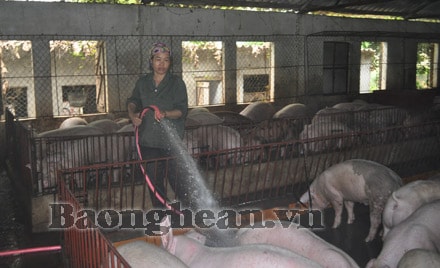
Ms. Le Thi Xuan's livestock farm is located in Hamlet 4, Nam Anh Commune, Nam Dan District.
Besides Mr. Chien's family, many other families, such as Mr. Nguyen Dinh Son in Hamlet 6, Nam Tan, who borrowed capital to build a farm, still have outstanding debt of 1.2 billion VND; Mr. Nguyen Quang Dai in Nam Xuan borrowed 1.7 billion VND to build a VAC (integrated farming) model… and have also achieved very effective results. Ms. Nguyen Thi Thuy, an officer at the Chua Market branch (Nam Dan) – who has nearly 20 years of experience working with local people – said: "The banks' expectation of injecting capital into agriculture and rural areas to ensure the completion of business plans is not without basis. Having worked in this area for many years, I find lending to the agricultural and rural sectors very safe and effective; especially recently, when farmers have learned to apply machinery and high technology to production, thus minimizing risks compared to when they were still heavily dependent on the weather."
While many credit institutions are facing inventory issues and low credit growth, many branches of the Agricultural Bank of Vietnam (Agribank) are experiencing strong and sustainable credit growth. Mr. Nguyen Sy Hien, Director of the Agribank branch in Nam Dan district, stated that as of March 31st, while the branch's deposits increased by 5.3% compared to the beginning of the year (reaching 747 billion VND), outstanding loans of 551 billion VND increased even more significantly, reaching 9.1%. Of this, loans for agriculture and rural areas amounted to 424 billion VND, accounting for 83% of total outstanding loans, mainly medium-term loans. The Agribank's lending capital effectively meets the needs of production, livestock farming, and service businesses, preventing capital shortages. The majority of people borrowing capital for production and livestock farming have achieved effective results, with no large outstanding debts.
While investment in non-agricultural sectors is currently facing many difficulties, even bad debts, the agricultural and rural sector is almost unaffected by Resolution 11. In agricultural production, diseases and fluctuating prices are unavoidable, but in those situations, we help our customers by extending repayment periods and investing more in farmers to give them a chance to recover production. With their hardworking and honest nature, farmers always keep their word to the bank. Unless there is a natural disaster causing crop failure and they are unable to repay on time, they repay their debts immediately after the harvest,” Mr. Hien shared.
While bank profits in Nghe An province decreased by three-quarters in 2012 compared to 2011, reaching 250,000 billion VND (compared to 1,000 billion VND in 2011), and credit growth did not meet targets, the Nghe An branch of the Agricultural Bank of Vietnam (Agribank) maintained very strong loan growth, achieving a figure that any credit institution would envy: 26%. Mr. Phan Hoang Vuong, Director of Agribank's Nghe An branch, stated that the non-performing loan ratio of all Agribank branches is below 1%, with many branches at only 0.5%. Previously, banks focused primarily on customers with large projects worth trillions of VND, but now commercial banks are paying attention to smaller loans with faster capital turnover.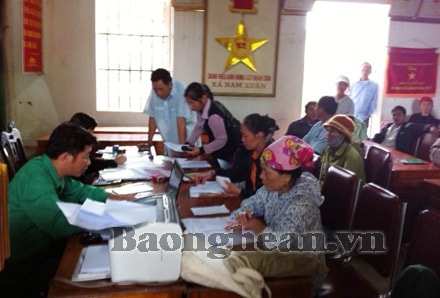
The Social Policy Bank disburses funds to poor households in Nam Xuan commune, Nam Dan district.
Mr. Nguyen Xuan Diep – Head of the General Department, State Bank of Vietnam, Nghe An Branch, said: The trend of credit flowing strongly into agriculture, rural areas, and farmers has increased sharply in the last two years because this is one of the priority areas of the Party and the State. This year, with the production and business situation not yet improved, many banks are directing credit towards agriculture and rural areas. Evidence of this is that in the first quarter of 2013, outstanding loans in the agricultural and rural sector of credit institutions in Nghe An reached VND 19,950 billion, accounting for 25% of total outstanding loans. This is a significant figure in the current difficult lending context. And currently, not only large banks like Agribank and BIDV but also some other commercial banks are increasing capital for this sector…
Mr. Le Van Tam, Director of the Phu Quy Investment and Development Bank, said that previously, the bank mainly focused on investing in infrastructure development, but recently, the unit has been promoting agriculture, rural areas, and farmers. By the end of the first quarter, BIDV Phu Quy's investment in agriculture and rural areas reached VND 158 billion out of a total outstanding loan balance of VND 1,100 billion. Compared to the same period last year, the outstanding loan balance in this sector increased by 41%.
Not only are banks boosting credit development, but many also consider this area a potential customer for capital mobilization. In fact, in recent years, savings mobilized from districts and rural areas have brought stability to banks, with very little risk of liquidity problems caused by mass withdrawals – a phenomenon that occurs quite frequently in urban areas. And at this point, not only Agribank but many other banks are reaching out to the people, viewing this as a reliable source for their deposit and lending activities. Nghe An is a large province, and agriculture and rural areas account for a significant proportion of its economic development; therefore, choosing this sector for exploitation and investment has been, is, and will continue to be an inevitable trend.
Thu Huyen


