
Strengthening the management of festival organization
(Baonghean) - Every year, Nghe An province has 25 licensed festivals held in 18 out of 21 districts, cities, and towns. State management of traditional festival activities is raising many issues. On the occasion of the Spring Festival, Nghe An Newspaper conducted an interview with Mr. Pham Tien Dung - Deputy Director of the Department of Culture, Sports and Tourism - regarding this issue.
(Baonghean) - Every year, Nghe An province has 25 licensed festivals held in 18 out of 21 districts, cities, and towns. State management of traditional festival activities is raising many issues. On the occasion of the Spring Festival, Nghe An Newspaper conducted an interview with Mr. Pham Tien Dung - Deputy Director of the Department of Culture, Sports and Tourism - regarding this issue.
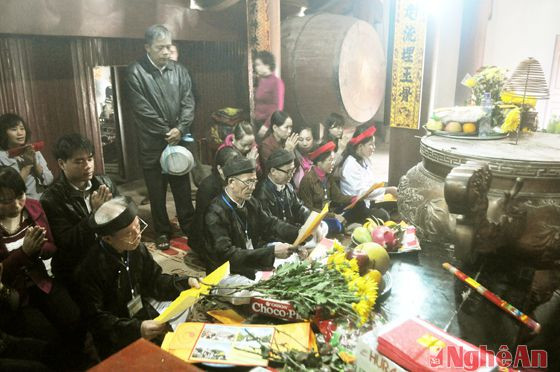 |
| Offering prayers at the beginning of the year at Cờn Temple (Quỳnh Phương Ward, Hoàng Mai Town). Photo: PV |
PV:As a province with many festivals taking place at the beginning of spring, could you please tell us about the Department of Culture, Sports and Tourism's plan for decentralizing the organization of festival activities in 2015?
Mr. Pham Tien Dung:At the beginning of the year, festival management was listed among the "hot" tasks, requiring relevant agencies to concentrate their efforts and resources, and to coordinate actively with the determination to minimize the negative aspects of the festivals. As the managing agency, from the beginning of December 2014, the Department of Culture, Sports and Tourism sent a document announcing the festival organization plan to all relevant levels.
Accordingly, in 2015, Nghe An province will host 25 festivals (including both traditional revolutionary and folk historical festivals), including: National and provincial-level festivals such as the Lang Sen Festival, associated with the birthday of beloved President Ho Chi Minh; District-level festivals including: the King Mai Temple Festival, the Van Loc Temple Festival, the Hang Bua Festival, the Corn Temple Festival, the Qua Son Temple Festival, the Nguyen Xi Temple Festival, the Duc Hoang Temple Festival, the Thanh Liet Temple Festival, the Bach Ma Temple Festival, the Lang Vac Festival, the Chin Gian Temple Festival, the Cuong Temple Festival, the Mon Son Luc Da Festival, the Cua Lo Tourism Festival, the Nguyen Canh Hoan Temple Festival, the "Drinking Water, Remembering the Source" Festival, the Hong Son Temple Festival, the Hoang Muoi Temple Festival, and the Van - Cua Rao Temple Festival. Commune-level festivals include: the Pan Pang - Nang Ny Festival, the Pu Nha Thau Festival, and the Cua - Nghi Khanh Temple Festival. In addition to the festivals mentioned above, our province also has many other festivals of various ethnic groups and localities. The Department requests the Provincial Center for Culture and Sports, the Management Board of Historical Sites and Scenic Spots, the General Museum, and the Soviet-Nghe Tinh Museum to provide professional guidance; and the Culture and Sports departments and centers of districts, cities, and towns to strictly implement the Law on Cultural Heritage and other regulations, decisions, and directives so that the 2015 festivals are conducted seriously, healthily, economically, and preserve the national cultural identity.
PV:So, what directives has the Department of Culture, Sports and Tourism issued regarding the management and organization of festivals, sir?
Mr. Pham Tien Dung:Recently, the management and organization of festivals have shown initial positive changes: overcrowding at some festivals has decreased; the phenomenon of chaotic stalls and aggressive soliciting of tourists has been reduced... At the start of the 2015 festival season, the Department of Culture, Sports and Tourism intensified its inspection and supervision efforts, coordinating with localities to ensure a safe festival season, contributing to the preservation and promotion of good traditional customs and practices. The Department coordinated with relevant units to implement the State Bank's directive requesting functional agencies to cooperate in inspecting and handling individuals and organizations that engage in the business of exchanging small denominations of money for personal gain. The Department also required festival organizers to strictly implement and prohibit the exchange of small denominations of money within historical sites. Drawing on lessons learned from previous festival seasons, starting in late 2014, the Department of Culture, Sports and Tourism proactively planned and directed localities with festival activities to effectively implement three requirements.
Firstly, all festivals must have serious, comprehensive, and focused scripts. Traditional festivals must ensure both the ceremonial and celebratory aspects, with priority given to reviving folk games and traditional sports that are unique to each region.
Secondly, standardize the ceremonial part: The chief officiant must be the Chairman or Vice Chairman of the People's Committee at the level organizing the festival; the ceremonial text must be written accurately, closely adhering to the theme, concise, and lasting approximately 15-20 minutes; the offerings must be placed according to requirements while still ensuring the characteristics of each festival.
Thirdly, strictly prohibit all forms of superstition, fortune-telling, and games with prizes that negatively impact the cultural and spiritual activities of the festival. Special attention should be paid to ensuring security and order, prohibiting the use of firecrackers, and maintaining a clean environment from the beginning to the end of the festival. To effectively address this issue, in addition to the involvement of local authorities, the Department, in coordination with the PA83 unit of the Provincial Police and relevant departments, established inspection teams along National Highways 7, 48, and 46, focusing primarily on districts with major festivals such as the Hoang Muoi Temple Festival (Hung Nguyen), Corn Temple Festival (Hoang Mai Town), Qua Son Temple Festival (Do Luong), Cuong Temple Festival (Dien Chau), Nguyen Xi Temple Festival (Nghi Loc), and the King Mai Festival (Nam Dan)... Each location has a team leader who is an official in charge of historical sites or cultural heritage, along with members responsible for inspecting everything from the script and activities of the ceremonies and festivities to visual propaganda and promotion. The aim is to mobilize social participation in festival management, ensuring that festivals belong to the people and fulfilling their spiritual and cultural needs.
PV:In recent years, despite many positive changes, problems such as fortune-telling, the widespread burning of votive paper, and placing small denominations of money on altars still persist, significantly affecting the identity of traditional festivals. As the managing agency, what specific solutions has the department implemented to address these issues, sir?
Mr. Pham Tien Dung:It can be affirmed that many festivals still openly exhibit unsightly activities such as gambling, fortune-telling, and card games; scenes of pilgrims crowding and jostling at places of worship, littering in the grounds of historical sites, placing money in inappropriate places; and persistent soliciting and harassment of visitors. To minimize these undesirable issues, first and foremost, local authorities need to strengthen public awareness campaigns through mass media to change people's perceptions and encourage them to be more conscious of protecting historical sites and ensuring hygiene. In particular, the management boards of historical sites where festivals take place need to strictly manage activities that take on distorted forms and severely punish violations. The Department of Culture, Sports and Tourism has assigned the Provincial Culture and Sports Center and the Management Board of Historical Sites and Scenic Spots to conduct training on festival management for cultural heritage officials and temple/pagoda management boards. Simultaneously, inter-agency inspection teams have been established, assigning supervisors to historical sites along specific routes. Local authorities are required to strictly prohibit these practices; violations will be handled by the inter-agency inspection team of the Department in accordance with the Provincial People's Committee's decision on implementing civilized lifestyles in weddings, funerals, and festivals.
Besides that, the most important thing is to educate the people about the meaning of the festival, thereby raising the awareness and responsibility of the community and each individual when attending each festival.
PV:Thank you, sir!
Thanh Thuy(Perform)


