
Strengthening the management of private pharmacies.
(Baonghean) - In recent years, the network of private pharmaceutical establishments in the province has developed rapidly. Currently, the province has 1,400 pharmaceutical establishments (including 69 limited liability companies and pharmaceutical branches; 165 pharmacies; and 1,176 drug counters and agencies), an increase of 115 establishments compared to 2013. Private medical and pharmaceutical activities have facilitated access to healthcare services for patients, especially in rural and mountainous areas. However, violations such as selling drugs without prescriptions, not displaying prices, and operating without licenses are still quite common.
There are still many violations.
Modern medicines are a special type of commodity, and their purchase and sale are specifically regulated by the authorities. However, a survey of several pharmacies on Nguyen Sy Sach, Ton That Tung, and Tue Tinh streets (Vinh City) revealed that buying and selling without a doctor's prescription is quite common. This practice stems partly from the habit of many people who, when suffering from common illnesses, self-medicate without consulting a doctor or following a doctor's instructions.
Mr. Le Duc (from Tan Tien block - Hung Dung ward) said: "I suffer from chronic sinusitis, so every time the weather changes, my nose acts up. Because I'm used to the condition, each time it happens, I just go to my usual pharmacy to buy medicine, instead of going to the doctor, which costs extra." Some young mothers also buy antibiotics on their own when their children are sick. This habit of self-medicating has made the sale of over-the-counter drugs an "incurable disease."
According to Decision 04/2008/BYT of the Ministry of Health on "Regulations on Prescribing Medications in Outpatient Treatment," the list of prescription drugs includes: narcotic drugs, psychotropic drugs, gout medications, antibiotics, tuberculosis medications, malaria medications, asthma medications, etc. These types of drugs are only allowed to be sold when the patient has a doctor's prescription. Despite this regulation, in reality, many prescription drugs are still easily bought and sold without a doctor's prescription.
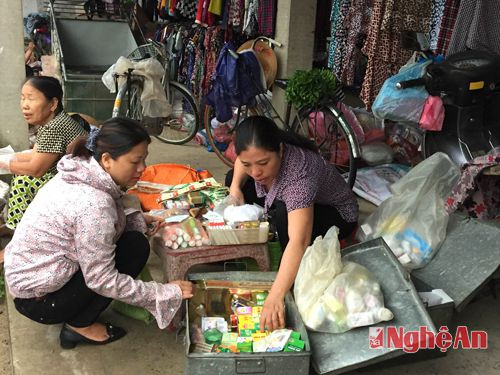 |
| Western medicines are sold at Do Market, Nam Cuong commune (Nam Dan district). |
One of the fairly common violations by private pharmacies is the failure to list prices or to comply with price listing regulations. Expected to help patients buy medicine at the correct price, the retail price listing regulation has become practically useless after many years of implementation. Joint Circular No. 50/2011/TTLT-BYT-BTC-BCT stipulates that retail pharmacies must list the retail price of each type of medicine by printing, writing, or affixing the retail price on the medicine's packaging or outer packaging, ensuring that the content of the original label is not obscured and that the medicine is not sold at a price higher than the listed price. However, inspections have revealed that many pharmacies, drugstores, and retail agents still do not comply with this regulation, with continuously increasing drug prices and varying prices from place to place.
Western medicine is a conditional business; sellers must have professional qualifications and are only allowed to trade and sell under the strict management of relevant authorities. However, in reality, in some rural markets, many stalls are openly selling Western medicines as if they were ordinary consumer goods. At the end of June, we visited Do Market (Nam Cuong commune - Nam Dan district), where there were three active medicine stalls. A variety of Western medicines were displayed on wooden tables and plastic trays. When we approached one stall to buy medicine for a child with a cough and high fever, the vendor quickly packaged three doses of Bao Thanh cough syrup, Amoxicillin 250g, and Hapacol, charging 42,000 VND without further instructions. When asked when to take the medicine, the vendor curtly replied, "It can be taken before or after meals." People in this rural area often choose to buy cheap medicine, so they don't pay much attention to whether the quality is guaranteed.
Violations of regulations by private pharmacies have been quite common recently. In 2014, the Inspectorate of the Department of Health inspected 540 private pharmacies, discovering 39 establishments violating regulations by operating without the necessary licenses, and 37 establishments were fined administratively. In the first five months of 2015, 229 establishments were inspected, with 37 establishments receiving administrative penalties. Most recently, on June 9, 2015, the inter-agency inspection team for medical and pharmaceutical practices in Vinh City conducted an inspection and discovered three pharmacies operating without professional practice certificates, without operating licenses from the Department of Health, without business licenses, and with the owners absent. The inter-agency inspection team for private medical and pharmaceutical practices in Vinh City issued a report and ordered the closure of Luong Thang Pharmacy at 134B Nguyen Thiep Street. The Nguyen Ngoc Hoa pharmacy at 280 Tran Phu Street and the pharmacy at 309 Le Duan Street are located in Trung Do Ward.
Currently, private pharmacies are mainly violating regulations by: not having a certificate of eligibility to conduct pharmaceutical business and not having a professional practice certificate (or the certificate has expired); not displaying drug prices or displaying incomplete drug prices; selling drugs without a prescription; and conducting pharmaceutical business without the required signage…
Difficult to rectify
Violations are readily apparent, but rectifying the situation and ensuring that these establishments operate within the proper framework remains a challenging problem. Ms. Pham Thi Hai, Head of the Health Department of Nam Dan District, acknowledged that despite regular public awareness campaigns through the media and annual inter-agency inspections, violations remain quite common. Currently, out of 143 establishments in Nam Dan District engaged in the business of selling medicine, traditional Chinese medicine, and herbal remedies, 72 still operate without licenses. The difficulty lies in the fact that the owners of these establishments often evade inspection; when inspectors arrive, their shops close, and stalls in markets quickly pack up, resuming sales as soon as the inspection team leaves. Furthermore, another problem is that private pharmacies in rural areas mainly operate on a small scale, so even after a fine is imposed, these establishments often lack the funds to pay. This is a common difficulty in many localities.
According to Mr. Le Hong Linh, Head of the Private Medical and Pharmaceutical Practice Management Department of the Provincial Department of Health, many shortcomings still exist in the management of pharmaceutical practice establishments: many localities have not yet taken action, considering the management of medical and pharmaceutical practice as the responsibility of the health sector. The awareness of practitioners is not high, and they do not regularly update their professional knowledge. A large number of graduates from colleges and vocational schools in medicine and pharmacy enter the workforce each year, but after graduation, many cannot find jobs at medical facilities and open their own practice establishments to make a living, but they do not meet the requirements for licensing, leading to illegal practice. The geographical area is vast, and the inspection and management personnel of the sector are insufficient.
Regarding the discussion on rectifying the situation of pharmaceutical establishments operating illegally, Mr. Le Hong Linh added that the department will continue to implement annual training activities for establishments practicing medicine and pharmacy in the province, while also issuing certificates and licenses for medical and pharmaceutical practice in accordance with the law. Furthermore, it will strengthen inspection and supervision of these activities, and strictly handle violations according to the law. The department is also advising the Provincial People's Committee to issue a directive to strengthen the management of non-public medical and pharmaceutical practices in Nghe An province (to assign responsibility for managing private medical and pharmaceutical practices to district-level People's Committees and relevant departments).
Another solution is to strengthen communication and raise awareness among the people, especially those in remote areas, about healthcare, how to recognize and use medicine correctly, and how to choose medical facilities and services that comply with regulations, ensuring high effectiveness and safety.
Ngoc Anh - Dinh Nguyet
| According to Government Decree 176/2013, the penalties for establishments operating without a license are between 50 and 70 million VND, and for practitioners without a professional certificate, the fine ranges from 30 to 40 million VND. Retail pharmacies selling expired medicine (whether 1 or 10 tablets) are fined between 10 and 20 million VND, while wholesale pharmacies are fined between 40 and 50 million VND. |


