
Creating opportunities for young people to contribute and grow.
(Baonghean) - On October 16th, in Vinh City, the Nghe An Provincial Council for the Selection of Young Intellectuals held interviews with 76 candidates...
(Baonghean)On October 16th, in Vinh City, the Nghe An Provincial Council for the Selection of Young Intellectuals held interviews with 76 candidates to select 26 young intellectuals to serve as vice chairmen of the People's Committees of poor communes in the province. A reporter from Nghe An Newspaper interviewed Mr. Vu Dang Minh, Director of the Youth Affairs Department of the Ministry of Interior and Director of the Project Management Board.
PV:Could you explain why the Prime Minister has adjusted the timeline for selecting, training, and assigning young intellectuals to serve as vice chairmen of commune People's Committees in 62 poor districts nationwide?
Mr. Vu Dang Minh:According to Decision No. 170 QD-TTG dated January 26, 2011, of the Prime Minister, the pilot project to select 600 outstanding young intellectuals with university degrees to serve as vice chairmen of commune People's Committees in 62 poor districts is divided into two phases. Phase 1 involves pilot implementation in five provinces: Cao Bang, Dien Bien, Nghe An, Quang Ngai, and Kon Tum; Phase 2, from after 2013 to 2020, will be implemented comprehensively in the remaining communes within the project's scope.
However, during the project implementation, we realized that selecting a project team member required significant effort from numerous agencies and departments at both the central and local levels, involving many stages from publicity and application processing to organizing application review and conducting direct interviews to select those who met the criteria and conditions for participation. A two-stage selection process would be costly and time-consuming due to the repetition of procedures and methods. Furthermore, if the old two-stage approach were followed, the last person to be assigned to a commune would be in 2014. Thus, project team members selected in stage 2 would need to serve through two terms of the commune People's Council to complete the required five years of service. Given this reality, we decided to simultaneously implement the project in all 62 provinces and cities at the same time.
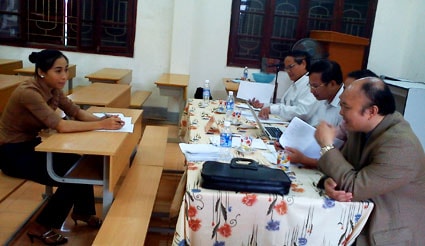
Mr. Vu Dang Minh (far left) during the interview.
at the Tuong Duong District Examination Council
PV:Could you please give your assessment of the preparations made by the Nghe An Provincial Council for the Selection of Young Intellectuals?
Mr. Vu Dang Minh:Nghe An is one of the five provinces selected for the pilot project. The province's preparation was relatively good, ensuring transparency, objectivity, and adherence to the law. The Provincial Party Committee, the Provincial People's Committee, and relevant departments and agencies paid close attention and created favorable conditions for the project's smooth implementation. All steps and stages were carried out according to the procedures, regulations, and guidelines of the Government and the Ministry of Interior. A very positive aspect is that Nghe An has a large number of young intellectuals registering to participate in the project (126 applications), most of whom have a formal university degree with good or excellent grades, and many are from ethnic minority groups. The fields of study are also relevant to the current practical needs of poor communes, especially in agriculture, forestry, fisheries, irrigation, and law. This demonstrates Nghe An's abundant human resources.
PV:Having observed the in-person interviews, what are your observations regarding the quality of young intellectual candidates in Nghe An?
Mr. Vu Dang Minh:The quality of young intellectual candidates in Nghe An is better than in other provinces, in terms of appearance, ability, qualifications, thinking skills, and interpersonal skills. Importantly, they all demonstrate high confidence and determination. Some even boldly submitted their applications directly to the Ministry of Interior. With a large number of candidates (76 applications) and having gone through the preliminary screening process, the level of qualifications is relatively uniform. Therefore, the "race" to select 26 candidates to reinforce 26 poor communes in the three districts of Tuong Duong, Ky Son, and Que Phong will be very difficult. The selection committee must work on the principle of "choosing the best from a bad bunch," ensuring objectivity and fairness.
In addition to the prescribed priority criteria, the selection process should consider the outstanding qualities of each individual. First, a willingness to work closely with the people, a spirit of daring to think, act, and take responsibility, and a willingness to overcome difficulties and hardships are essential. Second, priority should be given to those with leadership qualities, strong analytical and methodological skills, creativity, and keen insight. Furthermore, they must be individuals who know how to listen to the grassroots, especially ethnic minorities. Young intellectuals must define themselves accordingly.Participating in the Project is not for personal gain, but to volunteer our talents and youthful energy to help our compatriots in remote areas, contributing to local development of production and improving their material and spiritual lives.
PV:Experience is a weakness and a shortcoming of the young intellectuals participating in the project. So, after the selection process, what will the Ministry of Interior do to support these young intellectuals in successfully fulfilling their positions at the grassroots level?
Mr. Vu Dang Minh:After the selection process is complete and the People's Committees of the provinces have made official decisions, the Ministry of Interior will organize a three-month training course for young intellectuals on eight topics related to state management at the commune level and 15 essential skills and methods for a management official, such as planning skills, organizing and conducting meetings, receiving citizens, and resolving complaints and denunciations. Currently, the Ministry is assigning relevant agencies to compile a handbook, including questions and answers on related issues and potential situations, to serve as a bedside guide for young intellectuals. On the other hand, the young people themselves must independently research, study, listen attentively, and learn from the experiences of their predecessors in order to successfully complete their tasks.
PV:There are currently many concerns about the career prospects of young intellectuals five years after the project ends. What are your thoughts on this issue?
Mr. Vu Dang Minh:There are two options here. First, if after the project ends, the team members wish to stay and the locality has a need and the team members' abilities meet the requirements, the commune Party committee and government will continue to plan for them to fill vacant positions in the commune or consider transferring them to civil servant positions at the district People's Committee where they volunteered. If the commune or district People's Committee cannot provide a job, they will report to the Provincial People's Committee for consideration of transferring them to civil servant positions if they meet the conditions and standards as stipulated in Clause 2, Article 62 of the Law on Cadres and Civil Servants. If the local Party committee and government where they work cannot provide jobs for the project team members, the Provincial People's Committee in the poor district will report to the Ministry of Interior (through the Central Project Management Board) to coordinate with civil servant management agencies to organize recruitment according to the law. To do this well, the local Party committees and governments from the province to the grassroots level need to have a specific roadmap and personnel plan to ensure employment for young intellectuals. If project members do not wish to stay, there must be an open mechanism to create opportunities for their development and advancement. Furthermore, the project has an open principle: young intellectuals working for five years, if they perform exceptionally well, may be transferred or appointed to higher leadership positions by competent state agencies after three years. This also serves as motivation for young intellectuals to strive and is an opportunity for all those who aspire to advance. The important thing is to give them a chance to experience, prove themselves, and grow in practice; whether they succeed or not depends on their abilities and efforts.
PV:Thank you, sir.
Khanh Ly - My Ha (Produced)


