Creating momentum to improve the quality of medical examination and treatment.
(Baonghean) - During the implementation of the Health Insurance Law, several shortcomings have arisen, affecting the quality of medical examination and treatment for people in the area... The amended and supplemented Health Insurance Law, recently passed by the National Assembly, will be a "lever" to create momentum to improve the quality of medical examination and treatment and healthcare for the people even better...
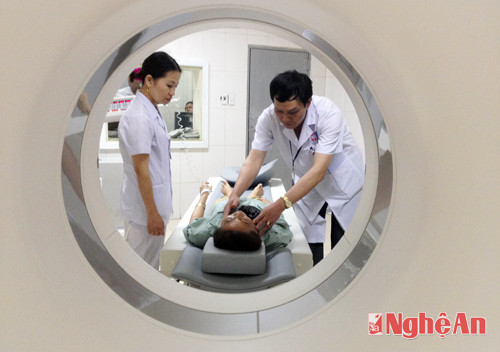 |
| Diagnosis of the disease was made using a 64-slice CT scanner at Nghe An Oncology Hospital. |
In Nghe An province, 2,118,159 people have been issued health insurance cards, accounting for over 70.7% of the population. The number of people participating in health insurance increases annually, creating a solid foundation for the goal of sustainable health insurance development, moving towards universal health insurance. The rights of health insurance participants are basically guaranteed according to regulations, and the quality of medical services is constantly improving. The number of people accessing and receiving healthcare from the health insurance fund right in their communities and many other medical services is increasing. However, alongside the achievements, the amended and supplemented Health Insurance Law and its implementation still reveal some shortcomings and problems, causing the quality of medical services and the rights of health insurance participants to not meet expectations.
Ms. Nguyen Thi Hoai, 39 years old, residing in Nghi Loc district, received treatment at K Hospital in Hanoi for 5 years before returning to Nghe An Oncology Hospital for 1 year. She underwent radiotherapy at Nghe An Oncology Hospital and is currently receiving outpatient treatment. Ms. Hoai expressed her confusion: "Previously, while being treated at K Hospital in Hanoi, I saw outpatients receiving 15 ampoules of Aslem immune-boosting injections per month. But at Nghe An Oncology Hospital, I haven't received any. When I asked the doctors and nurses here, they replied, 'Health insurance doesn't cover it, so we don't provide it.' K Hospital in Hanoi is covered by health insurance, so why isn't Nghe An Oncology Hospital?"
In a conversation with Dr. Pham Vinh Hung, Deputy Director of Nghe An Oncology Hospital, it was learned that not only Aslem, a medication dispensed on outpatients, but also many other inpatient treatment support medications are not reimbursed and therefore cannot be used for patients. Dr. Hung himself does not understand why these medications are reimbursed at K Hospital in Hanoi but not at Nghe An Oncology Hospital.
Dr. Pham Vinh Hung stated: To improve the quality of medical examination and treatment, Nghe An Oncology Hospital mobilized social resources to purchase a 64-slice CT scanner worth 25 billion VND, the most modern in the Central region. The equipment was installed immediately after the Ministry of Health's Circular dated April 11, 2013, regarding some difficulties in implementing Joint Circular No. 04, which clearly stated: "In cases where a unit only has machines with 64-128 slices and does not have machines with fewer than 32 slices, to meet diagnostic needs and ensure the rights of patients with health insurance cards, when a scan is ordered according to professional requirements, it will still be reimbursed at the price of the approved machine." However, upon use, only the Social Insurance Fund reimbursed the cost for the 32-slice machine (the Central Hospital charged 2.1 million VND per scan, while the Provincial Oncology Hospital proposed 1.5 million VND per scan). It wasn't until January 2014 that some cases of 64-slice CT scans were reimbursed at the proposed price, while others were still reimbursed at the price of the 32-slice machine… This kind of reimbursement by health insurance discourages investors, and people are not yet able to access high-tech medical services.
The current implementation of the Health Insurance Law and the Health Insurance system are revealing many shortcomings, one of which is the tiered system for medical examination and treatment. While this tiered system aims to reduce the number of patients at certain medical facilities, thus preventing overcrowding, it inadvertently creates many difficulties and obstacles for patients participating in health insurance. Specifically, patients with health insurance cards have to go through a lengthy and circuitous referral process, preventing them from directly accessing the hospital they need treatment at the moment. This wastes patients' time, impacts their finances, and, more importantly, prevents them from accessing effective treatment therapies in a timely manner, potentially negatively affecting their health. Furthermore, this tiered system creates a barrier to development and discourages the improvement of medical examination and treatment quality among medical facilities due to a lack of competition, and also leads to patient retention.
The pricing of medical technical services is currently inconsistent. For example, an appendectomy performed at a central-level hospital is reimbursed at a higher rate than at a provincial-level hospital, and vice versa, even though all hospitals perform the same procedure and use the same consumables. This disparity in reimbursement discourages units from developing their techniques and acquiring the expertise of higher-level facilities; lower-level units are hesitant to invest in personnel and equipment to alleviate the burden on higher-level hospitals…
Health insurance supports people in treating illnesses and receiving healthcare, but to make this policy even better, certain changes are needed to make it more suitable so that everyone can enjoy a more complete coverage. Dr. Nguyen Hoai Nam, Director of the Nghe An Orthopedic and Trauma Hospital, suggested that the law and implementing policies should clearly define the time when health insurance coverage is calculated for patients. Currently, we only calculate payments from the moment a patient arrives at the hospital; ideally, it should be calculated from the moment the patient begins needing medical care until the end of treatment and return home. Only then will health insurance be more comprehensive and humane.
The shortcomings and deficiencies of the Health Insurance Law and its implementation have been and are being rectified and amended, aiming for greater perfection and benefiting the people. The recently passed amended and supplemented Health Insurance Law includes many groundbreaking points that overcome the limitations of the current law. Specifically, these include: encouraging participation in health insurance by household, expanding the scope of health insurance benefits and medical coverage levels, opening up access to health insurance-covered medical examination and treatment services, and specifying regulations on the management and use of the health insurance fund… The opening up of access to health insurance-covered medical examination and treatment services has created maximum convenience for health insurance participants in accessing medical services. From January 1, 2016, access to health insurance-covered medical examination and treatment services will be opened between commune and district levels within the same province. Access to health insurance-covered medical examination and treatment services will also be opened to provincial and central levels nationwide for people from poor households and ethnic minorities living in areas with difficult or extremely difficult socio-economic conditions.
Dr. Bui Dinh Long, Director of the Nghe An Department of Health, affirmed: "In parallel with the law-making process, while awaiting further amendments, we need to implement solutions to improve the quality of health insurance medical examinations and treatments, reform administrative procedures, improve the health insurance payment process, and manage and utilize the health insurance fund effectively; strengthen inter-sectoral coordination, coordination between the Department of Health and the provincial Social Insurance agency, and between the Social Insurance agency and medical facilities… Only then can the goal of universal health insurance be successfully achieved, and health insurance will create momentum for the quality of medical examinations, treatments, and healthcare for the people to continuously improve."
Thanh Son - Tu Thanh