
Creating momentum for industrial breakthroughs.
(Baonghean) - Resolution No. 26-NQ/TW dated July 30, 2013, on the direction and tasks for the development of Nghe An province until 2020, opens up the direction and conditions for Nghe An to strive to become a relatively prosperous province in the Northern region by 2015, creating a basis for it to basically become an industrial province by 2020.
A dramatic shift
Over the past nine months, Cua Lo port handled more than 2 million tons of goods, a 4% increase compared to the same period last year; the total volume of goods handled reached over 4 million tons, a 28% increase. The enterprise safely received and unloaded 583 vessels entering and leaving the port for cargo handling.
Some items achieved significant production volumes, such as coal, which doubled due to increased coal supply to Vissai cement factories; and iron, steel, and equipment, which increased by 2% due to increased equipment shipments from China to Laos and increased demand from Song Lam Cement Factory, thus boosting overall cargo throughput.
Mr. Tran Van Dat, Deputy General Director of Nghe Tinh Port Joint Stock Company and Director of Cua Lo Loading and Unloading Enterprise, said: "In addition, container cargo volume has increased by shipping lines, which have continuously added new vessels. Furthermore, Cua Lo Loading and Unloading Enterprise has strengthened its efforts in ship clearance and arranged ship entry and exit schedules efficiently, resulting in a 15% increase in cargo throughput at the port…"
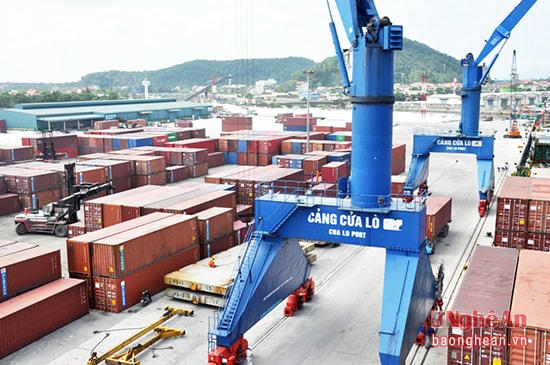 |
| Unloading cargo at Cua Lo port. |
Mr. Hoang Van Tam, Director of the Department of Industry and Trade, said: "In recent times, the Government has issued mechanisms and policies and directed ministries and sectors to coordinate and create conditions to help Nghe An implement many planning projects and attract a number of important industrial investment programs and projects. Many newly invested projects and factories have started operating and have initially shown effectiveness, creating a basis for accelerating industrial production value in the province."
In the first 10 months of 2016, the industrial production index in Nghe An province increased by 9.46% compared to the same period in 2015. One of the key investment projects that yielded good results and was highly anticipated was the Hoa Sen steel sheet manufacturing plant, a national brand (Hoa Sen Co., Ltd.). Located in Dong Hoi Industrial Park (Hoang Mai town), after a short period of rapid investment, construction, and machinery assembly, on June 4, 2016, the Hoa Sen plant's NOF coating line with a capacity of 400,000 tons/year went into operation, producing its first products. Shortly after, the color coating line with a capacity of 120,000 tons/year was also put into operation; The slitting line has a capacity of 100,000 tons/year, the steel pipe line has a capacity of 60,000 tons/year, and one line that started operating on June 30, 2016, will all be operational and producing products on July 3, 2017.
Mr. Pham Tien Phuong, Deputy Director of Internal Affairs at the company, said: "It is expected that by the end of 2016, the factory will produce products from the rust removal line. Around June 2017, we will produce products from the cold rolling line. After these two lines become operational, the factory will be completely self-sufficient in terms of raw materials."
Over the past years, despite the continued impact of economic recession, capital constraints, and a shrinking market, the province's industrial production has grown impressively, making a significant contribution to the province's overall economic growth. The industrial production index has steadily increased over the years, with an 8.3% increase in 2013, a 9.38% increase in 2014, and a 9.7% increase in 2015. Specifically: The manufacturing industry grew by an average of 12.84%, contributing the highest growth rate to the entire industrial sector; the mining industry increased by 0.79%; electricity production and distribution increased by 23.56%; and wastewater and waste treatment increased by 12.03%.
With a stable scale and growth rate of production value, during the three years of implementing Resolution 26 of the Politburo, the province has attracted a number of important investment projects in various fields: processing of agricultural, forestry, and aquatic products; food and beverages; building materials; garment manufacturing, etc. Among these, cement is considered a major breakthrough; projects such as Hoa Sen Steel, Royal Foods, Massan, etc., exceeded expectations.
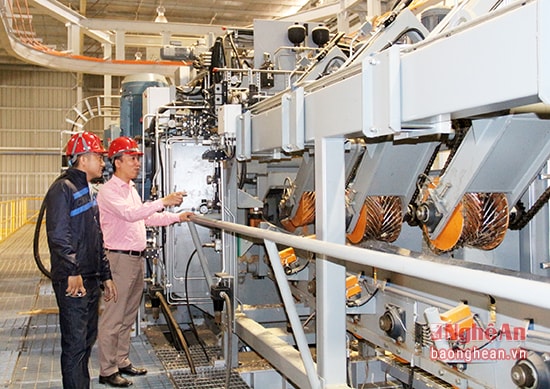 |
| Manufactured at the Wood Processing and MDF Fiberboard Factory (Nghia Dan). |
Industrial production in the recent period has grown at a rate higher than the national and regional average. Several products that account for a large proportion of the province's industrial production value, such as electricity production, flour, export garments, various types of yarn, cement, and non-fired bricks, have met or exceeded the targets set in the resolution.
Nghe An has achieved success in attracting investment in the industrial sector, including large-scale projects with high registered capital that have a strong impact on the province's economy (VSIP Nghe An project worth US$76.4 million; TH True Milk fresh milk processing plant; a project producing laminated wood and MDF boards with a capacity of 130,000 m3/year; Hoa Sen Dong Hoi project with an investment of VND 7,000 billion; Quynh Lap 1 Thermal Power Plant project with an investment of US$2.2 billion; Song Lam and Song Lam 2 cement projects of The Vissai Group; Hoang Mai 2 cement project of Vicem Vietnam Cement Corporation; Royal Food processing plant,...) which are extremely important prerequisites for promoting the image and attracting other corporations to invest in Nghe An.
We need long-term development solutions.
The achievements and experiences in developing various sectors, the effective implementation of completed projects from the previous term, and the trend of shifting resources related to Nghe An's geoeconomic position have positively impacted the prospects for industrial development in Nghe An, creating an important foundation for achieving the goals and tasks set out in the resolution.
Industrial development resources such as minerals, forest products, land, and human resources have been reviewed, planned, and exploited increasingly rationally. Infrastructure such as transportation, seaports, airports, economic zones, industrial parks, and industrial clusters have received investment, creating favorable conditions to attract industrial projects.
The North Central region is experiencing strong new development drivers (especially in Nghi Son - Thanh Hoa and Vung Ang - Ha Tinh), creating momentum for a shift to a new level of development, forming a clear trend of linkage and diffusion, and providing opportunities for Nghe An's industrial sector to attract many investment projects.
Furthermore, the province has considerable potential for industrial development: planted forest resources, mineral resources, land available for industrial development, and a workforce currently experiencing a "golden age" of demographic structure. The growing awareness of the role of industry in socio-economic development, along with the consensus and determination from leaders at all levels, from various sectors to localities, are crucial factors in successfully achieving the goals set forth in the resolution.
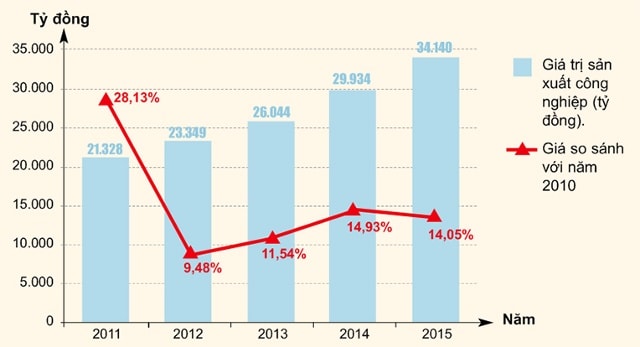 |
| Industrial production value of Nghe An province during the period 2011 - 2015. Graphic: Huu Quan |
Faced with both opportunities and challenges, the Ministry of Industry and Trade and related departments and agencies have developed a "scenario" to strengthen long-term, sustainable solutions for industrial development, ensuring the objectives set out in Resolution 26 are met. This includes reviewing, developing, supplementing, and adjusting programs, projects, and plans, and improving the efficiency of their implementation. A plan for the development of supporting industries will be developed based on selecting several sectors suitable to the province's actual capabilities to create domestic sources of raw materials and components, gradually reducing imports and creating a proactive approach in industrial development.
Identifying the development of supporting industries as a long-term strategic goal and in line with current trends, the province will build a list of supporting industry projects to be included in its annual investment promotion program. Research will be conducted to advise the Provincial People's Committee on the issuance of policies for the development of the supporting industry sector. Regulations will be established regarding the procedures for confirming incentives and post-incentive verification for projects producing supporting industrial products included in the list of priority supporting industrial products.
During the discussion, Mr. Hoang Van Tam, Director of the Department of Industry and Trade, stated that industrial development requires large investment capital, and attracting investment projects demands meeting many criteria regarding input raw materials, convenient transportation, large consumer market size, infrastructure, land, etc.
Therefore, in addition to specific solutions regarding processing industries, minerals, and traditional crafts, the sector has proposed operational solutions to achieve the highest efficiency. These include improving the quality of investment promotion and facilitation, and innovating the preparation, acceptance, and implementation of projects.
Implementing strong administrative reforms to create an attractive investment environment and space involves the synchronized implementation of eight groups of solutions approved by the Provincial Party Standing Committee, aiming to improve the Provincial Competitiveness Index (PCI) to prepare for the influx of foreign investment after Vietnam signs free trade agreements. In addition, strengthening support for businesses participating in trade promotion activities, market research, and improving the effectiveness of trade promotion through electronic information will be prioritized. The task of supporting businesses will be effectively carried out; coordination among sectors will be strengthened to inspect the implementation of environmental protection and food safety and hygiene in industrial parks, clusters, and secondary industrial projects.
Thu Huyen


