
Making history more engaging for students.
Results from high school graduation exams, university and college entrance exams, sociological surveys, and public opinion reveal that the younger generation's understanding of history remains very limited. This sad truth has caused widespread concern and anxiety throughout society. What are the causes? How can we change the current state of history teaching and learning? These are questions that many people are interested in.
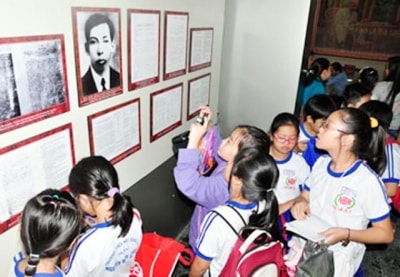 |
| Vietnam-Algeria Junior High School (Hanoi) teaches History to students using projectors, while also requiring students to collect images and materials related to the subject. In the photo: Students learn about various historical figures of Vietnam at the museum. Photo: MINH CHAU |
Results from high school graduation exams, university and college entrance exams, sociological surveys, and public opinion reveal that the younger generation's understanding of history remains very limited. This sad truth has caused widespread concern and anxiety throughout society. What are the causes? How can we change the current state of history teaching and learning? These are questions that many people are interested in.
In the field of education, History in secondary schools has played a significant role in fostering national pride, patriotism, and responsibility among young people towards the development of the country. Many dedicated teachers have consistently innovated their teaching methods, contributing to enhancing the subject's appeal and incorporating local history into the secondary school curriculum.
In the national history competitions for gifted students, many students achieve high results and are directly admitted to universities and colleges, or go abroad to study in their chosen field. To encourage and motivate teachers and students to participate in the national history competition for gifted students, the Vietnam Historical Association organized a ceremony to honor and award prizes at the Temple of Literature in April 2012... But why do most students dislike history, considering it a secondary subject with dry and boring events and dates?
Most historians, experts, teachers, parents, and students recognize that the main reasons why students dislike studying History are related to the curriculum and textbooks; teaching and learning methods; teacher training and development; and assessment.
Although the history curriculum and textbooks in secondary schools have undergone many changes, they remain cumbersome and full of events, years, and months. The current history curriculum is structured according to the principle of "concentric and linear" from primary to high school. Therefore, knowledge is repeated in textbooks, making it boring for both teachers and students. For example, primary school students currently learn history through a general history format. This is unsuitable for primary school students; a lighter history education program is needed, incorporating historical stories, historical figures, and field trips.
High school history textbooks are academic in nature, not engaging for students, and contain scattered and heavy information. This forces students to memorize too much information without being able to synthesize or generalize the fundamental issues. Furthermore, according to regulations from the Ministry of Education and Training and provincial education departments, high schools only allocate one to two lessons per week for teaching history from textbooks. With such limited time, it is difficult for history to be taught effectively, to synthesize information, to develop students' thinking, and for schools to conduct field trips and excursions.
Although teachers have received basic training and are committed to improving their professional skills, they still often use traditional teaching techniques and methods (teacher reads - students copy), and investment in teaching with projectors and visual aids remains limited. Furthermore, in remote and disadvantaged areas, economic conditions are still difficult, and there is a shortage of teachers and equipment for teaching History. In their studies, there is a tendency for students to focus on natural sciences, neglecting social sciences.
To foster student interest in learning History, many experts recommend that relevant authorities implement the following two measures: Firstly, reforming assessment methods and exam question design. This is a breakthrough in the reform of History education in high schools. While not a new issue, it is a crucial factor in ensuring students enjoy learning History in the future. Assessment methods and exam question design should be diverse, innovative, and promote students' abilities, creativity, application of knowledge, self-learning, and the evaluation of the learning process. Assessment should involve multiple participants and ensure fairness and accuracy.
Secondly, each teacher has a different way of teaching History. And each student at each age also has a different approach. History becomes a rich, diverse, and engaging subject. It would be a mistake to think that History is a subject that doesn't require creativity. The content of the current History textbook curriculum is prescriptive, considered a "mandate," lacking the arguments and guidance needed to help students feel they are acquiring new knowledge and discovering scientific truth.
Textbooks should be viewed as reference materials, a collection of carefully selected information that students can use to explore and decipher history. In reality, many teachers today want to be creative in their teaching methods, but they are constrained by the old-fashioned teacher evaluation system (especially during tests and demonstration lessons). Each lesson is evaluated according to the following criteria: results, methods, time, presentation on the board, connections to real-world situations, classroom atmosphere, etc.
Therefore, both teachers and students will be limited in the way they transmit and receive knowledge, making lessons burdensome and uninteresting. Perhaps the evaluation of a teacher's lesson should be based on its effectiveness through the results achieved by the students. History lessons need to be transformed into a creative and engaging intellectual playground.
To enable students to explore history in an engaging and effective way, schools and teachers need to be empowered with autonomy over "what to teach and how to teach." Each teacher is a rich "educational practice" where learning history is a process of discovery, deciphering, and reflecting on the past through historical sources, thereby shaping the character, qualities, and abilities of the learners.
Students become "mini-historians" instead of "machines" for memorizing events and making judgments. The Ministry of Education and Training should implement a "one framework program - multiple textbooks" to empower schools and teachers with autonomy and creativity. Once teachers are empowered with autonomy and creativity, the quality of history education will improve.
According to NDĐT


