
Táo Quân 2013: A whole year compressed into 3 hours!
The first filming night of the Tet Comedy Show (January 25, 2013) took place when there was only one week and one day left before the Kitchen Gods, according to folk belief, rode carp to pay homage to the Jade Emperor.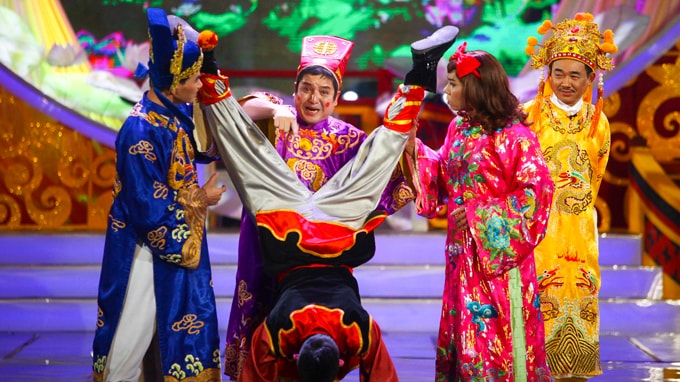
Traffic God (artist Chi Trung) proposes building a "traffic museum" in the shape of an inverted pyramid - Photo: Nguyen Khanh
Ten years have passed since the Táo Quân (Kitchen Gods) show first appeared on New Year's Eve on VTV, and it also marked the end of a difficult year. Therefore, Táo Quân 2013 took place amidst a frenzy of ticket hunting from a large number of curious viewers and under considerable pressure from the production team.
Whatever the entertainment industry has, Táo Quân (Vietnamese New Year's Eve comedy show) has it too.
Except for Mr. Dam's "kissing scene"—which, if re-enacted, could easily become over-the-top—almost all the joys, sorrows, loves, and hates that occur in Vietnamese showbiz in the Táo Quân show are either "replayed," emphasized intensely, or simply glossed over.
After a rather lengthy opening segment by Nam Tao and Bac Dau, and the refreshing but rather lackluster appearance of Thien Loi, the celestial court officially opened with four chairs... exactly like The Voice, with four "Tao" (characters representing different government departments) corresponding to the four coaches: traffic (Chi Trung) - Dam Vinh Hung, culture and sports (Minh Hang) - Thu Minh, social welfare (Van Dung) - Ho Ngoc Ha, and economics (Quang Thang) - Tran Lap. Lightly satirical details like: giving rings to entice contestants, "Quoc Cuong must be with Ha Ho," or intentionally pressing the wrong button for the person next to you... generated quite a bit of laughter for The Voice fans. Throughout the show, there were also screaming competitions (instead of singing competitions), gender reassignment surgery, regulations on penalties for revealing clothing with details like every penny for every percentage point of exposure (!), Kpop fanatics, the Gangnam Style craze, and the parody of "Chiec Khan Pieu" - the song of the year... all appearing in Tao Quan.
The Minister of Economy avoids the issue, the Minister of Transport is sympathetic.
A gloomy economic year, filled with the frustrations of all segments of the population, was encapsulated in Quang Thắng's Gangnam Style dance performance as the Economic God. This choice of format, however, implied a "lenient" approach, as the satirical lyrics recounting rising electricity, water, and fuel costs, reduced salaries and bonuses, and bank foreclosures, were set to a lively melody, allowing viewers to relieve stress. The Economic God skillfully evaded questions from the Nam Tào - Bắc Ðẩu duo, responding evasively with phrases like "bad debt is like buying sour plums to stew duck when you're short on money"—plus the script didn't give him much screen time. This led viewers to believe that the scriptwriters and producers of this year's Táo Quân show were too lenient towards the Economic God: there was no confrontation about pressing issues such as rampant price increases, a chaotic gold market, and especially the banking crisis.
The back-and-forth banter, while subtly suggestive, lacked emphasis and building to a climax, leaving the much-anticipated performance of the Economic God of the Kitchen disappointing.
Similarly gentle, yet quite charming and "compassionate," is the Traffic God played by Chi Trung. From proposals that have caused widespread public outrage, such as road ownership regulations, road maintenance fees, traffic accidents, and traffic jams, his sharp questioning doesn't corner people, and his heartfelt explanation makes many people think: before getting upset with mechanisms and policies bestowed from heaven, perhaps we should reconsider our own behavior, especially when "running a red light just because everyone else is doing it."
Literature and art are bland, but people's lives are rich and vibrant.
Choosing a prominent issue in the field—football teams abandoned by their owners and players left unemployed—the "Culture and Sports God" segment had few opportunities to entertain the audience. The violin and melancholic music played by the "Culture and Sports God" also made it difficult for viewers to relax. However, the somber tone wasn't deep enough, and the script didn't delve deeply into the subject matter, making it difficult to truly feel sadness and compassion. Culture is understood as everyday speech and activities, so the "Gods" and the "Southern and Northern Dippers" discussed these aspects among themselves, while other issues were only briefly touched upon, leaving insufficient room for a seasoned actress like Minh Hang to showcase her stage presence. It's a bit of a shame for the "Goddess" who could have brought some lighthearted laughter to bid farewell to the year.
The most lively, humorous, and insightful segment is undoubtedly the "People's Welfare" segment, because everyone needs to eat and study, so frustrations, annoyances, and worries stem most from these. Vân Dung's "People's Welfare" segment features a "two-in-one" role, encompassing both healthcare and education, giving her ample opportunity to showcase her acting skills.
If the first role-swapping scene involved Nam Tao and Bac Dau exchanging souls and bodies so that the strong, masculine one could understand the feelings of the naturally gentle, feminine one – a message from the Jade Emperor about the importance of people trying to put themselves in others' shoes to understand each other – then the second role-swapping scene, where the God of Public Welfare swaps roles with Nam Tao to become an ordinary citizen going for a medical check-up, truly captured the tragedy, suffering, and humor of human affairs in... the hospital.
The highlight of the 2013 Tet Comedy Show was this outstanding performance. Without hesitation, without compromise, and with exaggeration but without being harsh, the scriptwriters and the two comedians, Van Dung and Xuan Bac, once again demonstrated their class and prowess.
3 hours = a whole year of frustration
The first recording session of the Tet Comedy Show lasted four hours, from 8 PM to midnight, and the following two sessions on January 26th and 27th were of similar duration. General director Do Thanh Hai will select the most satisfying scenes, where the artists collaborate seamlessly and brilliantly, to create a spectacular program of approximately three hours to be broadcast on New Year's Eve.
There were quite a few shortcomings and disappointments in the first night, hopefully these will be adjusted and supplemented in the second and third nights. However, no one is under the illusion that a cultural program can encapsulate all the joys, sorrows, loves, hates, and pent-up frustrations of society over the past year into four hours, especially no one is naive enough to seek answers within it. Therefore, the poignant conclusion by Thổ Ðịa - Tự Long, with his warm voice and diverse talent (he sang from "Chiếc khăn piêu" and "Chị tôi" to traditional Vietnamese folk songs with a wonderfully gifted voice - of course, with a touch of... traditional opera), with lyrics about the plight of the peasant named Thạch Sanh losing his land to the owner of the new urban area, Lý Thông, transcended the mockery and humor to evoke a sense of anguish on the eve of the new year, and was enthusiastically applauded by the audience despite the late hour.
According to Tuoi Tre - TH


