
Focus on effective drought prevention.
(Baonghean)The prolonged heatwave across a wide area for nearly a month has caused water levels in reservoirs, rivers, streams, and farmlands throughout the province to evaporate rapidly. It is estimated that this is the earliest and most severe drought in many years.
At the beginning of the summer-autumn planting season, the rice seedlings, sown just with 3-4 leaves, were already cracked and parched in the fields of Phuc Thanh (Yen Thanh). In the Loc field, Mr. Le Quoc Tuong (Hamlet 13, Dong Nam), nearly 70 years old, was irrigating the fields under the scorching midday sun while lamenting: “I’ve rarely seen a drought like this year. My family has 2 sao (approximately 0.2 hectares) of rice, sown just over a week ago, and there isn’t a single day I don’t have to go to the field to irrigate, otherwise the rice would all die.”
For nearly a month, intense heat has persisted across a wide area. Rare, localized rains have only partially alleviated the heat and drought, limiting the evaporation of water from fields, reservoirs, and streams, but are insufficient to dispel farmers' worries about water shortages for their rice crops. Mr. Dinh Van Duong (Chairman of the People's Committee of Phuc Thanh Commune) stated: Approximately 120 hectares out of a total of 500 hectares of rice land in the commune are regularly affected by drought during the summer-autumn crop season due to their location at the end of the water source. However, it's rare for drought to arrive so early and on such a wide scale as this year. "Usually, drought only begins during the first weeding period, but this year, it started right from the time the rice was sown, affecting about 100 hectares in the downstream areas of reservoirs and dams, in the Loc, Do, Luoc, Mo Hon, and Go Moi fields."
"Although there are six small reservoirs and six electric pumping stations in the area, they are still insufficient to alleviate the drought," Mr. Duong said. According to the Vice Chairman of the Yen Thanh District People's Committee, Mr. Nguyen Sy Hung, over 3,000 hectares of rice fields in the district are currently severely affected by drought, concentrated in higher-lying communes such as Tay Thanh, Kim Thanh, Lang Thanh, and Phuc Thanh... The prolonged heatwave and low water levels in reservoirs have made drought relief efforts extremely difficult. If there is no rain after July 10th, plans will have to be made to convert some areas to other crops.
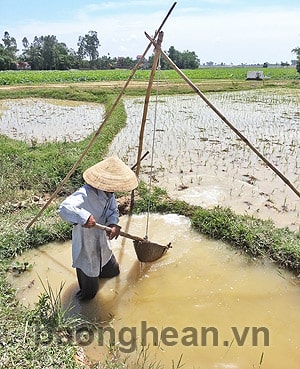
Pumping water to combat drought in Phuc Thanh commune (Yen Thanh district).
In Quynh Luu, while the rice planting season is nearing its end, farmers in some areas are still waiting for water. Mr. Nguyen Dinh Thang (Chairman of the Quynh Thanh Agricultural Service Cooperative) expressed his concern: "The 470 hectares of summer-autumn rice in Quynh Thanh commune rely on water from the N26 canal system of the Northern Irrigation System. Because we are located at the end of the canal, we almost never avoid drought. However, never before has the drought arrived so early across the entire rice-growing area of the commune. The water level in the canal is very low and cannot flow naturally. For more than a week now, officials from the Northern Irrigation Company have been constantly present in the fields to help farmers combat the drought, and diesel pumps have been continuously mobilized to provide alternating irrigation for rice planting."
According to Mr. Nguyen Xuan Dinh (Head of the Agriculture Department of Quynh Luu District), as a locality located at the end of the Northern Irrigation System, supplying water for agricultural production is often more difficult than in upstream areas such as Do Luong, Yen Thanh, and Dien Chau. However, early and severe droughts like this year are rare. Nearly 3,000 hectares of summer-autumn rice in the district remain unplanted due to water shortages, mainly in downstream areas or relying on water from reservoirs in Quynh Thuan, Quynh Nghia, Quynh Thanh, and Quynh Tho... Of particular concern is that water levels in small reservoirs in Quynh Luu district have also dropped to very low levels. Given this situation, the district is planning to convert areas of late-planted summer-autumn rice due to water shortages to planting the main rice crop.
The gravity-fed irrigation system of the Northern Irrigation Company irrigates 28,000 hectares of rice fields in four districts: Do Luong, Yen Thanh, Dien Chau, and Quynh Luu. According to Mr. Ho Ngoc Mai (Director of the Company), the water level on the Lam River is currently at a normal level; however, due to the prolonged heatwave causing rapid evaporation of water from reservoirs, rivers, streams, and rice fields, coupled with the fact that farmers are simultaneously planting rice during the peak production season, the water supply for production is facing many difficulties.
In addition to developing rational irrigation plans for irrigation systems and reservoirs, in recent days, the unit has also had to mobilize nearly 300 workers on constant duty to implement the water distribution and concentration schedule throughout the system, and to provide rotational irrigation for production. Furthermore, the pumping stations managed by the company and the mobile pumping stations of local authorities have also been mobilized, with measures taken to ensure water levels and flow rates at the Do Luong dam, and to direct the operation of the facilities according to proper procedures to thoroughly conserve water.
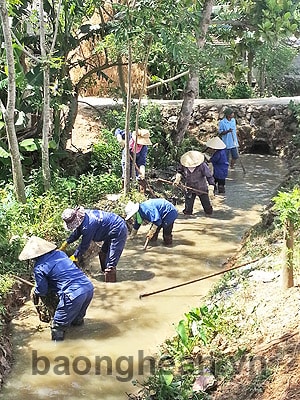
Workers from the Northern Irrigation Company are dredging.
Canals and ditches enhance irrigation capacity.
Currently, the summer-autumn crop season is in its peak irrigation period for land preparation and planting, but the weather conditions are extremely unfavorable. High temperatures, strong southwest winds, and low water levels in rivers, streams, lakes, and dams, especially the water level at the Nam Dan sluice gate, have only reached 0.2-0.3m above the designed level of 1.15m in recent days. Many areas are experiencing water shortages and drought, and the risk of saltwater intrusion into inland areas near river mouths and coastal regions is very high. Local authorities need to concentrate all resources and equipment to combat the drought.
According to Mr. Nguyen Van Hoa, head of the Nghe An Irrigation Department, the Southern and Northern irrigation systems need to operate the main sluice gates at Mu Ba and Nam Dan to maximize the amount of water that can be drawn into the system. The drainage gates at the end of the system, such as Nghi Quang, Ben Thuy, Dien Thanh, and Dien Thuy, should be closed to prevent saltwater intrusion and retain freshwater, and only waterway traffic should be carried out according to approved procedures. Irrigation pumping should be organized in rotation between the system and between individual structures. The Northern irrigation system needs to develop a rotational regulation plan to ensure the highest possible level of gravity irrigation. Areas at risk of not being able to flow naturally need to proactively implement measures to raise water levels or pump water to combat drought. For pumping stations drawing water from the Lam River, Cam River, Gai Canal, Hoang Can Canal, and Vinh River, salinity levels in the canals and at the pumping stations' intake basins should be regularly checked before and during operation. Absolutely no irrigation water with salinity levels exceeding the permissible limit should be pumped, as this will affect the growth and development of crops.
For rice irrigation, salinity should not exceed 1‰; for seedlings and young rice plants, the water must be completely fresh; rice should not be planted in areas where irrigation throughout the season is not guaranteed; strengthen the management and operation of irrigation facilities, and strictly adhere to reservoir operating procedures to ensure economical and efficient irrigation.
Besides the key rice-growing areas of Yen Thanh and Quynh Luu, drought has also appeared on a wide scale in most localities in the province, with thousands of hectares of summer-autumn rice not yet planted due to water shortage. According to the latest data from the Department of Agriculture and Rural Development, so far the province has planted 50,000 hectares out of a total area of 55,000 hectares of summer-autumn rice. According to Mr. Le Van Luong (Deputy Head of the Crop Production Department - Department of Agriculture and Rural Development), about 2,600 hectares are likely to be unplanted due to water shortages, concentrated in the districts of Yen Thanh, Do Luong, Nam Dan, Thanh Chuong, Anh Son... Currently, the planting season is still ongoing, however, if there is no rain by June 15th at the latest, this area will risk having to be converted to planting the main rice crop or other cash crops.
Text and photos: Phu Huong


