
Which aspect should we focus on?
(Baonghean.vn) - Since the 10th Party Congress, the issue of enhancing leadership capacity and fighting strength has been considered a crucial issue and the highest goal for all Party building work. All tasks of Party building must be directed towards this goal. This also means that, in order to achieve that goal, all tasks of Party building must be carried out effectively.
(Baonghean.vn) - Since the 10th Party Congress, the issue of enhancing leadership capacity and fighting strength has been considered a crucial issue and the highest goal for all Party building work. All tasks of Party building must be directed towards this goal. This also means that, in order to achieve that goal, all tasks of Party building must be carried out effectively.
A Party organization considered to have leadership capacity and fighting strength must first and foremost be strong in politics, ideology, and organization. Political strength means a firm commitment to its line. This means that the Party committee and its leader must be able to correctly and creatively apply the policies and guidelines from above to suit the conditions of their locality or unit. They must be able to consider and select the right tasks, issues, and priorities to lead and direct. They must be able to resolve (or coordinate effectively to resolve) complexities and difficulties arising in their locality or unit. Ideological strength means that all Party members must possess and maintain political and moral qualities. Because ultimately, the most concentrated expression of ideology is in behavior: from words to deeds, from relationships to daily life.
Organizational strength stems from the quality, competence, enthusiasm, and participation of Party members; from the quality of activities, the arrangement and assignment of tasks; from the awareness of adhering to the Party's principles, especially the principles of democratic centralism, self-criticism and criticism, unity, and constant connection with the masses... From strictly maintaining Party discipline and order, scientific leadership methods and working styles, through the development and effective implementation of internal regulations and rules. And of course, the Party committee, and especially the leader, must truly be competent and dedicated to the movement. If the leader lacks competence or dedication to the movement, the collective strength will certainly not be unleashed, and the leadership role of the Party organization there will not be high.
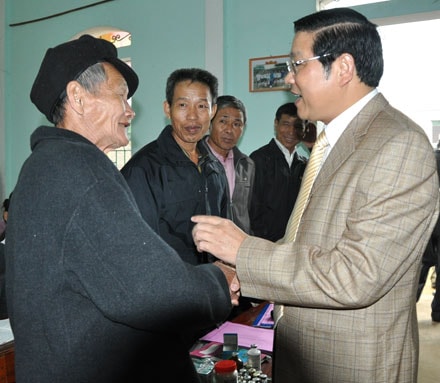
Comrade Phan Dinh Trac - Secretary of the Provincial Party Committee, meets and talks with people in Thanh Luong commune (Thanh Chuong district). Photo: T. LE
Enhancing the leadership capacity and fighting strength of the Party at the grassroots level is not a new issue, but it remains highly relevant and requires careful attention to meet the increasingly demanding requirements of the reform process, primarily to effectively address issues at the grassroots level.
Besides the need to synchronously implement the aforementioned tasks of Party building (which have been neglected in practice for a long time), which area is considered the weakest and needs focused improvement? Which area requires a correct understanding and more focused solutions?
When discussing the fighting capacity of the Party, we have often referred to it qualitatively, as the courage to think, act, take responsibility, and fight to defend what is new and right, while criticizing what is wrong and negative... However, there is a very important aspect of fighting capacity that is rarely mentioned quantitatively: the ability to organize and implement. A Party organization is considered to have fighting capacity not only when it can apply and formulate correct policies, but also when it can organize the implementation of those policies in practice. This is considered the most important step, the most accurate measure of the leadership role of the Party organization at the grassroots level.
To effectively implement resolutions and policies from higher levels and resolutions and tasks from their own level, the Party Secretary must first help the Party Committee quantify the tasks to be done, select priorities and key areas to develop practical and appropriate programs, projects, and plans (especially overcoming the tendency to develop programs that are merely reactive, summarizing resolutions and plans from higher levels and their own level in a general way). Programs, projects, and plans must be concise and specific regarding objectives, measures, timelines, and resources.
In particular, it is necessary to carefully discuss the organizational measures for implementation and assign specific responsibilities to the individuals in charge. Periodically (monthly or quarterly), the comrade assigned to be in charge must report the results of the implementation to the Party committee (this content must be permanently included in the work program) for timely adjustments.
To help grassroots Party committees accomplish this voluntarily and systematically, the Provincial Party Committee needs to direct the design of a specialized training program on how to develop and implement programs, projects, and plans for grassroots Party secretaries and standing committee members. A model for programs, projects, and plans for implementing resolutions should be issued (similar to the model for the working regulations of commune Party committees). Higher-level Party committees need to strengthen their role in guiding, urging, inspecting, and supervising.
Assign responsibility to Party committee members in charge of grassroots units and Party committees to provide specific guidance and supervision on this matter. Set targets for inspecting and monitoring the development and implementation of programs, projects, and plans to carry out the resolution (incorporate this into the annual inspection and monitoring program of the Standing Committee, the Party Committee's Inspection Commission at their respective levels, and the program of the grassroots Party committees). Seriously include this in the criteria for annual evaluation, classification, and ranking.
Ton Manh


