
Focus on preventing and treating diseases in shrimp.
(Baonghean) - According to information from the General Department of Fisheries (Ministry of Agriculture and Rural Development), currently in some key shrimp farming areas in Central Vietnam such as Khanh Hoa and Phu Yen, there is a widespread phenomenon of farmed shrimp dying. The main causes are erratic weather changes and the appearance of white spot disease with acute hepatopancreatic necrosis syndrome.
In Nghe An province, according to statistics from the Sub-Department of Aquaculture, as of April 25, 2014, the area of shrimp farms affected by disease was 9.78 hectares (twice the amount compared to the same period in 2013), mainly concentrated in Hung Hoa commune (Vinh City) with 4.29 hectares, Nghi Thai commune (Nghi Loc district) with 2.5 hectares, Mai Hung, Quynh Xuan, and Quynh Loc communes (Hoang Mai town) with 2.12 hectares, and An Hoa, Quynh Luong, and Trinh Mon communes (Quynh Luu district) with 0.87 hectares. Symptoms include red body, white spots on the carapace, sluggish swimming on the water surface in some ponds, soft and pale hepatopancreas, liver atrophy, and shrimp gathering at the shore before dying.
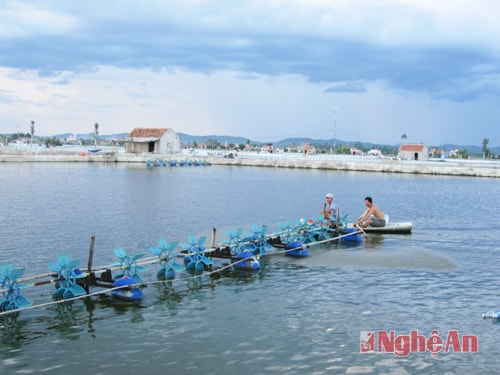 |
| Inspecting a shrimp farm in Quynh Giang (Quynh Luu). Photo: Thanh Le |
In light of this situation, the Department of Agriculture and Rural Development organized a conference on "Addressing the Management and Production of Shrimp Farming in 2014" in Quynh Di commune, Hoang Mai town, with the participation of leaders from the Department of Agriculture and Rural Development, the Veterinary Sub-Department, the Aquaculture Sub-Department, the Agricultural Extension Center, the People's Committee of Hoang Mai town, the Agriculture Departments, Economic Departments, and Agricultural Extension Stations of Quynh Luu, Nghi Loc, Dien Chau districts, Vinh City, and Hoang Mai town; aquaculture cooperatives, some shrimp farmers, and companies supplying shrimp seeds, feed, and aquatic veterinary medicines in the province. Based on reports from the Veterinary Sub-Department, the Aquaculture Sub-Department, and the CRSD Project Management Board, and through discussions, the conference unanimously agreed on several observations: From the beginning of the year until now, the weather has been complex, with high temperature differences between day and night, and dense fog occurring while stocking densities are high; when diseases occur, farmers do not comply with the disease prevention and treatment procedures of the relevant authorities; Some shrimp farms lack settling ponds, 80% treat water directly in the ponds, 90% do not check for chlorine residue before coloring the water and stocking shrimp, and 90% of shrimp ponds lose their color before disease outbreaks…
Based on some of the observations at the conference, several solutions were proposed: For shrimp seed production and trading establishments, it is required to strictly comply with the regulations on the production and trading of aquatic seeds as stipulated in Directive No. 01/2012/CT-UBND dated January 5, 2012, of the People's Committee of Nghe An province on strengthening the management of shrimp seed quality and brackish water shrimp farming areas in Nghe An province. Shrimp seeds imported from other provinces must ensure quality and have a clear origin. Imported seeds must be reared/nurtured in tanks for at least two days, then samples must be taken to test for white spot virus, Taura syndrome virus, MBV, and luminescence must meet the requirements before being sold (for whiteleg shrimp seeds, they must reach a size of P12 or larger).
Commercial shrimp farming units and facilities, especially those in areas not yet stocked, need to renovate ponds and lagoons according to technical requirements. They must have settling ponds and treat water before introducing it into shrimp farming ponds using chlorine at a concentration of 30 grams/m³ of water. They should regularly monitor the results of periodic environmental monitoring in shrimp farming areas from the Sub-Department of Aquaculture to take appropriate measures for water collection and treatment. They should also regularly monitor the disease situation in the area to implement preventive measures for farmed shrimp, using shrimp fry of clear origin, uniform size, and suitable size for stocking.
For areas where shrimp have already been stocked: Due to the erratic weather conditions causing significant fluctuations in the pond environment, shrimp are experiencing shock. Temperature and pH shock, in particular, can cause symptoms such as bent bodies, excessive swimming, and reduced appetite. Therefore, farmers need to regularly monitor water quality in the ponds, use biological products and limestone powder to stabilize the environment, and supplement vitamin C in the feed to increase the shrimp's resistance to disease.
On the other hand, it is necessary to regularly monitor the results of periodic environmental monitoring in shrimp farming areas by the Sub-Department of Aquaculture and the disease situation in some neighboring farming areas, install nets and spread lime around the pond banks to prevent intermediate hosts from outside from entering the pond, implement temperature stabilization measures such as: raising and maintaining the water level in the pond between 1.2 and 1.5m, limiting water changes and additions, using feed and biological products with clear origins, within their expiration dates, ensuring quality and storage according to the manufacturer's instructions, and regularly reporting production developments to local authorities and relevant agencies for coordinated guidance and timely handling.
For shrimp farming areas affected by disease: when shrimp in the pond show unusual symptoms or are suspected of being diseased, immediately report to the commune's veterinary officer, the commune People's Committee, the cooperative, or the community group for sample testing to promptly implement treatment measures; absolutely do not conceal the disease. After the test results are available, if the shrimp are found to be infected, farmers are required not to discharge wastewater from these ponds into the environment without treatment. They must close the water supply and drainage gates, spread lime around the pond banks, prevent intermediate hosts from carrying diseased shrimp to the outside environment, and treat the water with chlorine at a concentration of 25-30 grams/m3 for 7-10 days before discharging the water into the environment. Do not remove from the affected area any animal feed, farming equipment, or aquatic animal waste that could spread the detected disease.
For the People's Committees of districts, cities, and towns, it is necessary to direct specialized departments, the People's Committees of communes, cooperatives, and community groups to monitor and grasp the situation in their areas, implement technical measures to prevent diseases occurring in shrimp farming, coordinate with functional agencies to strictly handle shrimp seed production and trading establishments and farming households that do not comply with regulations; at the same time, compile statistics on the situation and report to the Sub-Department of Aquaculture for guidance and timely support for farmers.
Specifically, the Aquaculture Sub-Department and the Veterinary Sub-Department need to strengthen coordination and establish a special task force to effectively manage aquaculture breeds, feed, and veterinary drugs. The Agricultural Extension Center should send staff directly to farming areas and intensify on-site training with a "hands-on" approach to help farmers promptly handle shrimp diseases when they occur.
Tran Trung Thanh


