
CR conformity mark - Consumers need to pay attention
Given the widespread availability of substandard children's toys, electronics, and helmets, the unified use of a quality certification mark (CR) is essential to protect consumer rights and facilitate quality management of these products. However, after more than a year of implementing the unified CR certification regulations, the market in Vinh City remains a "difficult problem" for the authorities.
(Baonghean)Given the widespread availability of substandard children's toys, electronics, and helmets, the unified use of a quality certification mark (CR) is essential to protect consumer rights and facilitate quality management of these products. However, after more than a year of implementing the unified CR certification regulations, the market in Vinh City remains a "difficult problem" for the authorities.
The National Technical Standard issued by the Ministry of Science and Technology on the safety of toys for children under 16 years old came into effect on April 15, 2010. On June 1, 2010, six types of electrical and electronic devices, including instantaneous electric water heaters, electric water heaters and hot water storage devices, hair dryers and hair styling tools, electric kettles, electric rice cookers, and electric fans, had to be certified as compliant, marked with the CR symbol, and declared compliant. By July 1, 2010, the CS symbol and "inspected" sticker on helmets ceased to be valid; all manufactured and imported products uniformly used the CR compliance mark. And according to Circular 16/2010 of the Ministry of Science and Technology, starting from October 1, 2011, six more types of electrical and electronic devices, including electric ovens and electric grills, were added to the list of compliant devices. PVC-insulated electrical wires with a nominal voltage of up to and including 450/750V; immersion water heaters; tea or coffee makers; hand dryers; and electric irons must also meet similar conditions to be allowed on the market...
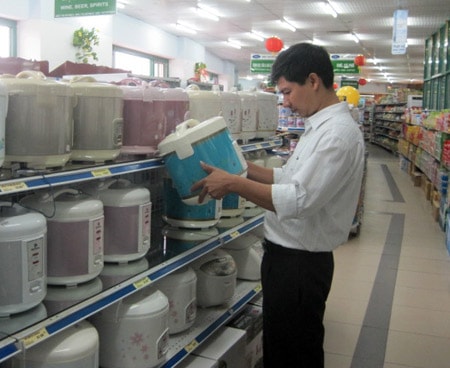
Most electrical and electronic equipment items in the regulated categories at Intimex supermarket have been labeled with conformity stamps.
After more than a year of implementing the conformity certification regulations, children's toys in supermarkets have started to show products with the CR certification mark. However, in shops along the streets and markets, goods of unknown origin and without labels still dominate and are sold openly. Visiting several stalls specializing in children's toys in Vinh Market, we easily found violent toys such as swords, rubber bullet guns, plastic bullet guns, or unsafe toys like airplanes, merry-go-rounds, and animal figures that play music and spray colorful foam from strange chemicals. When we asked why this airplane didn't have the CR certification mark, the shop owner laughed dismissively: "It's imported from China, where would they get the certification mark? You couldn't find any with it in this whole market. And it's rare to find someone who cares about labels like you do." A customer who was choosing a teddy bear also said: "The price here is 60,000 VND per bear, but if you go to supermarkets and choose products with the CR label, this product would cost more than 100,000 VND. Because they are the same model and style, I chose the cheaper one."
Regarding helmets, many manufacturing companies have declared compliance and affixed CR stamps, but their products still don't attract as many customers (especially young people) as the unlabeled helmets that are widely available on the market. This is because some people still prefer to buy cheap goods, or buy them to avoid regulations. Understanding consumer psychology, some manufacturers and businesses prioritize profit and have released a wide variety of substandard helmets in various styles and colors, designed to resemble safety helmets but labeled as "sports helmets" or "helmets for pedestrians and cyclists" to circumvent regulations, with an average selling price of 30,000 - 50,000 VND per helmet.
Following directives from the Ministry of Science and Technology and the Provincial People's Committee, the Inspectorate of the Department of Science and Technology, in coordination with the Market Management Sub-Department, the Standards, Metrology and Quality Control Sub-Department, the Center for Scientific and Technological Information and Communication, and the Economic Crime Investigation Police Department (Provincial Police), recently conducted a large-scale inspection of electrical and electronic equipment products throughout the province. The inter-agency team inspected 27 production, business, and import establishments, including 24 supermarkets and retail businesses, one import enterprise, and two manufacturing enterprises. The inspection results showed that production, business, and import establishments generally complied well with regulations related to standards, metrology, quality, and industrial property rights. However, some businesses were found to be unfamiliar with regulations concerning technical standards and conformity; they did not maintain conformity records and did not affix the required conformity mark to their electrical and electronic equipment products. These products, mainly hair dryers, electric kettles, rice cookers, etc., are imported goods that are still in stock and have not been declared as required by regulations.
In reality, the affixing of conformity stamps to electrical and electronic equipment at some businesses, supermarkets, and large stores is generally quite compliant with regulations. However, consumers often only focus on the design and price, and have not yet explored or understood the national technical standards for product safety. Mr. Nguyen Van Thai, who specializes in selling electronics on Le Huan Street (Vinh City), said: "Here, we usually import goods according to market demand; if it's imported goods, depending on the item, there are already import stamps, while domestically produced goods already have 'High-Quality Vietnamese Goods' certification stamps, so consumers don't pay much attention to conformity stamps. They only choose products that suit their appearance and price."
Mr. Nguyen Hong Quang, Deputy Head of the Nghe An Provincial Department of Standards, Metrology, and Quality, stated: "The CR mark signifies the responsibility of the producer and business. Therefore, when certifying and affixing the conformity mark, it simultaneously assigns responsibility to the producer, business, or importer regarding the safety of that product. This means there are no fake CR marks; only genuine marks affixed to products that have not been tested or evaluated. The CR conformity mark is affixed directly to the product or its packaging. Consumers, in addition to seeing the conformity mark, can request that the business provide proof of conformity certification and declaration... Currently, large, reputable production and business enterprises consider affixing the CR mark as an opportunity to affirm the superiority of their products compared to other similar products. Meanwhile, many businesses and establishments dealing in goods of unknown origin or smuggled goods do not cooperate in affixing the CR mark because those goods violate the law." Therefore, managing the quality of illegal goods and goods imported through unofficial channels is very difficult. The biggest difficulty in enforcing penalties is that Government Decree 54, which regulates administrative penalties for violations in the field of standards, measurement, and product quality, does not yet have provisions for penalizing the supply of goods to consumers without the CR conformity mark.
The purpose of affixing the CR stamp is to confirm that a product is of guaranteed quality and safe for use, thereby protecting consumer rights. Therefore, in addition to the efforts of relevant authorities, for this activity to be truly effective, consumers must reject products without the CR stamp; only buying products that meet quality standards and have proper labeling will hold manufacturers and businesses accountable for the products they sell. Only then can counterfeit and substandard goods be minimized, and the market made more transparent.
Ngoc Anh


