
"Better to starve than to be uneducated."
If you ever visit Xuan Huong hamlet, Nghi Duc commune, Vinh City, and ask about the family of Mr. Pham Quang Trung (born in 1963) and Mrs. Nguyen Thi Huong (born in 1966), many people will know them, because of their perseverance in overcoming difficulties and providing for their children's education while working the land year-round.
(Baonghean)If you ever visit Xuan Huong hamlet, Nghi Duc commune, Vinh City, and ask about the family of Mr. Pham Quang Trung (born in 1963) and Mrs. Nguyen Thi Huong (born in 1966), many people will know them, because of their perseverance in overcoming difficulties and providing for their children's education while working the land year-round.
Born into poor, large farming families, both Mr. Trung and Mrs. Huong experienced a difficult childhood. Mr. Trung's father died of a serious illness when he was six, so from a young age, he had to work as a servant for wealthy families and do various odd jobs. From his high school years, he had to walk 15 kilometers to school barefoot across scorching hot sand and gravel on sweltering summer days, without a single decent set of clothes, and always late paying his tuition. At the end of his final year (10th grade at that time), unable to continue his studies, he decided to join the army. As for Mrs. Huong, being the eldest daughter, she had to drop out of school and work hard from a young age, often carrying goods from Vinh City to Thanh Chuong and Quy Hop to sell.
In 1986, fate brought them together, and they settled down in Xuan Huong hamlet. Four years later, four children were born, including a pair of twins: Pham Thi Dao (born in 1990), Pham Thi Duyen, Pham Thi Dinh (both born in 1992), and Pham Minh Duc (born in 1995).
The family was already poor, and with so many children born close together, they were always struggling to make ends meet. However, deeply affected by the hardships and struggles of not having a proper education, and with the belief that "it's better to starve than to let our children be uneducated," the parents worked even harder to earn more income to support their children's education. This was especially true when Dao, Duyen, and Dinh went to school far from home, and Duc was in his final year of high school. On average, the monthly cost of tuition and living expenses for the three children in Hanoi reached 10 million dong – a large sum for a farming family. But Mr. Trung and Mrs. Huong were determined not to let their children's education be interrupted. Besides farming, Mr. Trung also worked various jobs such as electrician, construction worker, and construction site security guard. Recently, he also invested in livestock farming (mainly chickens and cows), borrowing money to buy a tractor and a rice threshing machine.
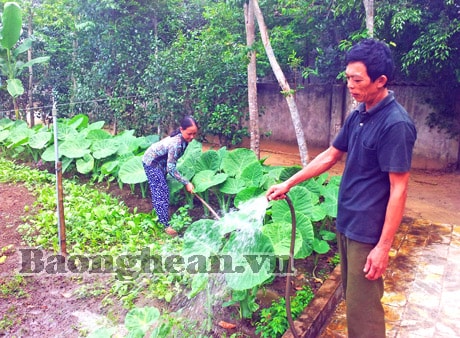
Mr. Trung and Mrs. Huong increased their agricultural production.
During the harvest season, rain or shine, he is always out in the fields. Meanwhile, Mrs. Huong takes care of all the farming on 3 sao (approximately 0.3 hectares) of rice and 4 sao (approximately 0.4 hectares) of other crops. Compared to other households in the area, the cultivated area isn't large, but for a middle-aged woman suffering from spinal degeneration, it's truly hard work. But like her husband, to ensure their children can focus on their studies, she silently works without a single complaint.
Because they were early aware of the difficulties, hardships, and expectations of their parents, Mr. Trung and Mrs. Huong's children were always diligent and hardworking in their studies. Not only were they studious and academically successful, but all four children also helped their parents with household chores and farm work. The eldest sister diligently guided and tutored her younger siblings and took on extra work to earn money to cover her education expenses.
In particular, her eldest sister, Pham Thi Dao, was a top student throughout her high school years. She consistently achieved the title of "Outstanding Student at the District and Provincial levels," and "Good Child of Uncle Ho." After graduating from high school, she passed the entrance exam to Hanoi University of Agriculture 1 and, a year later, was admitted to the Advanced Class – Faculty of Accounting and Business Administration.
Throughout my years at university, I was always an outstanding student, one of the few students to receive the HUA – JICF scholarship sponsored by the Japan International Foundation. From the second semester of my first year, I worked as a salesperson in shops, then as a waitress in restaurants, and as a tutor. Later, I participated in volunteer organizations and worked for a non-profit organization in Hanoi to learn skills and gain more knowledge. Although I won't graduate until September, I have already been hired by a joint venture company with Japan, with a fairly stable salary that is enough to cover my living expenses and help my parents to some extent.
Dao recounted, "I only get to go home once or twice a year, but each time I see my parents looking so much thinner and older. At times like that, I want to run and hug them, but then I quickly run back inside because I don't want them to see me crying."
Inspired by their older sister's example, her three younger siblings, Duyen, Dinh, and Duc, also strived to excel in their studies and self-improvement. Currently, Duyen is a fourth-year student at the University of Commerce, Dinh is a fourth-year student at the Academy of Finance, and Duc has just passed the entrance exam to the University of Law.
Even now, although their family life is still difficult, every time they look at the certificates and awards hanging in their modest living room, the couple can't hide their emotion mixed with pride. Because their children grew up in the harmony and love of their parents, achieving academic success thanks to the sweat and toil of their parents in the fields, and the belief that their children would not have to endure the hardships they themselves had faced.
Mai Anh


