
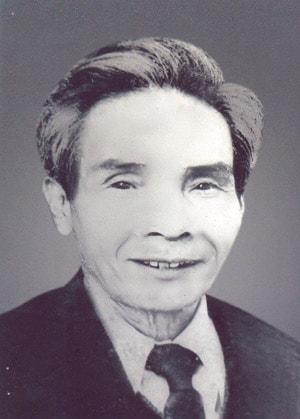
Thai Ngo Tai - The elder brother of the Nghe An Trade Union
But
(Baonghean)ButI visited Xuan Hung hamlet, a sandy area on the outskirts of Vinh City, the home of Mr. Thai Ngo Tai, the former Chairman of the Nghe An Provincial Trade Union for the past 24 years. Within his small compound stood a humble three-room, single-story house with a handcrafted tile roof. The house was as simple as the frugal lifestyle of a man who rose through the ranks from a military machinery mechanic.
With the permission of my youngest son, Thai Ngo Binh, and his wife, I light an incense stick to pay tribute to the spirit of Uncle... I remember that during the time of fierce bombing by the American air force, material life was extremely difficult, a section of cadres and workers were unsettled, and production came to a standstill. Uncle Thai Ngo Tai directed the industry's trade union system and the grassroots trade unions to both take care of each person's food rations and initiate cultural and artistic movements to dispel the tense atmosphere of war.
|
Thanks to the skillful "midwifery" of Mr. Thai Ngo Tai, the Nghe An Provincial Trade Union Federation produced two substantial literary publications, a collection of essays and reports imbued with the spirit of "Excellent Production" and "Excellent Combat," titled "From Ben Thuy" (2 volumes). Mr. Mai Tuan eagerly traveled to Hanoi to commission the renowned musician and artist Van Cao to design the covers and layout for these two volumes of Nghe An workers' literature. Beyond literature, the workers' singing movement also revealed talented vocalists: Thai Thi Kieu Anh, Phuoc My, Quoc Chung, and the once-famous songs of composers Tran Phuc Tang, Bui Ba Linh, Thanh Tung, Quang Vuong, Van The... These talents were organized by the Trade Union Federation into teams and groups to serve the military and civilians in the province and the 4th Military Region in defeating the destructive war waged by the US Air Force. The Ministry of Culture also confidently sent the songs of Nghe An workers across tens of thousands of kilometers to introduce them in Bulgaria, Poland, China, North Korea, Cuba, and other countries.
Deeply affected by the limited and inadequate knowledge of the workers, Mr. Thai Ngo Tai directed the Education Sector Trade Union to develop a secondary education supplementary program for agricultural, forestry, and transportation workers. Never before had the "Production by Day, Education by Night" movement been so captivating to laborers as during the years of the war. Countless of those supplementary students, upon meeting again after several years, had acquired sufficient knowledge to pass the entrance exams for regular high schools and universities!
Uncle Tài often said, "The collective is the foundation for individual development, but only with outstanding individuals can the movement be sustainable." And from that guiding principle, he focused on building the "Trade Union Home" model, with practical activities based on the formula "three help for one task," stimulating creativity and enabling workers to master situations in production and work. Interestingly, Mr. Bùi Khuyến – Head of the Propaganda Department of the Vietnam General Confederation of Trade Unions – enthusiastically composed the song "Trade Union Home." During the difficult anti-American war, the song served as a prelude to a movement to build "exemplary collectives and advanced individuals," expanding "socialist labor teams and groups" throughout factories, farms, forestry enterprises, and administrative agencies.
During a period when the Trade Union's position was second only to the Party, key and astute cadres such as Vu Thang, Le Con, Bui Khuyen, Dam Quang Long, Le Viet Tam, Nguyen Sy Dien, Nguyen Van Nhan, Nguyen Trong Van… all enthusiastically rallied around Secretary Thai Ngo Tai. This strategic team designed and built the emulation movements "For our beloved South" and "Each person works twice as hard," attracting over 700,000 union members to participate, resulting in 2,000 advanced collectives, culminating in 11 individuals being honored as Heroes, including 9 Labor Heroes.
In the early 1980s, the entire province of Nghe An was suffering from severe famine, with sorghum grains becoming the staple food, replacing rice to make ends meet. The lives of workers and civil servants were precarious, their wages dwindling in value compared to the black market. People passed around the verse, "In 1980, rice was 1980; the people of Nghe An had faces as yellow as turmeric."
Furthermore, some leaders even proposed cutting 15-20% of the food rations, urging workers and employees to self-supply the shortfall. Faced with the outrage of tens of thousands of people over a hasty, arbitrary, and bureaucratic decision, Mr. Thai Ngo Tai instructed his office to prepare a document from the Standing Committee of the Trade Union requesting that this policy not be implemented! From the forum of the Provincial People's Council, in the face of some harsh and accusatory opinions, Mr. Tai remained calm and steadfast in defending the rights of workers and employees. The intellectuals of the Education and Training sector, those who don't know how to plow or cultivate, who can't "leave the classroom to clear land and plant cassava in the forest," shed tears upon hearing this story…
Shortly after Mr. Thai Ngo Tai fell seriously ill, a retired worker from the 3-2 State Farm, who made a living repairing bicycles, rushed to Vinh to visit him. The old craftsman embraced Mr. Tai, weeping, and recounted, "If it weren't for Mr. Tai's intervention, I probably wouldn't have received my veteran's disability benefits yet!"
That's right, only someone who was a soldier in the ordnance corps during the resistance against French colonialism, or a mechanic like Mr. Thai Ngo Tai, can empathize with and understand the hardships and joys of soldiers and workers.
As I lit another incense stick, I silently repeated the words of the injured worker who had been helped by Mr. Thai Ngo Tai: "You are like an older brother to us!"
Van Hien


