
Visit the Great Wall of China
They say that traveling along the Chinese coast and heading north to Beijing is like going to "a place of torture." Even in late autumn, the nighttime thermometer here sometimes drops to 0 degrees Celsius; and in the middle of summer, those coming from the south would find it hard to endure the heat and wind. From the center of this ancient yet modern capital, the country's leading city, it takes nearly 100 kilometers by car deep into the mainland to reach the foot of the Great Wall. Luckily, when we arrived, it was already late afternoon and the sun was shining.
The ancients said, "He who has not been to the Great Wall is not a true hero." And I stepped before the large, solemnly erected monument and read that saying, inscribed in the calligraphy of Chairman Mao Zedong, with his signature below. Perhaps, I have had the good fortune to, for a moment, become a true hero?
But then I suddenly remembered that the place I had just set foot in wasn't the section of the Great Wall that the ancients spoke of in books. That place was far away, and the ancient city at Longgong Temple in the suburbs of Zhongwei, Ningxia Province, was one of the remaining sections from that era. It was built by the Han people during the Warring States period to defend against attacks from the Xiongnu and Western Regions tribes.
Thus, the Great Wall began construction around 2,500 years ago and was built in sections, mainly using rammed earth mixed with straw, with only the gates and guard posts having added stone. In 221 BC, Emperor Qin Shi Huang continued the work on a much grander scale.
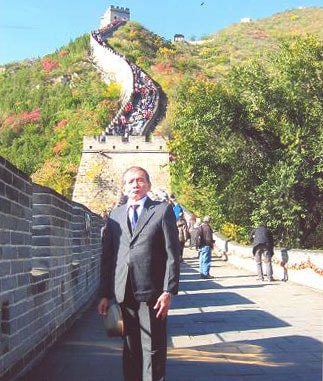 |
The author is at the Great Wall of China. (Photo courtesy of CTH) |
First, he ordered the existing sections of the rampart to be joined and expanded, forming a continuous rampart stretching 2,500 km (5,440 miles) from Jiayu Pass to Shanhai Pass, running through the Gobi Desert with towering watchtowers and numerous watchtowers perched high above the endless sand dunes. And I understand why the ancients called the battlefield a "battlefield," and why Wang Han, one of the great poets of the Tang Dynasty, wrote the immortal border poem "Liangzhou Ci," which includes the line: "Drunk and lying on the battlefield, do not laugh at me / Since ancient times, how many have returned from war?" In the past, for Vietnamese people, going on diplomatic missions to Beijing alone took several quarters, even nearly a year, so it was not easy for others to reach the land that was once the territory of the Han Empire.
But Dang Tran Con, a Vietnamese poet, imagined and wrote: "The drums of the Great Wall shake the moon's reflection / The smoke of Cam Tuyen obscures the clouds," which Doan Thi Diem translated as: "The drums of the Great Wall shake the moonlight / The smoke of Cam Tuyen obscures the clouds." Here, the Great Wall and Cam Tuyen are also names of ramparts and places in China. Thus, I knew I had arrived at a point on the present-day Great Wall and also realized that the Great Wall was being continued by later dynasties, and the section I had reached was only the part from Cu Dung Quan to Bat Dai Lang, which was added during the Ming dynasty, bringing the total length of the structure to 6,352 km (3,948 miles).
Admittedly, reaching this place, even with modern means of transportation, is a considerable effort, but it's nothing to be called heroic. Mao Zedong's reminder was meant to say that one must go even further to discover the origins of this rampart, built in the 5th century BC, a place where, in ancient times before cars and airplanes, only those from the Central Plains who were truly "heroes" dared to venture. Nevertheless, the Great Wall of China is a marvel, ranking at the top of the list of 30 World Heritage sites in China.
Visiting the Great Wall of China reminded me even more of the ancient architectural works of my country. One example is the Co Loa Citadel in Phong Khe. In the early decades of the Common Era, when our ancestors moved from Phong Chau to this location, they relocated their capital from a semi-mountainous region to the plains. The Co Loa Citadel was designed with nine spiral turns and was primarily built of earth because fired bricks were not yet available at that time. The total construction required approximately 2.2 million cubic meters of earth and stone. The ramparts reached heights of 8.2 meters in places and have stood firm for thousands of years.
These are Cham towers, the earliest dating back to the 7th century. These structures were all built with self-fired bricks, the binding material of which is difficult for outsiders to discern. Legend says some towers were built in a single night. Particularly noteworthy are the vivid carvings and scepters, showcasing superb sculptural artistry. For example, the My Son Sanctuary (Quang Nam province) has been recognized by UNESCO as a World Heritage Site.
This is the Ho Dynasty Citadel, also known as Tay Giai Citadel or Tay Do Citadel, built in 1397 under the direction and command of Ho Quy Ly when he was Prime Minister of the Tran Dynasty. The citadel is located in Vinh Tien and Vinh Long communes of Vinh Loc district, Thanh Hoa province. The citadel is quadrilateral in shape, each side measuring approximately 500 meters, and is 5 to 6 meters high. It is constructed from square, blue stones weighing 15 to 20 tons each. It's unknown how they stacked them, but the binding material is currently invisible to the naked eye. Legend says the citadel was completed in just three months. And in the construction of this citadel, there is also a story, much like the tale of Meng Jiang searching for her husband on the Great Wall of China.
And with so many other outstanding and remarkable cultural works in our country, I suddenly remembered a sentence by Nguyen Trai in "Binh Ngo Dai Cao" (Proclamation of Victory over the Wu), which said: "As for our Great Viet nation, it has long been known for its civilization. The mountains and rivers have been divided, and the customs of the north and south are also different... although strength and weakness may differ at times, there have always been heroes in every era..."
And today, we are strong and stable enough to stand shoulder to shoulder with friends from all over the world in integration and development, so we must make even better use of the beautiful landscapes that nature has bestowed upon us as well as the historical relics created by our ancestors.
Chu Trong Huyen



;)