
Beloved village name
In Nguyen Khoa Diem's "Epic of the Homeland," there is a simple yet incredibly memorable line that speaks of the people's feelings towards their villages and communes: "They carried the names of their villages and communes with them on each migration..." For many, the names of villages and communes are not merely for identification, but are a sacred part of their very being. The names of old villages...
(Baonghean)In Nguyen Khoa Diem's "Epic of the Homeland," there is a simple yet incredibly memorable line that speaks of the people's feelings for their villages and communes: "They carry the names of their villages and communes with them on each migration..." For many, the names of their villages and communes are not merely for identification, but are a sacred part of their very being.
The old name of the village...
In the life and activities of the Vietnamese people, villages have always been considered administrative units of immense importance. They are multi-functional communities, not only administrative in nature, but also containing layers of cultural sediment accumulated over generations of local people. Formed alongside migration and land reclamation, villages gradually stabilized over time. When naming a region or a village, our ancestors often conveyed their hopes for peace, prosperity, and abundance for their homeland. These names always retain sacred and enduring meanings in people's hearts, even in times of poverty, hardship, and difficulty. Today, with the development of economic and cultural life, people are beginning to rename villages…
For example, in Hung My commune, Hung Nguyen district, the Do Yen village gate was built grandly, with a two-roofed architecture, over 10 meters high and 7 meters wide, costing 120 million VND, funded by donations from the residents of hamlets 1 and 2. On either side of the gate are clearly inscribed two couplets: "Our ancestors built a beautiful Do Yen" (on the left) and "Future generations together build a prosperous My Giang" (on the right). This event holds significant meaning not only for the people living in the "village" but also for those who have left their hometown.
Confused about the two different place names in the couplet, we received a detailed explanation from Mr. Nguyen Van Tinh, 73 years old (Hamlet 1): “Before the 1930s, this area belonged to the Do Yen district. After independence, it was renamed My Giang and then divided into Hamlets 1 and 2. For a long time, there were two different names for it: Hamlet 1, Hamlet 2, or My Giang Hamlet. According to the wishes and consensus of the people of the two hamlets, when building the village gate, the old name Do Yen was restored, signifying that this land is prosperous, developed, and peaceful, as our ancestors had hoped when naming the village.”
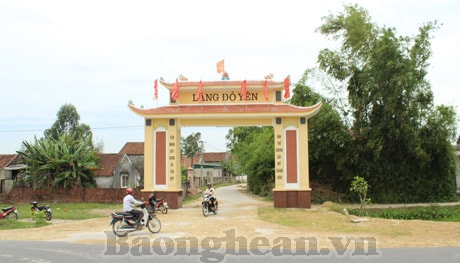
The village gate of Do Yen (also known as My Giang) of hamlets 1 and 2 (Hung My - Hung Nguyen).
Throughout the turbulent course of history, due to various reasons such as prolonged warfare, taboos, and the merging and splitting of villages, many village names have been changed. This is reflected in the replacement of part of the first or last letter, or the complete replacement with a new name. Some villages have also been separated and "numbered" with hamlets 1, 2, 3, 4, etc. However, in some rural areas, the village names have been retained by adding numbers after the old names. The most typical example is Kim Lien commune (Nam Dan district).
Previously, there was only one village called Sen – the ancestral home of President Ho Chi Minh's paternal family. However, due to population growth, the village has been divided into Sen 1, Sen 2, Sen 3, and Sen 4. Similarly, Hoang Tru village – the ancestral home of President Ho Chi Minh's maternal family – has been divided into Hoang Tru 1 and Hoang Tru 2. Mau Tai village (formerly known as Say village) has been divided into six hamlets, named Mau 1 to Mau 6. This naming convention, adopted in each division, was largely agreed upon by the local people. According to Mr. Pham Van Cuong, an 83-year-old resident of Sen 2 village, the reason why villages in Kim Lien commune retain their original names with added numbers is not due to a lack of names, but fundamentally because the people here are always proud of their village and commune names from the past. This reflects the will, aspirations, and determination of the people in upholding their homeland's traditions on a new path…
The village's current name
Previously, during the process of dividing villages, hamlets, and blocks, many residential areas chose political events to name their settlements, such as: Hamlet 2-9 in Chau Khe and Bong Khe communes (Con Cuong); Hamlet 1-5 in Cam Son commune (Anh Son), and in Nghia Dan and Quy Hop districts. This naming convention, in the subconscious of the people, served to educate future generations about traditions, foster unity, and build a new life together. However, many places still maintain the "numerical" naming of blocks, hamlets, and villages as a habit, replacing the traditional village and hamlet names used in the past. This phenomenon is understandable, stemming from the belief that names should be concise, or from people not paying attention to the traditional characteristics of their area. It must be acknowledged that, from the past to the present, the division of villages into hamlets, blocks, and communities in various localities has been carried out according to state regulations throughout different periods. This is a historical inevitability, an urgent societal requirement in the process of development, and stems from the majority will of the people.
During the French colonial period, the land of Dong Hieu commune, Thai Hoa town, had hamlets and villages with very "Western" names. After the country gained independence and the North built socialism, this area became Dong Hieu Agricultural Town. In 1995, the Government issued Decree 83-CP, transforming the agricultural town into Dong Hieu commune. The village of Doi, which processed agricultural products, was renamed Dong Xuan hamlet, and the village of Lui became Dong My hamlet. Currently, Dong Hieu commune has 14 hamlets: Dong My, Dong Xuan, Dong Hai, Dong Hong, Dong Du 1, Dong Du 2, Dong Tien, Dong Thang, Dong Thanh, Dong Son, Dong Ha...
Almost all of these hamlet and village names were recently chosen by the people, and each name carries a positive meaning. Mr. Tran Van Hong, Vice Chairman of the Dong Hieu Commune People's Committee and a resident of Dong My hamlet, said: “Dong My was formerly called Lui village because during the colonial years, when workers and farmers in the plantations were seriously ill, the French colonialists brought them here to bury them alive or abandon them to fend for themselves. The name Dong My was born because our people wanted everyone to work hard to build a prosperous and beautiful homeland to erase the sad and painful impression of the past. “I used to live in the village, now the village lives in me!” The name Dong My has become a source of pride for the people in the hamlet.”
Established in 1953, Nghia Hoi commune in Nghia Dan district currently comprises 19 hamlets and 1 residential area. For a long time, most hamlet and village names have remained stable, with only minor changes, such as Dong De hamlet becoming Dong Tien hamlet, and Bo Pheo hamlet becoming Dong Tam hamlet. Many hamlet and village names dating back centuries have remained unchanged, such as Khe Bai, Dong Sang, Dong Nap, and Dong My. And while some hamlet names have changed, like Dong Tam, the locals still prefer to call it Dong My.
Speaking about the changing names of villages and hamlets over time, Mr. Nguyen Sy Nghi, Chairman of the Fatherland Front Committee of Nghia Hoi commune, shared: “The names of the village, the river, and the mountains of my homeland are etched in my memory from my first steps outside the gate, babbling the words 'mother,' 'father,' and on the winding dirt road that led me to the thatched-roof, bamboo-walled school. And nothing could overshadow the concept of geography in my early years. The village was so big, so cozy, so sacred, seemingly boundless, with its village communal house, village roads, village pond, village well, village market...”
Changing village names over time is necessary. However, it sometimes makes people feel a little lost in the past. But I think that if you love your homeland, you should cherish the current village name as well. According to Mr. Nghi: When changing village names, there should also be a way to preserve the original name, because besides its administrative function, the (old) village or hamlet today is a basic unit deeply rooted in traditional culture.
Preserving rural traditions
In Vietnamese socio-cultural life, a "village" is a cultural community of a locality and nation. Relationships within the village are intertwined with neighborly and kinship ties. When choosing a place to settle and forming the village structure, our ancestors considered naming the village.
Village names are usually given using characters (Chinese characters, Vietnamese Quốc ngữ, assigned by the government) or vernacular names (common names of villages, given by the people), and village names typically consist of two characters. There are many different ways to name villages: villages named after the surnames of the pioneers who cleared the land (Hà Xá, Đặng Xá in Thanh Chương; Thái Xá, Nguyễn Xá, Cao Xá in Diễn Châu; Phan Xá, Đặng Xá, Nguyễn Xá in Nghi Lộc); named after natural features or activities; named after cultivated or wild plants; named after occupations (Vạn Tuần Lã village in Khánh Sơn, Nam Đàn; Vạn Thai in Sơn Hải, Mộng Ngư in Quỳnh Hưng, Quỳnh Lưu); villages named after their ancestral homeland or according to the wishes and aspirations of the inhabitants...
"Customs and traditions," almost every village has its own way of life and identity. It is this uniqueness that has fostered the endearing and precious "selfless localism" of the villagers. Conversely, the village name reflects pride in the characteristics and richness of the land that has existed for generations. The song "The Village Names Call Us On" (composed by Huy Sô, lyrics by Lâm Thị Mỹ Dạ) with its lines, "In each of our hearts we cherish a village name / In each dream, the longing for a village name / ... Oh, the names of Vietnamese villages / Unforgettable through countless bombs and bullets," resonates deeply, creating enduring emotions about the land and homeland. It is so dearly connected that those who have lived far from home for decades cannot forget it, and even those living in the village still remember it. They always wholeheartedly protect the reputation and "dignity" of their village.
In our province at the beginning of the 20th century, many different village models emerged. There were villages combining agriculture and handicrafts, villages combining agriculture and trade, villages renowned for their academic achievements, and villages combining agriculture, handicrafts, trade, and academic success. Previously, Associate Professor Ninh Viet Giao conducted research on villages, village names, and traditional village culture. He also wrote several individual dissertations on village names and village culture (specifically focusing on certain crafts or rural areas). However, in the context of development, these studies have not been applied or promoted. In particular, during the decades of reform, many regions have focused solely on economic activities, neglecting the valuable traditional cultural values of their villages. In many places, villages are numbered, and when negative events occur, people refer to them as "drug villages," "addiction villages," "cancer villages," "villages without husbands," etc. Although these names have no administrative value and seem somewhat "heartless" to the entire community, the fact that they are mentioned so often is worth paying attention to.
The process of dividing villages and establishing hamlets in our province is being carried out according to Decision No. 13/2002/QD-BNV dated December 6, 2002, of the Minister of Home Affairs "on the promulgation of regulations on the organization and operation of villages and residential areas," and Decision No. 84/2010/QD-UBND dated October 27, 2010, of the People's Committee of Nghe An province on regulations classifying hamlets, blocks, and villages in Nghe An province. Accordingly, the size of new hamlets, blocks, and villages is limited to a minimum of 50 households - for mountainous, highland, and remote areas, and over 150 households - for lowland areas. When the number of households is much larger, communes, wards, and towns need to carry out the procedures for dividing hamlets, villages, and blocks.
During this process, the names of hamlets, villages, and blocks must be agreed upon by a majority of voters. The People's Committee of the commune (ward, town) then finalizes the plan and submits it to the People's Council for approval. The People's Committee at the district level is responsible for appraising the plan and submitting the dossier to the Chairman of the Provincial People's Committee for consideration and decision. Such rigorous procedures promote democracy and unity within the community in discussing, deciding, and jointly carrying out self-governing tasks, ensuring solidarity, maintaining social order and safety, and environmental sanitation. This ensures the community's joint efforts in building a new life, helping each other in production and daily life, building infrastructure, and establishing village regulations; while simultaneously preserving and promoting the fine traditions and customs of the hamlets, villages, and blocks.
In recent years, alongside the national cultural revival movement and the development of a cultured way of life, people have begun to revert to the old village names. This is not simply a phenomenon of "city dwellers missing their hometowns," but also reflects affection and pride in the names of villages, mountains, and rivers. Currently, with the acceleration of the new rural development program, many rural areas have seen improvements, with economic growth, gradually increasing living standards, and people turning towards cherished traditional cultural values.
We see traditional festivals in various regions being restored and preserved. Village names, therefore, are mentioned with affection and reverence. Even in many places, while administrative documents list hamlets and villages by number, people still use the old village names when building community centers. For example, in Hung Thong commune (Hung Nguyen district), the official document designates hamlet 10, but the entrance to the community center bears the name "Dong Village"... Given this trend, it is thought that the village community will be the foundation for inheriting, adapting, and building a modern society with a strong national identity. Therefore, perhaps there needs to be a guideline for naming villages, hamlets, and blocks that ensures both traditional and modern elements. Because village names (hamlets, blocks) encompass cultural and emotional values – things that endure through time.
Nguyen Son - Thanh Chung


