
March of the Mother
(Baonghean) - For women in the highlands, International Women's Day (March 8th) is just another ordinary day. They still work hard in the fields and on the hillsides, struggling to make a living. But somewhere in their eyes, there still shines a longing for a truly joyful day…
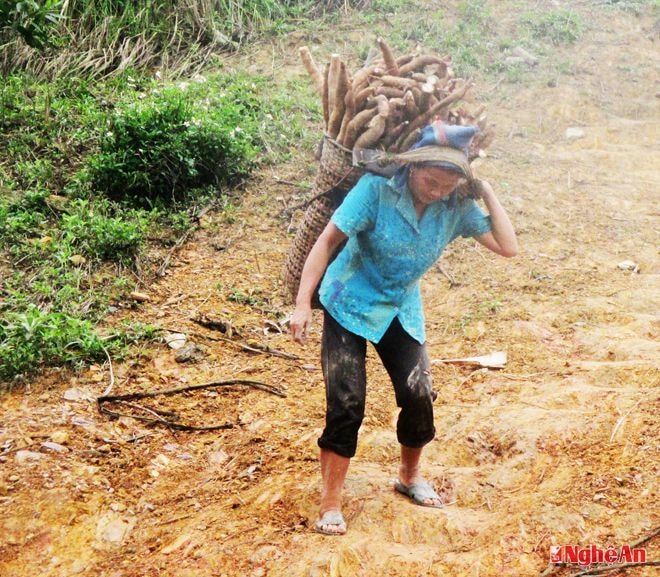 |
| Women in Ta Xieng - Ngoc Lam village (Thanh Chuong district) harvest cassava. |
On a significant March day for women, about a decade ago, I asked an elderly woman in the village what she did on March 8th, whether she got any rest, and if her husband cared for her like women in the lowlands. She shared: "It was just another normal working day in the fields. I know it's a happy day for women, but their biggest concerns are still food, clothing, and farming. On that day, which the women call 'Women's Uprising,' only the village women's association organizes singing and sharing of candy. Older women like me, past the age for association activities and not suited to the younger generation's singing, still go to the fields as usual. Some women, even though they are members of the village women's association, are busy earning a living on this day for various reasons, so it's just another ordinary day for them."
Things are different now, aren't they? I wondered, and I made my way to the highland villages of Ngoc Lam commune (Thanh Chuong district). We arrived at Xieng Lam village on a drizzly morning. Indeed, the old village only exists in memories, as the stilt houses have almost completely disappeared. What remains to recognize this village is the Thai language still spoken daily by the villagers and the scattered traditional women's clothing along the concrete roads in the village. On the village's volleyball court, a group of more than a dozen village girls were practicing to compete with other villages in the commune to celebrate International Women's Day. So, things are different from a decade ago, the day I spoke with that old woman. Today, women in Xieng Lam village, as well as in the highlands, know about volleyball and the day dedicated to women. This thought intrigued me as I passed through the village to visit an elderly woman in the fields named Luong Thi Minh, who had overcome hardship early on and whose life was now gradually stabilizing in her new homeland.
After a long motorbike ride and a short walk, we arrived at Mrs. Minh's family's hut in the fields. Around the thatched hut were rice paddies, fish ponds, and a eucalyptus forest. Mrs. Minh recounted: Her family moved to the new village in 2009, following the call from the Management Board of Hydropower Project II and the government's policy. At that time, there were six people in the family. When they arrived, most villagers were unfamiliar with the land, forests, and streams. The land was barren, the streams small, and there were few fish. Initially, when her husband and children discussed returning to their old village, she was also tempted. But then she thought, if they went back to that remote, isolated place, the old village would be gone, and how would her children and grandchildren get an education? Besides, they had managed to live well despite the difficulties with roads before, so why should they give up here? She discussed with her husband about clearing the allocated land and planning their livelihood…
At the end of 2009, Mrs. Minh and her husband started working again. At dawn, they would wake up, quickly eat some sticky rice, and then begin working, only returning home to cut grass for the buffaloes when the sun was almost setting. Their lunch usually came after 1 PM, and then the arduous task of reclaiming rice paddies continued until dusk. Her hands became calloused, her skin and hair tanned, but this hardship only strengthened her resolve to escape poverty. Back in their old village, her family owned over sixty cows and hundreds of goats. Every year, they deposited hundreds of millions of dong in the bank. When they moved, they could only take six cows with them; the rest were sold. The money from selling the cows and goats, and withdrawing from the bank, was only enough to cover the moving expenses and daily necessities. While it was more convenient here, they had to buy everything from vegetables to rice, and there were also expenses for their children's education, so their once vast fortune of hundreds of millions of dong had dwindled.
After more than five years of hard work, Mrs. Minh's family has acquired a small farm, over 1 hectare in size, consisting of rice paddies, a forest, and a fish pond. Although difficulties remain, the family can now feel secure in their new village. I asked: "You've spent many years working in the fields, so this year, are you planning to come back to the village to celebrate with the other women on March 8th?" Mrs. Minh replied: "I know it's an important day for women, but I can wait until the hardships are over before thinking about celebrating. We just celebrated Tet (Lunar New Year), and now I have to focus on work and family." So, for Mrs. Minh, "Women's Day" is just like any other day of the year. Even so, in her eyes, there's still a glimmer of longing for a truly joyful day.
Sitting shyly listening to our story for a long time was Ms. Vi Thi Loan, Mrs. Minh's niece-in-law, who had come to visit her aunt and uncle. After an initial moment of awkwardness, she confided that at 18, she moved from Tri Le commune (Que Phong district) to Tuong Duong to become a daughter-in-law. Less than a year later, she had to leave her old village with her husband's family and move to a new one. Her father-in-law had passed away, and now she had to care for her elderly mother-in-law, who was visually impaired and had difficulty walking. She didn't know when life would end. Fortunately, thanks to the kindness of the community and the care of the Youth Union and border guards, last year she received a house built with charitable funds, giving her a warm place to return to. Therefore, perhaps this year's International Women's Day will be happier for her.
Leaving Mrs. Luong Thi Minh's small family farm, we followed the newly opened roads on the Ngoc Lam route to Thanh Son commune. This season, the villagers are harvesting cassava. The women here are busy carrying cassava on their backs and shoulders to the trucks. The heavy loads on their backs and shoulders keep their bare feet firmly planted on the ground. I suddenly remembered a friend from the lowlands saying about mountain women: that mountain women are weathered by the elements, yet their skin remains fair. I only feel sorry for their bare feet clinging to the mountain slopes; they're not very attractive. But I think those are the marks of their sacrifices for their families and villages.
Not only their bare feet, but also their hands were calloused from hard work. Yet their eyes always held a smile. Hidden behind those innocent smiles was a dream of a truly joyful day, of a brighter life.
Huu Vi


