
Thanh Chuong faces the risk of water shortage for production.
(Baonghean) - Thanh Chuong district currently has 8,200 hectares of spring rice that are entering the heading stage and urgently need irrigation water. However, due to the low water level of the Lam River, there is a risk of water shortage for irrigation. Service units are also facing difficulties because, in addition to the water shortage, there is a risk of increased electricity costs due to extended pumping times.
Mr. Nguyen Phuong Huong, along with two employees of Thanh Chuong District Irrigation Company Limited, is in charge of operating the Ru Ngoc pumping station to irrigate over 200 hectares of rice fields in Thanh Ngoc commune. During the days when the rice is forming panicles and preparing to flower, in addition to operating the pumps, he has to regularly go down to the water collection pit to clear debris and remove mud before each pumping session.
Mr. Huong said: "In recent days, the demand for irrigation has increased significantly, but due to the low water level of the Lam River, the pumping station is 'out of commission,' so after pumping for a few hours, we have to wait for water to flow into the pump again, thus the water supply efficiency is not high. Never before has the water level of the Lam River been as low as this year..."
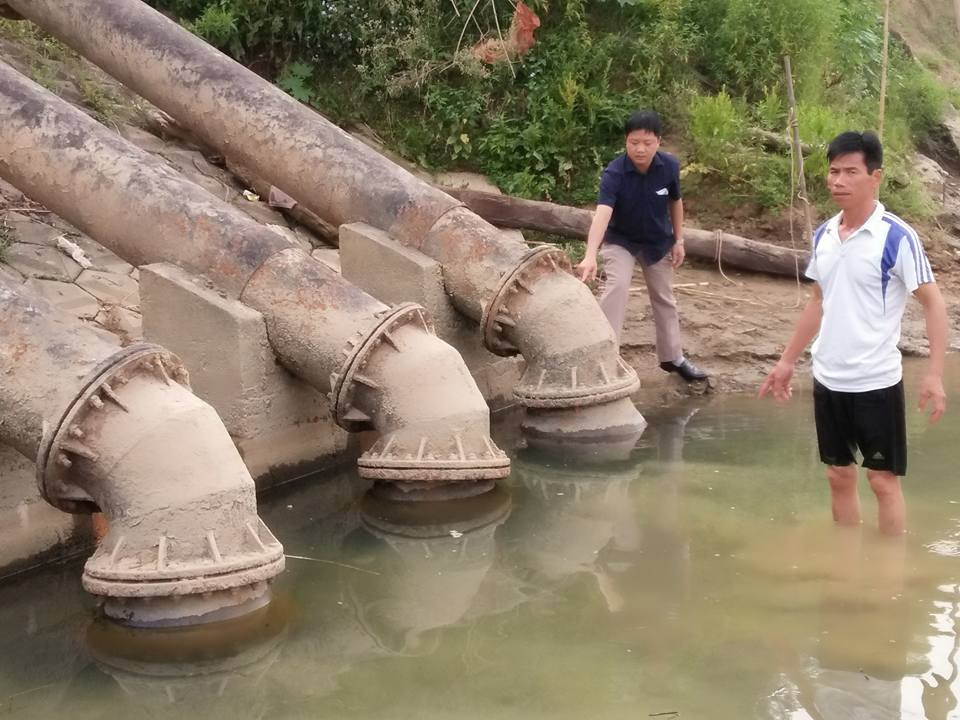 |
| Several pumping stations in Thanh Chuong district are experiencing water shortages for irrigating rice fields. Photo: Dinh Ha |
The Ru Nguoc pumping station is one of six large pumping stations managed and operated by Thanh Chuong District Irrigation Company Limited to irrigate 1,650 hectares of rice fields. Built many years ago, before climate change and the construction of hydroelectric power plants upstream, the Lam River always had full water levels, so most stations were designed with appropriate technical standards and elevations. Now, the river water is low, and many stations have exposed pump beds, making pumping impossible. In some stations, the river water level only covers the pump bed by 0.2-0.4 meters.
Mr. Nguyen Tri Hiep, Deputy Director of Thanh Chuong District Irrigation Company, explained: “Low water levels lead to insufficient pressure. When pumping, swirling water currents create and push air bubbles towards the center of the machine, reducing its power and water flow through the nozzle. Not only is the water supply insufficient, but it also damages the machine and increases electricity costs. The end of the spring crop and the beginning of the summer-autumn crop are the times when water is most needed, and we don't know if we'll be able to operate the system then...”
In response to this situation, to facilitate irrigation, the unit has extended the suction pipes to four stations: Rang, Thanh Hung, Dong Van, and Ru Dung. The Cat Van and Ru Nguoc stations have not yet been connected because the concrete at the bottom of the reservoir was very thick during construction, requiring the demolition of the concrete, which would take considerable time and expense. Simultaneously, manual solutions are being implemented to address the issue; local authorities are being advised to direct and organize water regulation effectively and efficiently. Agricultural cooperatives are also participating by regularly monitoring the fields to regulate water and advising farmers to strengthen embankments to retain water and reduce water loss in the fields.
Despite having a complete system of pumping stations and canals, the low water level of the Lam River is an unavoidable situation in drought prevention efforts. To address this situation, we request that the competent authorities instruct hydropower plants to release water to serve agricultural production, because not only Thanh Chuong district but also many other districts are experiencing water shortages for irrigation due to the depleted water level of the Lam River.


