
Thanh Chuong: Large areas of tea plantations destroyed by fire.
(Baonghean) - For more than a month now, there has been virtually no rain in Thanh Chuong district. The burnt red color of the tea plants is spreading across the hillsides. Rarely has the tea plant in Thanh Chuong faced such a severe drought.
Under the scorching sun, the tea plantation of Mr. Nguyen Doan Huu's family (Hamlet 1, Thanh An Commune) is tinged with a dark red. The tea plants, which have been harvested for the past two years, no longer have their original green color; the leaves have been drying and burning for the past week, and the damage is worsening. Ms. Tran Thi Kim Ngan (Head of the Commune's Agriculture Committee) worried: "With leaves wilting like this, the percentage of tea plants dying from the heat has reached over 70%. If there isn't a heavy rain in a few days to help the tea recover, the chances of saving them are almost nonexistent." Mr. Huu's 0.5-hectare tea plantation, planted five years ago and harvested for two years, is witnessing this situation for the first time. "The tea leaves have been wilting for over a week now, and the affected area and severity of the damage are increasing rapidly. If there are just a few more days without rain, or if the rainfall is insufficient for the tea to recover, we will definitely have to cut them down and replant. I'm worried; replanting one hectare of tea costs over ten million dong," Mr. Huu shared. Due to the drought, Mr. Huu has only harvested tea twice since the beginning of the year, whereas normally, from the first spring harvest until the hot season when harvesting is suspended, he harvests three times.
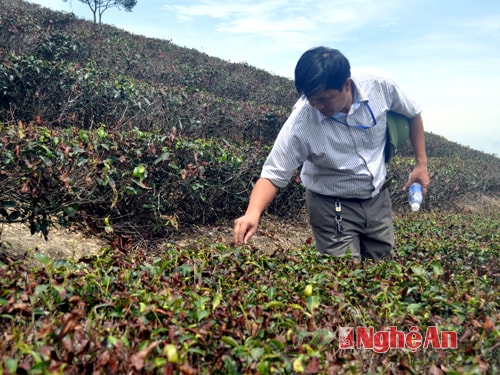 |
| The tea hills in Thanh An commune are scorched red. |
Thanh An commune has 440 hectares of tea plantations, of which over 390 hectares are already in production, and the rest are young tea plants planted last year. 2010 was considered a year of severe drought, but even then, the area of tea plants that died in the entire commune was only 40 hectares in Hamlet 15. However, this year, as of June 6th, Thanh An has 40 hectares of tea plants with over 70% of their leaves burned, with most of the remaining plants affected by 30-70% damage. The area and extent of the damage are still increasing daily. Ms. Tran Thi Kim Ngan (Head of the Commune's Agriculture Committee) said: The tea plants began to wilt on May 20th. On May 25th, there was a rain shower, but the amount of water was insufficient for the tea plants to recover. Instead, it increased the risk of wilting due to the alternating sun and rain, which intensified the heat, causing widespread wilting. If it rains in the next few days, it will have to be a heavy, prolonged downpour; only then might some tea plantations have a chance to recover.
In Thanh Thinh commune, a significant area of tea plantations has been completely destroyed. Mr. Phan Thanh Nga (Chairman of the Commune People's Committee) stated: "The entire commune has 230 hectares of tea, including both tea already in production and newly planted tea. The affected tea plantations are concentrated in both types. In previous years, Thanh Thinh also experienced leaf burn during the summer, but it was scattered and the extent and area were insignificant. However, this year, leaf burn has been occurring since May, and to date, approximately 60% of the commune's tea plantations have been affected. Some tea plantations located at the foot of steep hills, without shade trees, have completely died and are beyond recovery."
Thanh Chuong is considered one of the "tea baskets" of the province, with 3,600 hectares of tea plantations. This crop is very profitable in the hilly areas of the district. However, in recent years, tea growers have been facing difficulties due to drought. Never before has Thanh Chuong tea suffered such severe damage from the intense heat. As of June 6th, according to quick reports from tea-growing communes, over 50 hectares of tea plantations in the entire district have completely died, concentrated in the communes of Thanh An, Hanh Lam, Phong Thinh, Thanh Huong, etc. The remaining areas show widespread damage ranging from 30-70%, with many areas exceeding 70%, and the risk of complete death is very high if the hot weather continues, even if there isn't enough rain. The areas where tea plants have died are mainly concentrated in hilly areas with steep slopes, where the tea plants are unable to absorb water and lack shade trees.
According to Mr. Le Dinh Thanh, Head of the District's Agriculture Department: "Every year, Thanh Chuong district experiences tea plantations damaged by drought, but the severity of this year's drought-induced damage is rare. Tea is a crop that is very drought-resistant; even if leaves fall off due to drought, they can recover if there is enough rain. However, if there is no rain in the area for another week, the damaged tea plantations will be very difficult to recover. Most of the tea plantations are located on hillsides, making irrigation during the dry season virtually impossible. Given this situation, the district can only focus on raising awareness and encouraging people to plant legumes with nodular root systems to provide shade for the tea plants and increase photosynthesis. At the same time, we are advising people to minimize machine harvesting during the hot season to reduce water loss, promote the growth of new leaves, increase photosynthesis, provide nutrients for the tea plants, and enhance their resistance."
Currently, in all tea-growing areas of the province, tea plants are continuing to burn and die at a very rapid rate. According to the Department of Agriculture and Rural Development, as of June 6th, 110 hectares of tea plants have completely died, mainly those newly planted at the end of 2013. The department is currently submitting a proposal to the Provincial People's Committee to declare a natural disaster due to drought, which will then lead to policies to support the affected people. According to weather forecasts, showers and thunderstorms will continue in the province in the coming days. However, to restore the burnt tea plantations, a large and continuous amount of rain is needed. Hopefully, this rain will save the tea hills that are dying from the fire. |
Phu Huong


