
The city and its bridges
(Baonghean) - In the process of "Building Vinh City into a rapidly and sustainably developing city, worthy of a Class 1 urban area and soon becoming the economic and cultural center of the North Central region," the newly completed overpasses are one of the connecting links that alleviate traffic congestion and are a highlight of the landscape of the Red City. When night falls, the bridges become even more dazzling under the colorful lights, further enhancing the charm of a dynamic young city…
In the last months of 2014 and the beginning of 2015, Vinh City had three overpasses completed and put into use: the Cua Nam overpass, the Quan Banh overpass, and the Nghi Kim overpass. These are modern transportation projects that contribute to improving traffic flow, reducing congestion and accidents, and bringing economic benefits. The Cua Nam overpass is the first railway overpass in Nghe An province. Construction began on February 15, 2014, with a total investment of over 435 billion VND. On September 4, 2014, the overpass at the intersection of National Highway 46 and the North-South railway line south of Vinh City was officially completed and opened to traffic.
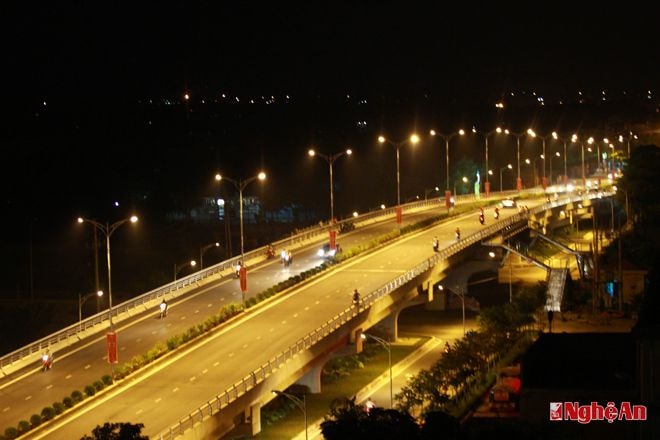 |
| Cua Nam overpass (Vinh City) at night. Photo: Tran Hai |
Nearly two months later, on October 26, 2014, the second railway overpass in Vinh City was also inaugurated and opened to traffic. This overpass is located at the northern "gateway" of the city, at the intersection between the North-South railway line (railway kilometer marker 314+713) and National Highway 1A (road kilometer marker 456+629) in Nghi Kim commune. The joy continued, and on January 31, 2015, the railway overpass connecting National Highway 46 with National Highway 1A and the North-South railway line in the Quan Banh area of Vinh City was also inaugurated. The overpass is 395.5m long and 12m wide. Construction began in August 2014, and after six months of implementation, the project was completed to the required quality standards, nine months ahead of schedule.
Not only have these overpasses solved traffic problems, but they have also contributed to beautifying the architectural landscape of Vinh City, creating scenic highlights in the areas they cross. In particular, the Cua Nam overpass has been fitted with LED lights, creating a magical atmosphere at night and becoming a popular destination for tourists. Ms. Nguyen Thi Van (63 years old), a tourist from Ho Chi Minh City, shared her feelings about exploring: “From the vantage point on the three overpasses, I can broaden my view and clearly see a part of the heroic Red City. It's really interesting. Especially exploring the overpasses at night. I am very impressed with the lights and the shadows of the overpasses reflecting on the Cua Nam Park lake and the Can Linh pagoda…”
From the elevated bridge, one can enjoy a panoramic view of the vast Cua Nam Lake, with the distant Quyet Mountain and Phuong Hoang Trung Do, and closer by, the Can Linh Pagoda beside a picturesque lotus pond. This ancient temple, formerly known as Linh Van Tu, was built in 886 during the Early Le Dynasty and was officially classified as a historical monument by the State in January 1992. Previously, two kings, King Tu Duc and King Bao Dai, visited the temple. Notably, King Tu Duc donated two plaques in Chinese characters with the inscription: "Offered by the Duc Tu Dynasty," along with the large inscription "Can Linh," signifying the temple's sacredness. Currently, the temple houses 100 statues showcasing the masterful sculpting skills of contemporary artisans, including a precious statue of Buddha Shakyamuni located in the center of the main hall. In summer, from the elevated bridge, visitors can admire the white lotus pond in front of the temple, inhaling the fragrant scent carried on the breeze, bringing a unique sense of refreshment and tranquility. Today, Can Linh Pagoda is not only a place of worship and spiritual and cultural activity for the people in the surrounding area, but also an attractive tourist destination.
From the Quan Banh overpass in Nghi Kim, one can see a vast area of Nghe An province. To the east lies the coastal town of Cua Lo – situated between two major rivers, the Lam River to the south and the Cam River to the north. Here, Thach Dong mountain rises high, with Song Ngu Island and Hon Mat Island visible in the distance. The mountains of Bang Nhan, Kiem, Lo, and Song Ngu Island are all scenic spots associated with legends of famous officials and generals. Cua Lo is also a land linked to many myths, where the footprints of the two children of Lac Long Quan and Au Co are left on their path to establishing their lives; to the north are Dien Chau and Nghi Loc, where the Cuong Temple and Bai Lu beach are located, the site of the tragedy of My Chau being beheaded by her father, King An Duong Vuong, and her body parting with a rhinoceros horn as she descended into the sea; My Chau's tomb is in La Nham; and Ngoc Well is where My Chau's last drop of blood remained, which Trong Thuy used to look into and transform into a sparkling pearl. The temple dedicated to King Ho Quy Ly's beloved daughter is located beside the verdant Iron Canal, once stained red with blood in the legend of the White-Clothed Princess; to the west lies Nam Dan with its famous mountains of Dai Hue and Thien Nhan.
The presence of bridges, along with the groundbreaking development of infrastructure, has made the urban landscape of Vinh increasingly attractive and beautiful, promising to soon become a tourism and service city.
Thanh Son


