
Vinh City: Lack of clean industrial cluster models
(Baonghean) - With 5 industrial clusters (ICs) namely Dong Vinh, Nghi Phu, Hung Loc, Hung Dong, and Nghi Kim, Vinh City is one of the leading units in the development of industrial clusters in our province. Besides the practical benefits of this model, such as creating jobs for workers, increasing production value, and boosting state budget revenue, the ICs have revealed many shortcomings during their operation, including: inappropriate mechanisms, policies, and planning and investment; inconsistent technical infrastructure; and outdated production lines and technologies in some enterprises.
Mr. Nguyen Van Thao, Director of Viet My Fertilizer Joint Stock Company in Nghi Phu Small Industrial Park, complained: “Following the investment incentive policy in Vinh City's industrial clusters, businesses are allowed to lease land for a stable period of 5 years. After 5 years, the land price is adjusted according to preferential policies, with the adjustment not exceeding 15% of the previous price. To date, some businesses in Nghi Phu Industrial Cluster have completed their first 5-year stable lease period, but the relevant departments have issued new prices that are excessively higher than the old ones. For example, Viet My Fertilizer Joint Stock Company saw an increase of over 500% (from over 20 million VND to over 100 million VND/year). Similarly, Thanh Trung Trading Joint Stock Company increased by over 1,226%, Ngoc Thach Trading Joint Stock Company by 653%, Long Binh Production and Trading Joint Stock Company by 625%, and Tung Duy Private Enterprise by 642%... In the current difficult economic conditions, such a price increase is unacceptable.” "The excessively high land prices have directly affected the production and business activities of enterprises." It is known that the Nghi Phu Industrial Cluster Business Association has repeatedly sent documents to relevant authorities at all levels requesting a review of land lease prices in the Nghi Phu Industrial Cluster, but the issue remains unresolved. The Nghi Phu Industrial Cluster covers an area of 10.5 hectares and currently houses 18 enterprises that have built factories to serve their production and business operations.
One particularly difficult problem to solve at some industrial parks in Vinh City is that residential areas are located right next to them, causing significant inconvenience for both residents and businesses. Mr. Truong Quoc Tuan, Director of Thien My Co., Ltd. in Hung Loc Industrial Park, recounted: “In 2009, our company invested in building a factory in Hung Loc Industrial Park, initially processing white limestone powder to produce various building materials and interior decorations. However, after thoroughly investigating the situation there, we discovered that several other factories that had invested in crushing limestone powder had struggled due to complaints from residents about noise and wastewater. Therefore, we had to change our investment project to a different industry: building a factory to serve as a warehouse for trading high-end interior and exterior decoration products and roofing tiles… Even so, despite investing over 15 billion VND here, our company remains apprehensive because we still haven't secured a land lease contract. Consequently, we haven't been able to obtain bank loans to implement the project of building a steel rolling mill, resulting in missed investment opportunities.” To avoid public backlash and disruption, Thien My Co., Ltd. has agreed to change its production purpose and, in its factory expansion plan, is also considering importing steel billets for rolling to minimize the impact on the lives of people in the surrounding area.
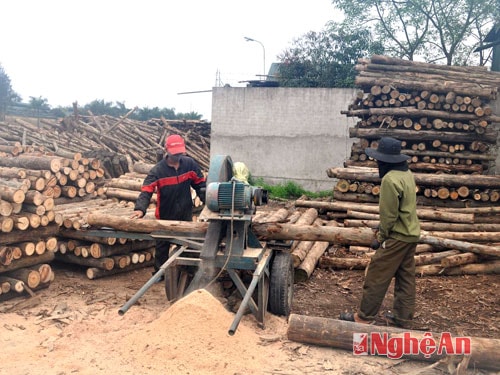 |
| Forest product processing in Hung Loc Industrial Cluster. |
The Hung Loc Industrial Cluster covers an area of nearly 8.9 hectares, with phase 1 of the project covering 5.5 hectares. Ten businesses have established factories there, and currently nine are operational in the fields of timber processing, packaging, plastics, limestone powder processing, and various types of paper. Recently, due to market fluctuations, difficulties in raw material supply, and strong opposition from residents near the Hung Loc Industrial Cluster, businesses in the limestone powder processing sector have had to temporarily suspend or halt production. Vinh An Co., Ltd. leased over 4,168 m2 of land to invest over 16.9 billion VND in building a limestone powder processing plant. Prior to 2012, its production value reached nearly 8.2 billion VND (in 2012), providing employment for 35 workers. However, since 2013, the company has been operating at a reduced capacity. Currently, some manufacturing businesses in the fields of timber processing, plywood production, and toilet paper production are operating efficiently, but are causing environmental pollution.
Mr. Nguyen Tien Nam from My Ha hamlet, Hung Loc commune, reflected: "The people living around this area are very uncomfortable with the foul smell emanating from the drying ovens of the wood processing factories, as well as the waste and wastewater in this industrial cluster. Environmental pollution from the Hung Loc industrial cluster has not been thoroughly resolved, greatly affecting the lives of the people." Although Hung Loc Industrial Cluster is generally clean, some businesses involved in paper production, timber processing, and stone powder processing have been discharging waste, wastewater, noise, and foul odors into the environment during their production processes. Meanwhile, the technical infrastructure is not yet fully developed; wastewater and waste treatment facilities are only at a basic level. Furthermore, the drainage system is not regularly dredged, leading to blockages and overflowing waste in some sections. To gradually address this situation, Hung Loc Industrial Cluster is currently upgrading and renovating its wastewater treatment system; however, the slow progress continues to affect the lives and production of local residents.
These problems also occur at the Dong Vinh Industrial Cluster, and some businesses face difficulties in their production and operations due to the reaction of residents living near the cluster. Ideally, a comprehensive green space system should be planted at the Dong Vinh Industrial Cluster to create an environmental buffer zone between the cluster and residential areas. However, due to a lack of investment capital, this project has not been implemented. The estimated capital for planting trees in 2002 (when the Dong Vinh Industrial Cluster investment project was launched) was 180 million VND, but at this time, it will cost billions of VND. In addition, the Dong Vinh Industrial Cluster also needs an investment of approximately 2 billion VND to upgrade and renovate the wastewater treatment plant to meet the production and business requirements of 7 enterprises operating in the fields of packaging, stainless steel, aluminum and glass, forest product processing, fine art woodworking, and rattan and bamboo weaving.
To date, 3 out of 5 industrial clusters in Vinh City have basically filled their area, but during operation, many problems have arisen that have not yet been resolved satisfactorily, causing frustration not only for businesses but also for residents in the surrounding areas. To prevent the two industrial clusters currently being prepared for development (Hung Dong Industrial Cluster with an area of nearly 40 hectares - the investor being Vietnam Railway Construction Corporation JSC, which is building and operating the technical infrastructure, and Nghi Kim Industrial Cluster with an area of over 25 hectares, currently seeking investment for the construction and operation of technical infrastructure) from falling into the aforementioned difficulties, relevant levels and sectors first need to unify and stabilize the mechanisms and policies to incentivize investment for businesses in industrial clusters in Vinh City. Furthermore, specific planning that aligns with reality is necessary, along with strengthened management of plan implementation. It is crucial to prevent overlapping plans and the mixing of residential areas with industrial clusters. Particular attention should be paid to the investment and construction of clean water supply, wastewater treatment, waste disposal, and environmental protection facilities.
To date, Vinh City still lacks a model of a truly clean industrial cluster. Therefore, in the coming time, Vinh City needs to pay attention to and invest in achieving this goal to create a solid foundation for the sustainable development of industrial clusters.
Hoang Vinh


