
Members of the Vietnam Fatherland Front contribute their opinions on Article 4 of the draft Constitution.
On February 27th, in Hanoi, the Central Committee of the Vietnam Fatherland Front held a conference to gather opinions from member organizations and a number of socio-political organizations on the draft amendments to the 1992 Constitution.
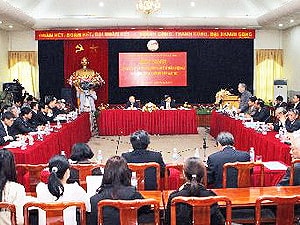
Overview of the conference to gather opinions from member organizations of the Fatherland Front and a number of socio-political organizations on the draft amendment to the 1992 Constitution.
(Photo: Nguyen Dan/VNA)
Many delegates agreed that the draft amendment to the 1992 Constitution continues to affirm and clearly express the idea of promoting the strength of national unity, considering national unity as a driving force and a great source of strength for building, protecting, and developing the country. The content of the draft is expanded, highly generalized, and more concise, in line with the development trends of society.
According to Associate Professor Dr. Tran Van Ta (Chairman of the Vietnam Association of Certified Public Accountants), this draft has several noteworthy new points: it places the people at the center, with the people's right to self-governance as a consistent theme; and it clarifies and upholds human rights.
Secondly, it is necessary to recognize and define the Vietnamese economy as a socialist-oriented market economy with diverse forms of ownership, multiple economic sectors, and a long-term, cooperative, equal, and legally-based development model.
This is the first time the Constitution includes provisions on environmental protection and sustainable development, and also the first time it stipulates three independent constitutional institutions: the Constitutional Council, the National Election Council, and the State Audit Office – a new provision to perfect the mechanism for protecting the Constitution.
Addressing a topic of great public interest, namely the role of the Party in the draft amendment to the Constitution, Associate Professor Dr. Tran Van Ta affirmed that the leading role of the Communist Party of Vietnam in the State and society cannot be denied, and he agreed with the addition of Clause 2, Article 4: "The Party is closely connected with the people, serves the people, is subject to the supervision of the people, and is accountable to the people for its decisions."
However, the issue is that the mechanisms and methods of public oversight, and the mechanisms and methods of accountability to the people, must be legally defined to avoid mere slogans, formalities, and a lack of implementation in practice.
Professor, Doctor, and People's Teacher Nguyen Lan Dung also emphasized that the draft has added two extremely important paragraphs to Article 4. These are: "The Party is closely connected with the people, serves the people, is subject to the people's supervision, and is accountable to the people for its decisions" and "Party organizations and Party members operate within the framework of the Constitution and laws."
According to Mr. Dung, strictly implementing the provisions of Article 4 of the amended Constitution will certainly restore the immense trust that our people have in the pioneering Party.
Professor Nguyen Quang Thai (Secretary General of the Vietnam Economic Science Association) suggested that all provisions regarding the Party should be consolidated into Article 4 and written carefully and rigorously, clarifying that the Party leads but remains within the nation, under the law, and subject to the supervision of the entire population.
Mr. Nguyen Anh Lien (Chairman of the Vietnam Association of Former Youth Volunteers) suggested emphasizing that the Party's leadership role must go hand in hand with the Party's responsibility to the people, while the people have a role to play in relation to the Party; the Party is intimately connected to the people.
Regarding human rights and the rights and obligations of citizens, Associate Professor Dr. Tran Van Ta believes that regulations restricting certain citizens' rights accompanied by phrases like "as prescribed by law" or "as decided by competent authorities" should be minimized, as such regulations are unclear and easily abused, violating the legitimate rights of citizens.
Professor-Doctor Nguyen Lan Dung suggested amending the phrase "according to the provisions of the law" to "if those freedoms do not go against the aspirations and happiness of the people," because in reality, there are many wrongful acts of wrongdoing that later require exoneration, compensation, and waste a great deal of time and money for innocent people.
Many opinions suggest adding a clause to the Constitution regarding the "people's right to referendum" on the Constitution and important national affairs, and establishing the principle that the most important issues must be submitted to the people for referendum. This would serve as the basis for developing a law specifying the methods, procedures, and processes for exercising the people's right to referendum.
Professor Nguyen Quang Thai stated: "To create a truly meaningful and lasting constitution, it requires broad public participation and must be ratified by the people."
Emphasizing the issue of children's rights, including those of disabled children, Mr. Nguyen Ba Duyet (Vice President of the Vietnam Association for the Relief of Disabled Children) stated that the issue of disabled children is not clearly addressed, but only mentioned generally in the provisions concerning disabled persons. Furthermore, the role of the State in ensuring children's rights in a market economy has not been fully demonstrated.
Mr. Nguyen Ba Duyet suggested that the draft should dedicate a separate article to fully express the rights of children and the role of the State towards children, especially disabled children, as this is a vulnerable group in society.
Regarding one of the new institutions, the provision on the Constitutional Council (Article 120 of the Draft), many opinions suggest that the Constitutional Council should be designed as an exclusive institution with jurisdictional capacity to proactively protect the Constitution and ensure the independence of constitutional review activities. The Constitutional Council, as stipulated in the draft, is currently limited to advising on and reviewing the constitutionality of legal documents and making recommendations or requests to relevant agencies to take action when there are unconstitutional legal documents.
Some opinions suggest researching and selecting the optimal model currently adopted by many countries: the Constitutional Court – a completely independent body, bound only by the Constitution, with the function of making decisions such as suspending, rejecting, and annulling unconstitutional legal documents, and other powers, including the power to judge disputes and lawsuits in elections and election results, and the power to impeach high-ranking state officials.
At the conference, delegates also contributed many opinions on the role and position of the Vietnam Fatherland Front; on the state apparatus; state power; social security issues and preferential treatment for meritorious individuals; and nurturing the younger generation. Besides suggestions on content, there were proposals for amendments to the constitutional drafting techniques, clarifying and making more complete some articles that were vague, lacking specificity, unreasonable, and difficult to apply in practice, such as: Everyone has the right to life (Article 21); Everyone has the obligation to pay taxes (Article 50).../.
According to (VNA) - LT


