
Removing loan restrictions for farm businesses.
(Baonghean) - In recent years, farm economics in our province has contributed to promoting the transformation of the agricultural and rural economic structure, accelerating the new rural development program with the formation of large-scale, concentrated commodity production areas. However, there are still bottlenecks that need to be addressed for the sustainable development of farm economics.
Farm-based economy is booming...
After many years of wandering, Mr. Hoang Van Son (from Yen Son commune) finally returned to his hometown to start his own business. With many years of experience in livestock farming, after more than 10 years of development, Mr. Hoang Van Son's pig farm in Yen Son commune is considered one of the largest in Do Luong district. Currently, Mr. Son owns 2 hectares of ponds for raising traditional fish species and 100 breeding sows, averaging 3 batches of about 600 pigs per year. After deducting expenses, he earns a profit of 700-800 million VND. In addition, his farm provides regular employment for 8-10 local workers with an income of 2.5-3 million VND per person per month.
Currently, Mr. Son has invested in building a solid farm divided into three separate areas: a breeding sow area, a piglet area after weaning, and a fattening pig area... Do Luong district is a locality with a rapidly increasing number of farms in the province, currently having over 300 farm and household economic development models, of which 85 farms meet the new criteria of the Ministry of Agriculture and Rural Development (according to Circular 27/2011/TT-BNNPTNT); 25 farms have been granted land use right certificates. In general, the livestock farms are operating effectively, exploiting human resources and the potential strengths of the locality, creating jobs, increasing income for workers, and helping many farmers rise to prosperity...
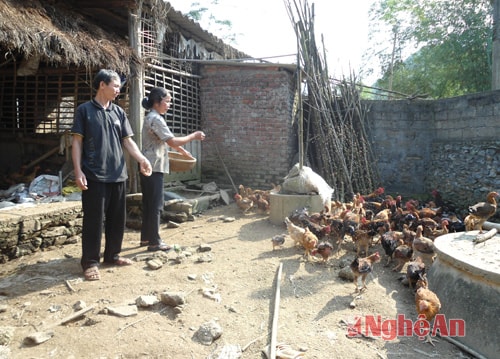 |
| The effective livestock farming model of war veteran Nguyen Ba Dai in Hamlet 9, Hong Son Commune, Do Luong District. Photo: Doan Hoa |
In Hung Nguyen district, as of the end of 2013, there were 310 farms, with a total land area of over 400 hectares, averaging 1.3 hectares per farm, and a total estimated investment in basic construction of over 130 billion VND. Of these, 16 farms met the standards according to Circular 27. Currently, the most common type of farm in the district is the mixed farm, with over 200 farms, ranging in size from 0.5 to 2 hectares (mainly raising pigs and ducks combined with aquaculture). The duck-fish farming type has 20 farms in the district, ranging in size from 0.3 to 1 hectare, with 500 to 1,000 laying ducks per farm. Profits range from 100 to 150 million VND per farm per year, not significantly lower than pig farming combined with fish farming, but it offers greater stability. Most farms are able to independently secure funds for duck feed thanks to daily egg sales. The specialized aquaculture sector comprises 60 farms, primarily raising traditional fish species on a scale of 1 to 3 hectares; average revenue ranges from 100 to 300 million VND per year per farm...
To date, there are approximately 2,300 farms in the province, with an average income of 150-200 million VND per farm per year. It can be said that the collective farming model has helped many families escape poverty and become wealthy, with the emergence of many advanced models and new approaches using scientific management methods and incorporating advancements in breeding and livestock production. Through these models, farmers have learned and adopted effective practices, gradually replicating them and transforming the economic lives of their families and the appearance of rural areas. The development of the collective farming model has also effectively exploited and utilized barren hills, riverbanks, ponds, and the sea, creating significant agricultural, forestry, and aquatic products. Farm economics has opened up new avenues of business, forming a dynamic and proactive farming community. More and more successful farm models are emerging...
There are still difficulties.
Since the 2000s, Government Resolution 03 has identified two limitations hindering the development of farm-based economies: capital and production land. Even after 13 years, both "bottlenecks" regarding production land and credit have yet to be resolved.
For nearly two years, pork prices have consistently fallen, making it difficult for farmers to develop and expand their operations. A recurring theme, though not new, remains highly relevant whenever we speak with farmers: the ever-increasing price of animal feed, while the price of their finished products continues to plummet. Not only are farmers struggling to find buyers, but they also face difficulties in obtaining loans. With an annual revenue of approximately 800 million VND, farm owner Hoang Van Son considers himself a loyal customer of the Agricultural and Rural Development Bank for many years. In our conversation, he expressed his hope that the government would continue to provide farmers with better access to capital to encourage them to invest more confidently.
Mr. Son pointed out the shortcomings in accessing capital from banks, arguing that there shouldn't be such rigid loan conditions: "People's resources are limited to land and housing, a small amount of land for barns, and some capital for building barns. The remaining investment capital for breeding stock and feed absolutely depends on the bank. However, in reality, the bank's valuation of collateral for livestock farmers' assets is too low, and the loan rate is only 50-75% of the total appraised value. Furthermore, farmers are not allowed to mortgage movable assets, even though these are the most valuable assets for livestock farmers."
Sharing Mr. Son's viewpoint, many livestock farm owners in Hung Nguyen also believe that the current valuation of collateral assets by banks is still low and has many shortcomings. Because of this, livestock farmers are always in a state of "capital shortage" to maintain production. Mr. Nguyen Van Cuong, owner of a mixed farm in Hamlet 1, Hung Tan Commune (Hung Nguyen), cited an example: "For my family's farm, raising 10 sows costs 150 million VND just for the breeding stock. And to meet the needs of a breeding cycle for 10 sows until the first batch of market pigs is ready for slaughter requires more than 300 million VND because on average, one pig costs nearly 3 million VND in feed. Meanwhile, the bank, after appraising the fixed assets, can only lend my family around 50-70 million VND."
"It's not just my family; this is a common problem for pig farmers when their pigs reach their feeding stage. In my opinion, if a farmer can ensure adequate housing and invests in raising more than 10 foreign breed sows, then a loan of 200 million VND from the bank would be reasonable. If they only rely on the valuation of fixed assets, farmers are always short of capital. Because they can't secure their own funding, many farms have run out of capital midway through production and have to borrow money at high interest rates, accumulating feed debts to suppliers." Mentioning the interest on feed debts, Mr. Cuong shook his head in frustration: "At least 5-7% of the feed bag's value is charged by the supplier before they'll release the goods. That means each pig costs an additional 180,000-200,000 VND. Selling a batch of 100 pigs means a farmer loses nearly 20 million VND. How can there be any profit left?"
The State's consistent policy in promoting self-reliance in the economy is to facilitate land allocation and the issuance of long-term, stable land use right certificates. However, in reality, the process is currently slow. Farm land is mainly leased, contracted, or auctioned from the 5% land fund of localities (contracted through the commune level, with a usage period of no more than 5 years requiring renewal). Because of the lack of long-term land allocation and lease, and the high investment capital and risks involved in farms, people are hesitant to invest in building large-scale farms for sustainable production and business development. In addition, the "constraints" regarding criteria and procedures for granting farm certificates are a pressing and difficult issue for many farms to resolve. According to Circular 27/2011/TT-BNNPTNT, only integrated economic models that generate at least 500 million VND per year are eligible for farm certification… This regulation leads to a situation where many models can generate billions of VND in income after a production cycle of a few years, meaning each model exceeds the criteria to be called a farm, but the producers are excluded from state support policies and benefits they should rightfully receive.
To develop the farm economy, relevant agencies need to quickly address the aforementioned difficulties; at the same time, comprehensive measures should be taken to plan production, clearly identify specialized areas for crops and livestock linked to the processing industry; determine the types of crops suitable for each type of soil, and link this with investment in infrastructure systems such as transportation, irrigation, and electricity to serve production. Strengthening management capacity, transferring scientific and technological advancements, and updating market information are also crucial to support farmers…
Ngoc Anh


