Anxious about the temporary bridge.
(Baonghean) - In Quy Hop district, there are nearly 10 temporary bridges that do not meet standards but are still being used by local people. This poses a major danger, acting as "traps" that could lead to accidents at any time.
CThe Dinh River, which runs through Coc Mam hamlet, has a fairly wide channel. During the hot, dry season, the water level drops, and the riverbed is sometimes only about 40-50 meters long. However, during the rainy season, the river water rises, and the channel widens to almost three or four times its original width. Despite the distance, the only means of connecting the residents of Coc Mam hamlet in Tho Hop commune with two other hamlets in Chau Dinh commune is a fragile, dilapidated bamboo bridge.
According to the head of Coc Mam hamlet, Truong Van Bien, the bridge is makeshift, lacking railings, and its deck is weak, made of brittle bamboo that easily breaks. Even walking across it requires caution, let alone riding a motorbike. The bridge deck is just a flimsy woven bamboo mat, less than a meter wide, with holes everywhere; a child could easily slip and fall into the river. Every three or four days, the villagers take turns going to the river to repair the bridge. The work is so frequent that the hamlet can no longer rely on "volunteer" help and has to form separate teams. Each team assigns people to inspect and repair any damaged sections as needed.
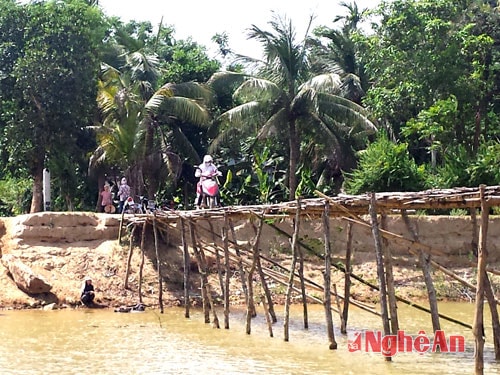 |
| The Coc Mam bridge is a makeshift structure, posing a high safety risk. |
One of the victims of this bridge accident was Mr. Truong Van Kien. Nearly two years have passed, but he and the villagers still remember the accident vividly, because the water level in the river was quite high at the time. While riding his motorbike from one side to the other, Mr. Kien suddenly lost control and unexpectedly both he and his motorbike plunged into the river. The impact was severe; the motorbike was completely damaged, but Mr. Kien also suffered numerous abrasions, including a broken neck that required pins to immobilize it.
Just standing on the Coc Mam bridge for five or ten minutes, you can see dozens of motorbikes belonging to residents of Tho Hop and Chau Dinh communes speeding across the bridge, oblivious to the creaking and swaying of the structure. Mr. Truong Van Hung, a resident of the commune, said: “If we don’t use this bridge, where else can we go? Should we have to go around to Nghia Xuan, Tam Hop, and then back, a distance of over twenty kilometers? The most heartbreaking thing is for the students, from kindergarten to high school, who have to cross this bridge every day to get to school.”
Also from Coc Mam, Mr. Truong Hai Nam, Deputy Head of the Industry and Trade Department of Quy Hop District, said: "Without bridges, people suffer in many ways, from transportation and education to daily life. Agricultural products are also sold at low prices due to the difficult transportation conditions… There are currently 9-10 such makeshift bridges across rivers and streams in Quy Hop District. The common feature of these bridges is that they are all made of bamboo, have no railings, and lack any safety features."
The Dinh River, which runs through Quy Hop district, has more than 40 large and small tributaries. The terrain is also fragmented by many rivers and streams, so bridges are the only solution for people's transportation. Without bridges, people would be isolated. To address the transportation problem for the people, Quy Hop district has developed a transportation development plan from now until 2020, which focuses on building suspension bridges and causeway bridges. However, due to limited funding, after much effort, the only suspension bridge currently in the area, running through Chau Dinh commune, was only completed in 2013. The rest are still in the planning stage, such as Son Tien bridge, Tam Lien bridge, and Ban Thinh bridge. The Coc Mam bridge is considered the most feasible, having been approved with a total project budget of nearly 27 billion VND and planned for construction in 2014, but it has also been delayed due to waiting for funding. In many other areas, building causeway bridges is considered a more economical solution, but it is not yet feasible to implement, even though people are facing a real and urgent need for transportation.
In an effort to find solutions, residents of Coc Mam hamlet (Tho Hop commune) and Tan Hop, Dong Hop, and Dong Song hamlets (Tam Hop commune) have contributed their efforts and resources to build concrete bridges. Thanks to this, for a short period, the people here had semi-permanent concrete bridges to use. However, due to limited funds and a lack of careful consideration of technical conditions, soil conditions, and flood levels, both times the bridges built with the people's money in Coc Mam were swept away by floods. The most recent incident was in 2009, when the bridge was completely destroyed less than a year after its construction, resulting in losses exceeding 500 million VND. The Tam Lien bridge in Tam Hop commune, while not completely destroyed, is now severely dilapidated. Currently, the railings on both sides of the bridge are broken, and the bridge itself is narrow, making it extremely dangerous to cross. Mr. Nguyen Van Trung, Chairman of Tho Hop commune, also said: "Building a sturdy bridge is beyond the commune's capacity. Therefore, when proposing a plan, all aspects must be considered to avoid waste and inefficiency like in previous constructions, in order to reassure the people."
To ensure the safety of the people, Quy Hop district has also issued a document to all communes and towns currently having temporary bridges. The document affirms that all these bridges are unauthorized, self-built, and unsafe for people to cross. Therefore, it requires communes, wards, and towns to direct their respective hamlets and villages to dismantle these temporary bridges. Simultaneously, they must arrange safe ferry services with permission from the competent authorities or upgrade and improve inter-hamlet roads to serve the people's safe and convenient travel and daily life. Regular inspections and preventative measures must be taken to stop individuals from building bridges without authorization. If accidents occur, the local authorities responsible for allowing people to build bridges without authorization will be held accountable.
My Ha