
Teacher who suffered horrific traffic accident has his arm reattached.
(Baonghean.vn) - While driving a white Ford Ecosport, a teacher named Nga lost control and crashed into a road barrier. A barrier pierced his right arm, almost severing it completely.
To date, three days after undergoing surgery to reattach his nearly severed arm at Nghe An General Hospital, patient Ha Huy Nga (36 years old, a teacher in Quy Hop district) has shown good progress, and his severed arm is showing signs of recovery.
Driver loses arm after car splits in two.
At approximately 2 PM on July 16th, a serious accident occurred on National Highway 48C, specifically the section running through Lien Tan hamlet, Tho Hop commune (Quy Hop district). The white Ford Ecosport, driven by Mr. Ha Huy Nga, was traveling from Quy Hop town towards National Highway 48. Upon reaching the Thung Heo bridge, in Lien Tan hamlet, Tho Hop commune (Quy Hop district), the driver suddenly lost control and crashed into the road barrier. The accident caused the barrier to almost pierce the windshield, and the driver's right arm was nearly severed. |
At 5 PM on July 16th, the Emergency Department of the Provincial General Hospital received patient N., who was admitted with a nearly severed wound to the lower third of his right arm, 4 hours prior to the incident, following a traffic accident that occurred earlier that day.
Upon admission, the patient was in traumatic shock. All bones, blood vessels, muscles of the right arm, and the median, radial, and ulnar nerves on the right side were completely severed. Only a 5cm piece of skin remained on the patient's arm; the arm was pale and cold, the wound was jagged, contained many foreign bodies, and was severely crushed.
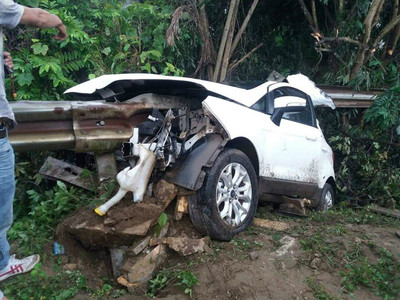 |
| The Russian teacher's car was severely damaged after crashing into a road barrier. Photo: Hung Cuong |
Immediately, an interdisciplinary consultation team comprising specialists in Trauma, Thoracic Surgery, and Anesthesia and Resuscitation was mobilized. Recognizing the patient's severe blood loss due to the lack of blood supply to the limb, and the high risk of limb necrosis and disability if not treated promptly, the consultation team decided to proceed with emergency surgery.
The surgery, which lasted over 3 hours overnight, was a coordinated effort by doctors from two specialties: Traumatology and Orthopedics, and Cardiovascular and Thoracic Surgery.
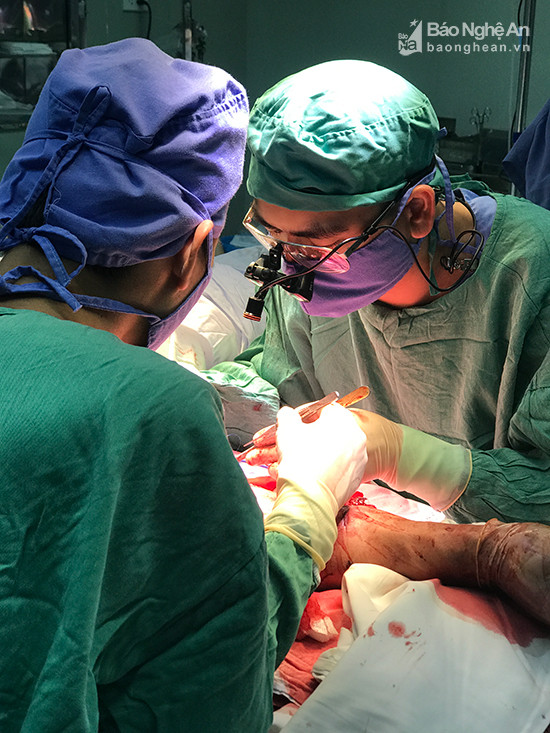 |
| Doctors are in the process of reattaching the patient's arm. Photo: Hoang Yen |
"Immediately after the trauma team fixed the fractured humerus with pins, the vascular surgery team quickly exposed the vessel, controlled bleeding, and removed the damaged brachial artery tissue. Then, they performed brachial artery and vein grafting using an autologous saphenous vein taken from the patient's thigh."
"After vascular grafting, and observing that peripheral circulation had restored blood flow and venous return was possible, the trauma team proceeded to debride necrotic and crushed muscle and soft tissue, and reconnect tendons, the median nerve, and the ulnar nerve," said Master Pham Van Chung, deputy head of the Department of Cardiovascular and Thoracic Surgery, and vascular surgeon.
After surgery, the patient was transferred to the Surgical Intensive Care Unit for close monitoring and intensive care. The resuscitation and wound management process was carried out strictly according to protocol. Controlling post-operative necrotic infection was crucial, as the patient's arm wound was crushed and very dirty. The patient was maintained on anticoagulants, painkillers, diuretics, and high-dose antibiotics, along with frequent dressing changes and wound cleaning. Due to arterial damage, the hospital mobilized nearly 3 liters of blood and plasma for transfusion.
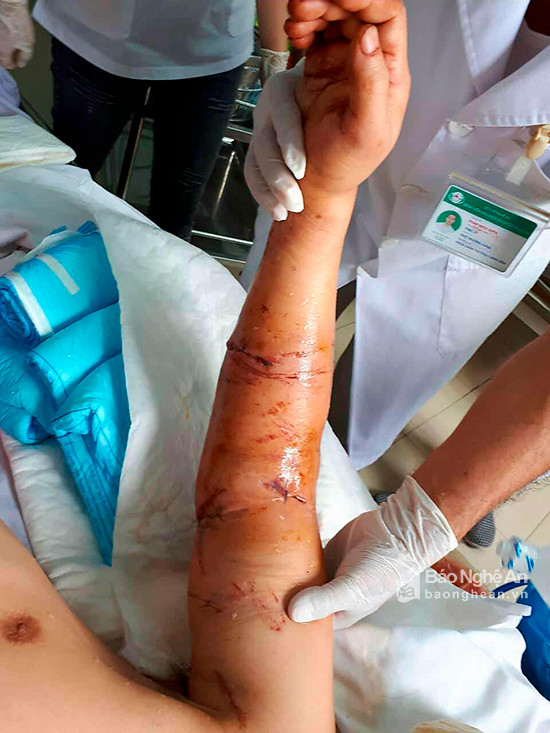 |
| The patient's arm after surgery. Photo: Hoang Yen |
“To date, the patient's health has stabilized, the hand is warm and pink, and the pulse is clear. Initially, the reattached arm has shown promising results. It is expected that once the patient's arm condition stabilizes, the Orthopedic Trauma doctors will proceed with surgery to reconnect the two missing segments of the radial nerve to restore the patient's mobility,” said Master Phan Ngoc Khoa, Deputy Head of the Orthopedic Trauma Department.
Hoang Yen


