
Doctors in the highlands
(Baonghean) - They chose the white coat to pursue their dream of "healing and saving lives," chose remote villages to stay in, and chose their homeland, still facing many difficulties, to return to. As the end of February approached, the day honoring doctors and medical professionals, the Baonghean newspaper's reporting team visited doctors and medical staff in the most remote areas to understand and hear many stories and concerns…
Come and stay, leave only to return…
Although retired for a long time, Mr. Le Trong Ba is still affectionately known by the people of Hoa Binh Town as "our doctor." Now 80 years old, Mr. Le Trong Ba remains remarkably sharp. "I've been here for over 50 years," he begins, his eyes reflecting a distant look. Originally from Nam Cuong (Nam Dan), in 1958, just over 20 years old, having graduated from medical college, the young medical officer was assigned by the Nghe An Provincial Health Department to become the Head of the Health Department of Tuong Duong District. At that time, the Tuong Duong Health Department had six staff members. Initially, they shared a three-room wooden house with earthen walls. Back then, the entire district had 21 communes, but only 9 along the national highway had health stations. Later, he requested a quota from the Provincial Health Department to allow qualified individuals to establish commune-level health stations. By 1967, Le Trong Ba, having graduated from a specialized medical training course, volunteered to go to Laos to help establish a medical school, returning only in 1976. He confided: It was the affection of the people in the highlands that kept him rooted in the villages. Through many years of work, he understood and appreciated the lifestyle of the highland communities and had long considered himself a "local."
After saying goodbye to Doctor Le Trong Ba, we went to the Xieng My Commune Health Station (Tuong Duong District). There, we met midwife Nguyen Thi Thu. Thu is from Hoa Binh Town, but married and moved to Quynh Luu. At 32 years old, Thu has already worked at the station for six years. We asked her, "Your husband and children must be here too?" She shook her head, "My husband and children are back in Quynh Luu." Seeing our concerned expressions, she said, "My husband and children are used to it. I only worry when my child gets sick. I'm a doctor, but I'm so far away, and I'm busy taking care of the children of the villagers here. How can I come back to see my child? The people of Xieng My still face many hardships."
Like Thu, nurse Nguyen Trong Long (My Ly Health Station - Ky Son) also left his wife and children behind in his hometown of Tan Son, Do Luong. Born in 1967, Long has been working in this border district for 14 years. Before coming to My Ly, he worked at the Muong Tip Health Station. My Ly is 60 km from the district center. Located at the headwaters of the Nam Non River, My Ly's terrain is extremely complex, with some villages more than 20 km from the center, such as Cha Nga and Xop Duong, requiring a motorboat trip upstream, crossing dozens of large waterfalls; Nhot Lot village requires almost a day's walk. Reaching the center is a difficult journey, so like Thu, Long only visits his wife and children once every few months.
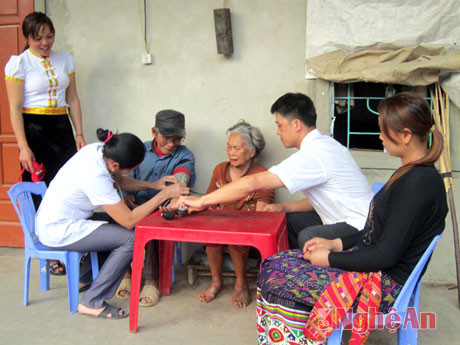 |
| Medical staff from Huu Kiem commune (Ky Son district) provide medical examinations and treatment to villagers at their homes. Photo: Cong Kien. |
The youngest doctor we met and talked to on this trip was midwife Vi Thi Dung at the Keng Du Health Station (Ky Son). Her family is from Huu Kiem, and Dung has been working in Keng Du for three years. “My friends have all found their places, but I live so far away, who would dare to love me?” Dung said, her playful tone tinged with sadness. Keng Du is a border commune, located 80km from the district center, with very difficult transportation. Many villages in Keng Du still maintain outdated customs, such as inviting shamans to perform rituals whenever someone in the family is sick. Families face economic hardship, sometimes even starvation, but they still have to slaughter pigs or cows for the shaman's ceremonies. Only after the ceremony, if the patient doesn't recover or gets worse, do the villagers consider taking them to the health station or asking doctors to come to their home for treatment. “It is because I witnessed these difficulties that I couldn't leave…” Dung confided.
Unlike other doctors who came and stayed, Dr. Ngan Van Anh left only to return. Born in Khe Lo village, after graduating from high school in 1995, he was selected to study at Thai Nguyen University of Medicine. There, he specialized in internal medicine. After seven years of study and graduation, he was assigned to work at the district health center. While this was a very convenient location, he thought that his hometown was far away, the people were still very poor, and many suffered from illness without doctors to provide medical care. So, in 2004, he requested to return to his hometown. Upon returning, he was elected head of the commune's health station, a position he holds to this day. “When the commune health station has a doctor, especially if that doctor is a local resident who volunteers to come back to their hometown to provide medical services to the people, the bond between the people and the doctor becomes even stronger,” Dr. Anh proudly said. “The people feel more secure when a doctor examines them. Therefore, on the days I'm on duty, there are many patients. I examine the people, guide them on how to use the medicine carefully and clearly, so everyone likes me. My advantage is that I'm a local, so I understand the customs and traditions, and I'm fluent in the language, so when I speak, the people understand and follow my instructions.”
Memories related to the profession
So much sadness and joy follow the footsteps of the doctor as he travels to the villages. Sometimes it's helplessness and sorrow, other times it's overwhelming happiness. But from those moments of selflessness, trekking through forests and wading through streams, from those difficult cases where he had to snatch patients' lives from the clutches of death, faith and love for the doctor have been kindled in the hearts of the people in the villages, near and far.
During his nearly 40 years working in the health sector of Tuong Duong district, Mr. Le Trong Ba still remembers most vividly the malaria and measles outbreaks in the area in the mid-1980s. Those outbreaks claimed the lives of 650 people. He directly reported the situation to the Central Government, the Provincial Party Committee, and the Provincial People's Committee, and received instructions to address the problem immediately. The province then "assigned" 250 health workers to Tuong Duong to directly care for the health of the people in the villages, thus bringing the measles and malaria outbreaks throughout the district under control. He himself worked day and night in the affected areas during those months. He considers his and his colleagues' victory the greatest honor of his life.
For midwife Nguyen Thi Thu, "Although our profession is midwifery, we have to know everything, and sometimes we're forced to handle situations." Thu remembers most vividly treating a patient with a severe cold. This patient was from the Thai ethnic group and didn't speak Vietnamese. Thu didn't speak Thai either, so the two couldn't communicate about the patient's health condition. In this situation, Thu had to go to Phay village to ask someone to translate. From then on, Thu tried to learn Thai and is now quite fluent. Another time, in the middle of the night, during Thu's shift, a patient was brought in by their family with a torn upper lip and four broken teeth due to an accident. The patient was in pain, and the wounds needed immediate treatment; there was no time to wait. Thu decided to stitch the patient's lip. At that time, Xieng My didn't have electricity, so Thu had to ask the family to use a flashlight to stitch it. The stitching lasted from 11 PM to 3 AM the next morning. The next morning, the patient's family said they didn't have the money to pay and had to wait until the corn harvest was over, as they had no money left. Seeing this, Thu gave them some money to buy milk for the patient to help him regain his strength...
The most memorable experience for Doctor Nguyen Trong Long occurred two years ago, when the My Ly Health Station received a difficult delivery case that required referral to a higher-level facility. However, the journey from My Ly to Muong Xen town was 60km through a rugged, winding forest, and the weather was cold and rainy, so the pregnant woman's family earnestly pleaded with the doctors and nurses at the station to assist with the delivery. After consultation, the station decided to proceed with the delivery, as there was no better alternative. It was highly likely that the lives of the mother and child would be at risk on the way. After the family signed a guarantee, Doctor Long, along with one doctor and two midwives from the station, immediately began the procedure. The delivery lasted nearly five hours before the baby was delivered. At times, the situation was extremely critical, and they considered the possibility of saving only the mother but not the child. The newborn lay motionless for about an hour before stirring and letting out a weak cry. Everyone provided emergency care, the baby gradually regained consciousness, and signs of life became clearer. The delivery was successful, and the mother's family was overwhelmed with joy. To this day, the child has begun to babble its first words. Its parents named it Kha Dinh Menh (Kha Destiny) to always remember the difficult and critical moments of its birth and to remember the hard work of the doctors and nurses at My Ly Health Station.
Midwife Vi Thi Dung also shared with us a difficult case that she and two other doctors successfully saved. It was the case of a pregnant woman in Huoi Pho village. Before her husband rushed to the station seeking help, the family had also invited a shaman to perform rituals. Only when the wife's pain worsened and her life became critical did they think of medical professionals. At that time, the station chief, a doctor from the Keng Du Border Guard Post, and midwife Vi Thi Dung personally followed the man to Huoi Pho. The journey was quite long, requiring nearly five hours of walking. Upon arrival, they discovered it was a premature birth; the woman was in agony and crying desperately. The fetus had already died, so they had to work hard to save the mother. Dung was assigned the task of repositioning the prolapsed cervix. This was a specialty of obstetricians, and since she was only a midwife, Dung was initially very apprehensive and worried. But with no other option in this situation, Dung mustered all her courage to carry out the mission. Ultimately, thanks to the efforts of the doctors and nurses, the pregnant woman from Huồi Phó village was saved.
There are still concerns…
What surprised and impressed us was that when asked about their aspirations, none of the doctors thought about their own personal desires. For them, the most pressing concern was the immense difficulties faced by the people in remote villages, their limited awareness, and their lack of genuine concern for their health. Each vaccination campaign requires immense effort from the doctors to encourage people to get preventative care. Besides transportation difficulties, lack of medical equipment, and inadequate healthcare facilities, many remote villages lack electricity and clean water at their health stations, such as Keng Du (Ky Son). Even the Mon Son commune health station, one of only two commune health stations in Con Cuong district recognized as meeting the new national health standards, still faces numerous shortcomings. According to regulations from the Ministry of Health, commune health stations that meet standards must have electrocardiogram machines, ultrasound machines, and blood glucose meters to provide primary healthcare services to the people. However, Mon Son Commune Health Station lacks all three of these machines. Currently, the station only has one oxygen tank and one suction machine. The lack of medical equipment hinders the effective use of doctors' knowledge, leading to disadvantages for local doctors and residents. Therefore, a large number of patients are referred to higher-level hospitals each year. For example, in 2013, the station had 2,200 patients referred, many of whom did not need to be referred.
Con Cuong District has 13 commune and town health stations, of which 5 have doctors serving for many years and 2 have doctors seconded from other areas: Mon Son, Lang Khe, Don Phuc, Binh Chuan, Chi Khe, Town, and Thach Ngan. Most commune health stations were built with funding from government investment programs. However, current medical equipment has not been invested in to match the professional level of the medical staff, especially at commune health stations that have been recognized as meeting the new national health criteria. This means that we have only focused on the people, while working conditions remain neglected, preventing doctors working at commune health stations from fully utilizing their trained knowledge. Another concern of doctors in the highlands is the fear of falling behind. In such a remote area with limited information and resources, they do not have the opportunity to develop their skills. "Spending a year working with doctors in the central region feels like we've fallen behind by several years." This is a bitter truth that the doctors and medical staff here are having to accept. They hope to be provided with more information and resources so they can self-study, improve their skills, and keep up with advancements. They also hope to attend annual training courses and have internet access to stay updated on the latest information…
And as we bid them farewell and sent them back to the lowlands, we knew they would once again shoulder their medicine bags... Perhaps those hopes and anxieties will take a long time to become reality, but the lives and hopes of the patients have called them back to those rugged roads, to those misty villages... They stayed, because there was no other way; the sacred duty of a doctor is to heal the sick and save lives!
PVMN Group


