
Teacher Van Nhu Cuong: What is VNEN if it's just a way to spend tens of millions of USD?
When commenting on the New School Project (VNEN), teacher Van Nhu Cuong expressed many concerns and anxieties.
"As I understand it, the World Bank is funding $86 million for the project, which, if completed, will continue to phase 2 (applying to lower secondary education), but first of all, this $86 million has not yet been reported or summarized as to what it was spent on."
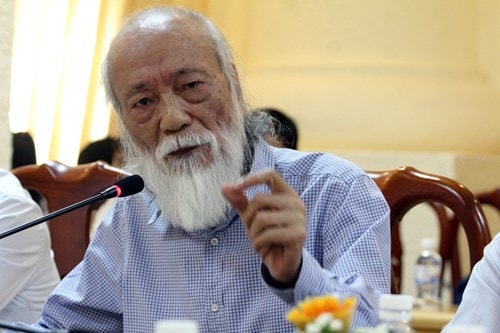 |
| Associate Professor Van Nhu Cuong expressed concerns about the feasibility of VNEN. |
How many schools benefited from the VNEN project, and how were they changed after its implementation? Furthermore, why did we have to adopt a model from Colombia – a model originating from combined classes in a disadvantaged country?
While we have been working on this project for a long time, I don't understand, and neither do the people, why the world is proposing it to us," Associate Professor Van Nhu Cuong wondered.
Given the current infrastructure in Vietnam, implementing the VNEN model would require arranging desks and chairs in six rows, with 6-7 people per row. Students would not only have to bend down to eat but also have to tilt their heads to look at the blackboard due to the seating arrangement and the fact that the chairs are not swivel chairs.
According to Associate Professor Van Nhu Cuong, many people have complained about this. Because we applied the VNEN model exactly as it was, the World Bank only provided funding then. Even the title "class leader" was replaced with "chairman of the self-governing council," a matter that has drawn strong reactions from the public and society. So, according to Associate Professor Cuong, what's wrong with keeping the title "class leader"?
“VNEN has mechanically implemented a rigid system (from seating arrangements, class leaders, and class leader elections – everything follows a process). I don't understand the purpose of all that. I wonder if it's right, but do we have to do it this way to receive funding? That's illogical. In all educational projects, generally speaking, every project faces quality issues,” Associate Professor Van Nhu Cuong emphasized.
Speaking of educational projects, the feasibility and quality of a project are difficult to quantify. Associate Professor Van Nhu Cuong gave an example: if we bid against a professor for a road construction project, and that road sinks after only a month, everyone knows what the quality is like.
Conversely, with projects like VNEN, no one can verify their success or failure (perhaps the project's success is that students in a region attend school regularly, but then they drop out again at the end of the project?).
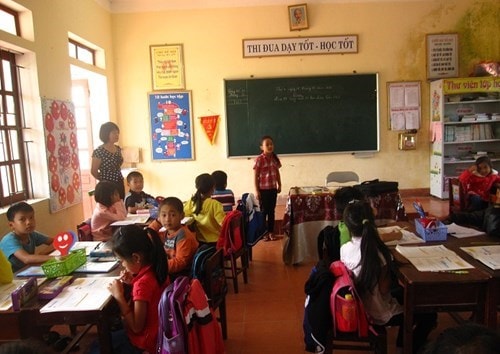 |
| Decorating a VNEN classroom at Son Tay Primary School, Huong Son. |
"I'm not talking about corruption in education, it's probably less than in other sectors, but the VNEN model is a huge waste. The project is erratic, lacks transparency, reporting, summaries, and quantification. I think this is a very big problem for education," Associate Professor Van Nhu Cuong stated.
Therefore, based on the above observations, Associate Professor Van Nhu Cuong believes that the biggest problem is that the Ministry of Education and Training often doesn't listen, or only listens superficially.
With the VNEN model, many parents and teachers have voiced their concerns, most notably regarding enrollment in grade 6. Students who studied under the VNEN model often require retraining upon entering grade 6, including guidance on how to take 15-minute tests and how to complete homework assignments, because elementary school students are not graded.
"I wonder, if the VNEN pilot program proves successful, will it be included in the upcoming education reform? Would that mean abandoning our entire traditional teaching methods? And would all primary schools follow the Colombian model?" Associate Professor Van Nhu Cuong questioned.
Meanwhile, Associate Professor Nguyen Ke Hao, former Director of the Primary Education Department (Ministry of Education and Training), commented that with the new school model, the physical infrastructure is not needed in large quantities; the main focus is on changing the teaching methods. Previously, students sat in rows, but with VNEN, they sit at round tables to learn.
However, one concern among educators is whether the VNEN project will be continued after its completion in 2016, and whether it will be integrated with the existing curriculum and textbooks.
Associate Professor Nguyen Ke Hao believes that all projects stop when they end and the funding runs out. However, the application of VNEN in Vietnam has stirred up some changes, but these changes are minimal.
The New School Project is a pedagogical project aimed at building and replicating an advanced school model, and it is scheduled to conclude in 2016.
According to Associate Professor Nguyen Ke Hao, the implementation of a new educational model from Colombia in Vietnam is, to some extent, not harmful if we know its limits. The VNEN curriculum is built upon the old textbooks and only applies new methods to rewrite and reprint them for students.
“Every improvement can bring benefits, just as teachers who prepare good lesson plans will achieve results. VNEN is implemented on a large scale, and when the project ends, teachers may continue to teach according to VNEN in the coming years, or they may teach according to the old curriculum, because the fundamental change is in the method,” Associate Professor Nguyen Ke Hao said.
Regarding the reason why VNEN is not applied in urban areas, Associate Professor Nguyen Ke Hao believes that the number of students per class is too large in urban areas, making it impossible to implement. He suggests that in mountainous and remote areas, classes have fewer students, allowing for the arrangement of desks and chairs as in VNEN.
“The funding for VNEN doesn't have to be returned. Since there's a foreign element involved, we have to spend the money according to what's been signed. I think that with VNEN, students get to play and enjoy themselves, but just because students enjoy something doesn't mean everything is right. If you give students heroin, they'll enjoy it too, but is that enjoyment right? Is it beneficial?” Associate Professor Hao commented.
According to Giaoduc.net
| RELATED NEWS |
|---|


